Cline Releases @cline/core v0.0.93: SDK Core Package Update
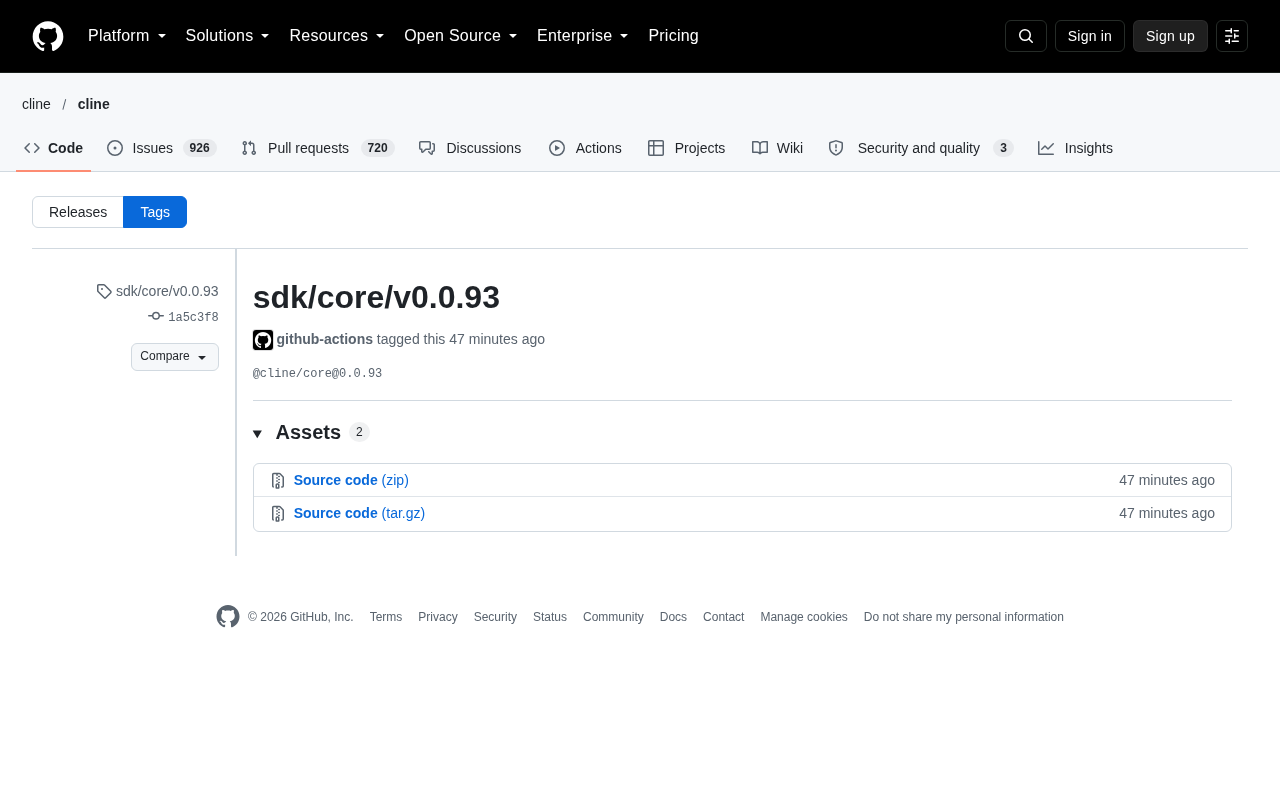
Cline auto-publishes @cline/core v0.0.93 via CI, reflecting its engineered SDK maintenance approach.
The article reports Cline's automated publication of @cline/core v0.0.93 via GitHub Actions and analyzes the engineering practices behind it. The bot applied the tag on 13 Oct 08:26, with 2 build artifacts and a commit 1a5c3f8 comparison entry. The sdk/core path structure shows Cline has extracted core agent logic from the editor extension into an independent SDK, yielding reusability, version decoupling, and testing benefits. Since the version is still 0.0.x, APIs are unstable, so secondary developers should pin versions and monitor the CHANGELOG or diff. Three practical approaches are offered for evaluating high-frequency micro-releases: examine diff scope, Assets content, and release cadence, emphasizing that the Release page itself lacks change descriptions.
Automated toolchains are accelerating the iteration pace of AI coding assistants. According to the GitHub Release page, the Cline project has automatically published the v0.0.93 version tag for @cline/core via GitHub Actions.
Version Release Overview
According to the Release record, this tag was automatically applied by the github-actions bot on 13 Oct 08:26, with version number @cline/[email protected], accompanied by 2 build artifacts (Assets). The page also provides a comparison entry point for commit 1a5c3f8, allowing developers to trace code changes between this release and the previous version.
From the release format, this is a typical npm package monorepo automated release workflow: after code is merged into the main branch, the CI pipeline detects a version number change, automatically creates a Git tag, generates a Release page, and uploads build artifacts. The sdk/core path structure indicates that the repository has clearly modularized the SDK layer from core logic, with @cline/core responsible for outputting underlying capabilities beyond the editor extension.
monorepo (single repository, multiple packages) refers to the engineering practice of managing multiple interrelated software packages within the same Git repository. In the JavaScript/TypeScript ecosystem, the common layout is a packages/ or functional directory (like sdk/core in this article) at the repository root, with each subdirectory being an independently publishable npm package. Its core value lies in: cross-package changes can be completed atomically in a single commit, and shared build scripts, type definitions, and CI configurations only need to be maintained once.
However, monorepos also bring release complexity: tools (such as Changesets, Lerna, or pnpm workspace) are needed to track which packages have changed, which version number to increment, and generate CHANGELOGs. This is precisely why Cline adopts GitHub Actions for automated releases—manually determining "which package to release this time and what version number to use" becomes almost unsustainable as the number of packages grows. Understanding this point clarifies why even a small 0.0.x version is worth handling with an automated pipeline.
The Position of @cline/core in the Cline Ecosystem
Cline is one of the more closely watched AI coding assistants, known for its deep integration into VS Code, support for multi-step task execution, and tool calling. As the project scale expands, extracting core logic from the editor extension into an independent SDK is an inevitable choice for maintainability:
- Reusability: The core package can be directly referenced by CLI, other IDE plugins, or third-party integrations, without needing to reimplement the agent loop and tool calling protocol;
- Version decoupling: The SDK and UI layer can each release independently, avoiding frequent editor extension updates that disturb users;
- Testing friendliness: Once core logic is separated from the editor runtime, the cost of unit testing and CI is significantly reduced.
v0.0.93 is still in the 0.0.x stage, indicating that this SDK has not yet entered a stable API commitment period, and interfaces may still be adjusted rapidly according to requirements. For developers wanting to build custom integrations based on Cline, this means they need to pay attention to the CHANGELOG or commit diff, and carefully lock versions.
SDK (Software Development Kit) in this context refers to a set of externally exposed APIs for other programs to call and reuse Cline's agent capabilities. Unlike ordinary libraries, SDKs usually imply a "contract" meaning: once depended upon externally, interface changes will cause downstream breaking impacts.
The project's @cline/core is in the 0.0.x stage. According to semantic versioning (SemVer) conventions, a major version number of 0 means "initial development stage, public API may change at any time." This means SDK maintainers have the right to change interfaces without incrementing the major version number—this is the technical basis for the article's emphasis on "carefully locking versions." To use it safely, a more reliable approach is to hardcode the exact version in package.json (such as 0.0.93), rather than using range notations like ^0.0.93 that allow automatic upgrades, while subscribing to the repository's CHANGELOG to respond promptly when breaking changes arrive.
How to Evaluate Such High-Frequency SDK Updates
For high-frequency small version releases like v0.0.93, the information on the Release page alone is limited, and the actual value needs to be judged in conjunction with the diff of commit 1a5c3f8. Here are several practical evaluation approaches:
- Look at the diff scope: If changes are concentrated in internal refactoring, type definitions, or dependency upgrades, they are usually imperceptible to upper-level users; if they involve tool calling protocols, prompt structures, or configuration schemas, key regression testing is needed.
- Look at the Assets content: The Release comes with 2 build artifacts, usually corresponding to packaged ESM/CJS entry points or source maps, which can be used to confirm whether the release artifacts are complete.
- Look at the release cadence: High-frequency releases in the 0.0.x stage often mean rapid fixes and experimental features coexist. For production use, it is recommended to pin version numbers to avoid caret ranges automatically introducing behavior changes.
For ordinary users, such SDK version updates will mostly take effect alongside subsequent editor extension versions, requiring no manual intervention; for secondary developers, version changes of @cline/core should be included in dependency monitoring scope.
diff (difference comparison) is a way in Git to view code changes between two commits or two versions. The commit comparison entry point on the GitHub Release page (like 1a5c3f8 mentioned in the article) will display all added and deleted lines of that release relative to the previous version when clicked. For high-frequency release SDKs, the diff is often more valuable than the Release description, because automatically generated Releases often only have tags and artifacts, without human-readable change descriptions.
When reading a diff, you can layer it by priority: first check whether publicly exported interface signatures have changed (such as index.ts, type definition files), which determines whether downstream compilation will fail; then check runtime behavior-related files such as tool calling protocols, prompt templates, and configuration schemas, as such changes may trigger logic regressions even if types remain unchanged; finally, internal implementations, tests, and dependency upgrades, which are usually transparent to users. Mastering this layered approach can quickly compress hundreds of lines of diff into a risk assessment that can be judged in a few minutes.
Summary
@cline/core v0.0.93 is a routine release automatically completed by CI, and itself does not include public change descriptions. Its significance lies more in corroborating that the Cline project is maintaining its SDK layer in an engineered manner—consolidating core capabilities into reusable packages, laying the foundation for subsequent ecosystem expansion. It is recommended to follow the repository's CHANGELOG and commit history to obtain the substantive change content of this version.
Related articles

Anthropic IPO Countdown: The Compute Cost Ledger Behind a $2 Trillion Valuation
Anthropic's IPO targets up to $2 trillion — double its Series H valuation. We break down the timeline, compute cost logic, and the key question investor day must answer.

Anthropic IPO Prospectus Revealed: Behind 12x Revenue Growth, the Twin Tests of Compute Costs and Customer Concentration
Anthropic filed its IPO prospectus: 2025 revenue up 12x to $4.6B, net loss $42B including $34B non-cash. Breaking down compute costs, $2T valuation logic, customer concentration risks, and founder control.

Xteink X4 Pro Review: A Mini E-Reader That Fits in Your Pocket, Now More Affordable
Xteink X4 Pro is a 4.26-inch mini e-reader, smaller and thinner than a 6-inch Kindle, magnetically attachable to phones, and cheaper than ever. We analyze its screen, design, use cases, and value.