Cline v4.1.27 Update Breakdown: A Major Model Catalog Overhaul and Reasoning Chain Fixes

Cline v4.1.27 overhauls the model catalog and fixes reasoning effort, tool calls, and file read truncation.
Cline released v4.1.27—an unassuming version number with changes that hit real pain points. The model catalog adds 94 providers from models.dev, removes Lilac and Tempr, and switches default models for 67 providers, mostly to Kimi K3.1 Pro, Gemini 4 Neon, or DeepSeek V4.1 Flash 1017, while narrowing the free and ClinePass pools. The key fix is reasoning effort: None is now saved and sent, native OpenAI providers adapt levels per model to avoid GPT-5.x and o-series rejecting max and Extra High, and leftover reasoning text is cleared. read_files is no longer truncated to 8k chars, capped at 2000 lines or ~48k chars.
Cline has released v4.1.27, and this update carries more weight than the version number suggests. On the surface, it's a routine model catalog refresh plus a handful of bug fixes, but a closer read of the changelog reveals that several changes strike directly at the pain points most commonly hit in real-world use of an AI coding assistant: reasoning effort settings not taking effect, rejected tool calls, and truncated context.
Model Catalog Restructuring: 94 New Providers and Widespread Default Model Switches
The most visible change in this update is the model catalog refresh. The team brought in 94 providers from models.dev while removing Lilac and Tempr. This isn't a simple add-and-remove of list entries—the default models for 67 other providers changed, with most pointing to Kimi K3.1 Pro, Gemini 4 Neon (covering both the gemini and vertex provider paths), or DeepSeekAd V4.1 Flash 1017.
The Cline recommended list added Muse Ember, while the free list dropped Reflection Beam, Laguna S 2.1, and Solar Mini 4, and ClinePass removed DeepSeek V4.1 Flash, Mimo V2.6 Flash, Mimo V2.6 Pro, MiniMax M3, Qwen3.7 Plus, and Qwen3.7 Max.
The signal from this round of adjustments is clear: Cline is deliberately narrowing model choices in the free and subscription pools, consolidating default routing onto a handful of flagship models. For users, if you previously relied on a model that's been removed, you'll need to reconfigure after upgrading. The good news: new users without a saved model now start on the first free model with the Cline provider by default, rather than the previous Claude Sonnet 5.5; existing saved choices are unaffected.
Reasoning Effort: From "Setting Not Taking Effect" to Per-Model Adaptation
The reasoning effort fixes are the most technically substantive part of this update, and they best demonstrate the maturity of a coding assistant product.
Previously there were several intertwined issues. When "None" was selected as the reasoning effort, the setting wasn't saved or sent, causing GPT-6 on Azure to keep its default effort and reject tool calls. The instruction to disable reasoning also couldn't reach custom models that had saved Model Configuration overrides, so the chat-completions endpoints for gpt-5.6 and gpt-6 rejected every tool call.
The v4.1.27 fix: on native OpenAI providers, the reasoning level is now adapted to the range each model actually supports, so max and Extra High are no longer rejected by GPT-5.x and o-series models. Meanwhile, the reasoning effort dropdown now shows the effort the new task will actually use, and a new Default entry has been added to clear saved settings.
Another subtle bug was fixed as well: reasoning text produced by a cancelled or failed turn no longer appears at the start of the next turn's reasoning. This kind of leftover content pollutes the model's thinking context—not fatal, but it quietly degrades the quality of multi-turn conversations.
Reasoning effort is a reasoning-budget control parameter introduced by recent reasoning-capable large models (such as OpenAI's o-series and GPT-5.x), commonly taking values from low and medium up to high, extra high, and even max, determining how many internal thinking tokens the model invests before producing an answer. Vendors differ in naming and supported ranges; some models accept only low/medium/high and return a 400 parameter error when max is passed. This is why "setting not taking effect" can cascade into tool call failures: coding assistants depend on structured tool call responses, and once a request is rejected for an out-of-range parameter, the entire turn is interrupted. The client therefore needs to maintain capability metadata for each model and, before sending, clip or map the user's selected effort to the levels that model actually supports—which is the core meaning of the "per-model adaptation" fix.
read_files Is No Longer Truncated: Full Read Capability Returns
If you could pick only one change with the biggest impact on daily use, it would probably be this: the result of read_files is no longer truncated to 8k characters when passed to the model. A single read is now delivered in full, with the limit determined by the tool's own constraints—2000 lines or roughly 48k characters.
This sounds like a small fix, but the practical impact is significant. One of the core competencies of an AI coding assistant is understanding full file context; an 8k truncation means the second half of a long file is invisible to the model, which may then offer modification suggestions based on incomplete information. Lifting this limit will produce a perceptible improvement in the success rate of tasks like large-file refactoring and cross-function analysis.
The context window is the maximum total number of tokens a model can process in a single request, shared across input, tool results, and output. Early coding assistants often imposed hard character truncation on file read results—for example, capping at 8k characters—to control costs and avoid exceeding the window. The cost of this approach is that the model only sees the first half of a file, making it prone to modifications based on incomplete information in long files. With truncation lifted, the real constraints shift to the tool-side line and character limits (such as 2000 lines or roughly 48k characters), layered on top of the model's own context budget. Note that full reads significantly increase token consumption and may still trigger compression or truncation in long sessions approaching the context limit, so large-file analysis is still best paired with segmented reads or project indexing.
Authentication, Permissions, and Security: Several Practical Improvements
LM Studio settings now include an API key field for servers with "Require Authentication" enabled. The MCP tab shows a "read-only" badge for tools that a server declares as read-only, making permission boundaries visible in the UI. The Account view adds a link to the privacy settings of the Cline web app. The extension package itself now also includes third-party license notices.
Additionally, a provider's model list now refreshes automatically after saving an API key or base URL, and a failed refresh (for example, a rejected key) is shown as an error in the model selector rather than failing silently. Commit search now passes the query to git as an argument instead of concatenating shell text, so quoted searches now match phrases exactly. On the security side, undici was upgraded to 7.30.1, fixing two process crash issues.
MCP (Model Context Protocol) is an open protocol that lets AI assistants connect to external tools and data sources in a standardized way; servers can declare each tool's capabilities and access attributes. The read-only annotation is part of a tool's annotations, and clients can use it to inform users that the tool produces no side effects, thereby providing a safety boundary when auto-approving tool calls. undici, meanwhile, is a widely used high-performance HTTP client in the Node.js ecosystem; many AI SDKs and provider requests go through it, so its process-crash defects manifest directly as unexpected extension exits or interrupted requests—upgrading to 7.30.1 is security and stability maintenance for an underlying dependency. Changing commit search to pass parameters to git is done to avoid splicing user input into shell commands, eliminating command injection and quote-parsing errors at the root.
A Few Miscellaneous Stability Fixes
The issue where Reflection Beam reported 400 Missing required parameter: 'messages[n].reasoning_content' every turn after compression or model switching has been fixed. Model compression no longer falls back to a basic summary for models not described in the catalog. In LiteLLM scenarios, when a model reports max_output_tokens, the legacy max_tokens field is no longer mistakenly used as the input budget.
Individually these fixes look trivial, but together they reflect the inherent complexity Cline is grappling with in a multi-provider, multi-model integration architecture—differences in API semantics across providers, missing model capability metadata, and the precedence of configuration overrides. Each one is a seam that's easy to get wrong.
Conclusion
v4.1.27 isn't a release with flashy new features, but it's a solid "debt-clearing" update. The large-scale model catalog adjustments mean users need to actively check their configurations, while the reasoning effort and read_files truncation fixes directly improve tool call success rates and the quality of long-file handling. For users who rely heavily on Cline for development, this version is worth upgrading to soon.
One-line Summary
Cline v4.1.27 restructures the model catalog and fixes core issues including reasoning effort, tool calls, and file read truncation.
Paragraph Summary
Cline released v4.1.27—an unassuming version number, but the changes hit real pain points. The model catalog brings in 94 providers from models.dev, removes Lilac and Tempr, and changes the default models for 67 providers, most pointing to Kimi K3.1 Pro, Gemini 4 Neon, or DeepSeek V4.1 Flash 1017, while narrowing the free and ClinePass subscription pools; new users now default to the first free model. The most technically substantive part is the reasoning effort fix: the None setting is now saved and sent, native OpenAI providers adapt reasoning levels to each model's supported range, avoiding GPT-5.x and o-series rejecting max and Extra High, and leftover reasoning text across turns is cleared. read_files is no longer truncated to 8k characters, with a full read limit of 2000 lines or roughly 48k characters. There are also improvements such as the LM Studio API key, MCP read-only badges, automatic model list refresh with explicit errors, the undici upgrade, and parameterized commit search.
Related articles

The Bottleneck of AI Programming Isn't Generation: Why Software Factories Collapse
After AI coding tools went mainstream, PR review quality dropped and incidents rose. The speaker argues the bottleneck isn't code generation but models' inability to sustain maintainability.
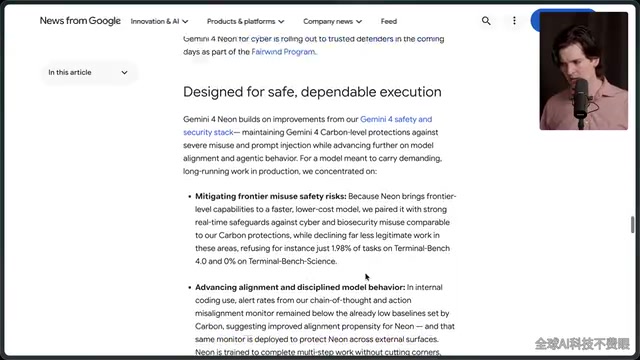
Gemini 4 Neon Hands-On: 10 Hours to Achieve What Opus Couldn't in Days, 20x Faster Warm Start
Google's surprise Gemini 4 Neon release made critic Theo change his tune: 10 hours to finish what Astra couldn't in ten days, 20x faster warm start, coherence beating Opus.

Gemini 4 Neon Hands-On: Which $20 AI Subscription Should You Choose?
Bilibili creator tests Gemini 4 Neon: composite intelligence index 61, beating Claude Opus 5.5, with API 25% cheaper. With a $20 budget, how to choose between Google AI Pro, Claude Pro, and ChatGPT Plus? Includes three must-know pitfalls and recommendations by user type.