Clipwing Autopilot Review: The Third Path for Repurposing Long Videos into Short Clips

Clipwing Autopilot offers a middle path between AI slop and hiring hassles for repurposing long videos.
Clipwing Autopilot positions itself between pure AI clipping tools and human editors, promising style-consistent, ready-to-post short clips from long recordings. This review examines its three-step workflow, market positioning against competitors like OpusClip, and the real value of workflow consolidation for content creators seeking hassle-free video repurposing.
Long Videos to Short Clips: A Persistent Pain Point
If you've ever produced podcasts, livestreams, or long-form video content, you've almost certainly wrestled with the same problem: how do you efficiently slice a two-hour recording into dozens of short clips suitable for social media distribution? Historically, there have been two paths — either use AI auto-editing tools or hire a dedicated video editor. Neither is particularly comfortable.
AI editing tools are fast and cheap, but the results are often what's known as "AI slop": mechanical captions, jarring cut points, and outputs lacking any sense of rhythm — publishing them actually drags down your account's perceived quality. Hiring an editor gives you more control over quality, but means bouncing between Slack conversations, Google Drive file transfers, and scheduling tools, with absurdly high management overhead and inconsistent style.
Clipwing Autopilot, which recently appeared on Product Hunt, targets precisely this gap. It earned 75 upvotes, 13 comments, and ranked #18, categorized under Social Media and Video tools. Its core proposition is straightforward: it's neither another AI clipper nor another editing outsource service, but rather combines the best of both into a single workflow.
Core Features of Clipwing Autopilot
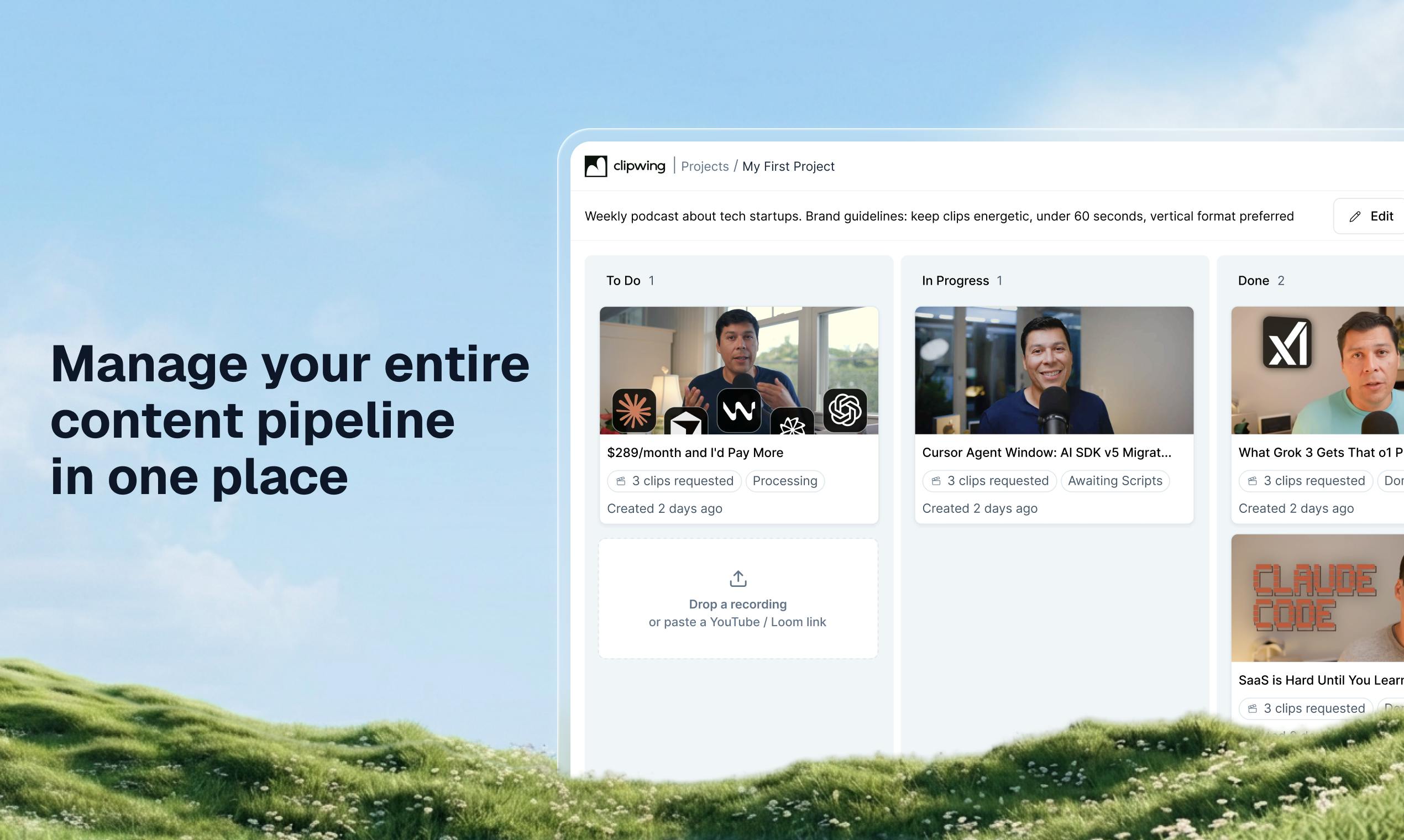
According to the official description, Clipwing Autopilot's workflow is compressed into three steps: upload your recording, choose your editing style, then receive ready-to-publish clips.
Two keywords in this workflow design deserve attention.
Style Consistency: More Important Than Individual Clip Quality
The first keyword is consistent. For content creators, "style consistency" across short videos matters more than the absolute quality of any single clip — the same caption style, the same opening rhythm, the same thumbnail logic — that's what builds recognizable account identity. Pure AI video editing tools often perform inconsistently in this area, and this is exactly the selling point Clipwing emphasizes.
Ready-to-Post: Eliminating the Underestimated Coordination Time
The second keyword is ready-to-post. It doesn't just deliver a pile of raw materials to process further — it provides finished products that require no additional rework. This means creators save not just editing time, but also the severely underestimated "coordination time" between editing and publishing.
The Real Value of an All-in-One Workflow
The product repeatedly emphasizes "Everything happens in one place." This sounds like marketing copy, but the pain point it addresses is quite specific: efficiency loss in content teams usually doesn't happen within a single step, but in the transitions between steps.
Exporting from your recording platform, uploading to cloud storage, notifying the editor, waiting for drafts, downloading to review, then re-uploading to a scheduling tool — every handoff is a context switch. Clipwing Autopilot redefines "editing" as a closed-loop service, attempting to eliminate these process gaps. This "workflow consolidation" approach is actually the prevailing evolutionary direction across the content tools space in recent years.
Market Positioning: Clipwing Autopilot vs. OpusClip and Other Competitors
The short-form video editing space is already crowded. Pure AI editing tools like OpusClip and Vizard take the automation route, prioritizing speed and scale; on the other end are various editing outsource platforms and freelance marketplaces, prioritizing human quality.
Clipwing Autopilot deliberately positions itself between the two, summed up by its slogan: "No AI slop, no hiring hassle." This is a smart positioning — it doesn't promise to be the fastest or the cheapest, but rather promises to be "hassle-free without dropping the ball."
Opportunities and Risks of the Middle Position
This middle ground does serve a real need. A large number of individual creators and small teams neither have the budget to maintain a full-time editor long-term nor are satisfied with the quality of pure AI outputs — what they want is precisely this kind of "managed" consistent output.
But the middle position also means pressure from both sides. On the upper end, mature content teams may still prefer fully controllable human workflows; on the lower end, budget-sensitive users may feel AI tools are "good enough." Whether Clipwing can defend this niche ultimately comes down to the actual quality of its deliverables — whether it truly escapes "AI slop" territory, and whether its style system is flexible enough.
It's worth noting that currently available information comes primarily from the Product Hunt listing, with no independent output comparisons or long-term user feedback yet available. Whether it's an "AI + human" hybrid model or a highly tuned pure automation pipeline isn't made explicit in the official description — something worth watching going forward.
Three Evaluation Dimensions When Choosing Short-Form Video Editing Tools
If you're struggling with short-form video production capacity, products like Clipwing Autopilot offer a new evaluation dimension: don't just compare "AI vs. human" — compare "overall workflow peace of mind."
When evaluating this type of tool, focus on three things:
- Output style consistency: Can it match the existing tone of your account?
- Revision and feedback mechanisms: What's the rework cost when you're unsatisfied with the output?
- Reduction in cross-tool switching: Does it actually deliver a true all-in-one experience?
These three points determine whether a tool truly saves time or just moves the hassle somewhere else.
For the space as a whole, the emergence of Clipwing Autopilot confirms a trend: competition among content tools is shifting from "single-feature capability comparisons" to "complete workflow management." Whoever lets creators worry less is more likely to win long-term subscriptions.
Related articles

Amphibious Transforming Drone: Beyond 100x Power Savings, What Are the Real Needs?
Is the amphibious transforming drone just a gimmick? Starting from the 100x power difference of the M4 Morphobot, explore real application scenarios and thesis topic ideas, analyzing boundary conditions where pure drones and pure ground robots both fail.

Warhound Raises $200 Million: Genetically Engineered "War Dogs" Paired with Anduril Gear
Warhound raises $200M, backed by Ben Lamm and Palmer Luckey, to genetically engineer dogs for military and law enforcement use and equip them with Anduril gear. This article analyzes its technology direction, funding logic, and ethical controversy.

Claude API Comes to Google Cloud: IAM Integration and SDK Access Guide
Anthropic hosts the full Claude API on Google Cloud with IAM-controlled permissions and unified billing. This guide covers the Vertex AI and Anthropic-hosted entry points, IAM role configuration, and SDK access.