Clock Tower Mystery Live Breakdown: Lies and Deduction in a Manor House

How poison and a secret kill phrase let the evil team defeat a good team that had every information advantage.
This article breaks down a Blood on the Clocktower playthrough where the evil team won through two layered strategies: Poisoner Ben continuously targeted Fortune Teller Pyrrion, corrupting all his readings without him ever knowing; and demon Tom disguised his kill trigger phrase "I trust them absolutely" as casual conversation, which the good team never connected to the nightly deaths. A Knight's repeated self-executions added dark comedy. The core takeaway: in social deduction games, letting your opponents deceive themselves is more devastating than any direct kill.
Blood on the Clocktower is a social deduction board game, and this playthrough recorded at Brindley Manor showcases its appeal at its finest. Eight players, two lurking villains, a Storyteller who controls the whole game, and a "Big Tom" who gets executed repeatedly but just won't stay dead — together they make for a strategically rich deduction spectacle laced with dark humor.
What makes this game worth watching isn't just who fooled whom — it's how information gets manufactured, corrupted, and misread in a social deduction game. Let's break down the key mechanics and strategic dynamics at play.
The Evil Team's Hidden Coordination
The evil team consists of two players: Tom Nicholas playing the Yagababble demon, and Ben as the Poisoner.
Yagababble is a uniquely flavored demon — rather than designating a nightly kill like a typical demon, it receives a secret phrase from the Storyteller. If the demon says this phrase out loud while all players are present, someone may die that night. Tom's phrase was "I trust them absolutely." The elegance of this design is that it requires the demon to disguise the act of killing as natural conversation.
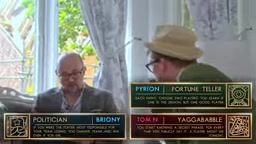
Ben's strategy as the Poisoner was remarkably disciplined. He poisoned Pyrrion every single night from the very first, rather than switching targets. His reasoning was clear: "If I switch who I'm poisoning, the person who stops being poisoned will quickly realize they were poisoned before." By locking onto the same target continuously, he kept Pyrrion convinced that his information was genuine — even though every piece of it was false.
The Poisoner in Blood on the Clocktower is a Minion role — a demon's helper. Its core ability is to secretly choose a player each night to poison; the poisoned player's special ability fails or produces false information, but they have no way of detecting anything is wrong — their ability appears to function normally, delivering only fake feedback. This makes the Poisoner one of the most destructive yet hardest-to-detect roles in the game. Unlike an Assassin who leaves a body behind, the Poisoner leaves no corpse — only a polluted information field that sends the good team further astray with every step they take.
The Good Team's Information Trap
The good team had a full suite of information roles, and yet they were undone by the very core mechanic they should have accounted for: information might be false.
Pyrrion played the Fortune Teller, who can check each night whether two players are the demon — but one good player is designated as a "red herring" who will falsely ping as a demon. The problem was that Ben had been poisoning Pyrrion from start to finish, making every reading unreliable. He got a hit on Kirstie and Bryony and, based on that, insisted on nominating Bryony at the end — completely off the mark.
Tom Clark was the Knight, who knew Kirstie and Boba were not the demon; Boba was the Undertaker, who learns the role of each executed player; and Kirstie was the Gambler, who each night bets on a player's role and dies if wrong. Together these roles should have formed a cross-referencing information web — but poison and false readings left it full of holes.

One amusing side note is Ben's cover identity — the Cannibal, a good-aligned role that gains the ability of any executed player. Its cleverness as a bluff lies in the fact that claiming to be the Cannibal requires revealing almost no substantive information, making it an ideal disguise.
The Fortune Teller's Red Herring mechanic deserves its own explanation. At the start of the game, the Storyteller secretly designates one good player as the red herring; from then on, whenever the Fortune Teller checks a pair that includes this player, they receive a false "demon detected" signal. This design forces the Fortune Teller to cross-reference multiple nights of results rather than trusting any single reading. But once the Fortune Teller is poisoned, this verification system collapses entirely — readings taken while poisoned are determined at the Storyteller's discretion and may be completely opposite to reality, while the Fortune Teller has no way of knowing. This is the root of Pyrrion's tragedy: he diligently checked all game long and received a dossier that was wrong from beginning to end.
"Big Tom": The Repeatedly Executed Running Gag
The most comedic thread running through the game is Knight Tom Clark's strategy of voluntarily seeking his own death. He reasoned that if this were a Legion game, the good team would be the majority, so he chose to put himself on the execution block on day one — hoping to trigger roles like the Cannibal that depend on deaths, and to test the voting mechanics in the process.

What followed was players repeatedly "executing" his corpse over the next several days — because executing a dead body can serve as a test against Vortox (a demon that causes all information to be inverted). "Third time's the charm" and "We'll deal with Tom eventually" — the absurdity of the repeated executions became a running joke, and also a window into the players' collective anxiety about information reliability.
How Poisoning Decided the Game
Ultimately, this game was decided by that bottle of Mountain Dew. Ben joked his way through the poisoning as though he were just making Pyrrion drink more soda — but the effect was lethal.

When the final reveal came, everything clicked into place: the reason Pyrrion's Fortune Teller readings pointed at the wrong targets was that he had been poisoned all along. "No one even considered poisoning" and "I assumed it was the Assassin" — the players' reactions confirmed just how invisible the Poisoner role can be. Compared to outright killing, corrupting information is far harder to detect, because the victims actively vouch for the false information they believe in.
In the end, demon Tom Nicholas claimed a player every time he said "I trust them absolutely," eliminating Ben, Boba, and Kirstie in quick succession before the final round. The good team never managed to connect the unusual phrase to the nightly deaths, and the evil team won through a combination of keyword kills and information corruption.
Good-aligned Politician Bryony had a chance to "defect to victory" — the Politician wins with the evil team if they are the single greatest contributor to their own team's loss. But the Storyteller ruled that she wasn't the decisive factor in the defeat, so she fell alongside the rest of the good team.
What This Game Teaches Board Game Enthusiasts
From a strategic standpoint, this playthrough distills several core lessons of social deduction games:
The reliability of information is always in question. Powerful information roles like the Fortune Teller and Knight can flip from being trusted anchors to sources of misdirection the moment they're poisoned or face a Vortox. The good team put too much faith in Pyrrion's readings and ended up being led astray by them.
The optimal evil play is to create confusion, not to kill directly. Ben locking onto the same poison target and Tom disguising his kill trigger as a casual phrase both reflect the advanced strategy of making the good team deceive themselves.
Unusual patterns are worth being suspicious of. The Storyteller had already hinted early on to watch for someone repeatedly saying an unusual phrase — yet no player actually connected Tom's frequent utterance to the nightly deaths. That is precisely the cunning in Yagababble's design.
For players looking to get into Blood on the Clocktower, this playthrough is excellent learning material: it demonstrates how role abilities interact, and captures a high-level back-and-forth of lies and deduction.
One of the fundamental differences between Blood on the Clocktower and traditional social deduction games like Werewolf is the role of the Storyteller. The Storyteller doesn't participate in either faction's struggle — they serve as a neutral referee who runs the game, with the flexibility to determine specific information within the rules (such as what result a poisoned Fortune Teller receives). This grants the game tremendous narrative elasticity, but it also means that every session's experience depends heavily on the Storyteller's skill and style. A great Storyteller creates dramatic tension within a framework of fairness, rather than simply helping one side win. This is why the Blood on the Clocktower community often treats cultivating high-quality Storytellers as a central part of growing the game.
Related articles

Amphibious Transforming Drone: Beyond 100x Power Savings, What Are the Real Needs?
Is the amphibious transforming drone just a gimmick? Starting from the 100x power difference of the M4 Morphobot, explore real application scenarios and thesis topic ideas, analyzing boundary conditions where pure drones and pure ground robots both fail.

Warhound Raises $200 Million: Genetically Engineered "War Dogs" Paired with Anduril Gear
Warhound raises $200M, backed by Ben Lamm and Palmer Luckey, to genetically engineer dogs for military and law enforcement use and equip them with Anduril gear. This article analyzes its technology direction, funding logic, and ethical controversy.

Claude API Comes to Google Cloud: IAM Integration and SDK Access Guide
Anthropic hosts the full Claude API on Google Cloud with IAM-controlled permissions and unified billing. This guide covers the Vertex AI and Anthropic-hosted entry points, IAM role configuration, and SDK access.