Closed-Source vs. Open-Source AI: Who Really Controls Your Data?

The real AI model choice isn't about performance — it's about data ownership and control.
This article examines a dimension companies often overlook when choosing AI models: data ownership and control. Closed-source models like GPT and Claude are fast to deploy but route data through third-party servers and create vendor lock-in risks. Open-weight models like Llama and Mistral can be self-hosted, keep data on-premises, and support deep fine-tuning — but require GPU resources and operational overhead. The article warns that "open weights" is not the same as "open source," and license terms must be reviewed before any commercial product is built. The practical advice: use both, with an abstraction layer that preserves the ability to switch, and let privacy requirements and workload economics guide the decision.
A Question Most Teams Ignore
When choosing an AI model, we tend to fixate on benchmark scores, inference speed, and pricing. Those metrics matter, of course — but one question often gets shelved until it's too late: Who owns the data, and who holds the control?
Today's AI ecosystem is split cleanly in two. On one side are proprietary models — the classic "black boxes." On the other are open-weight models you can download and run yourself. Developer Domenico Tenace has argued that this choice carries far more weight than it appears on the surface. This article breaks down what's really worth weighing in the closed-source vs. open-source debate.
Closed vs. Open Source: A Quick Comparison
Closed-source models run behind an API. You send text, you receive text, and what happens in between is none of your business. They're easy to get started with, which is exactly why so many companies choose them.
Open-weight models are a different story entirely — Llama, Mistral, Qwen, and DeepSeekAd all fall into this category. You get the model itself and can run it on your own servers, a private cloud, or even a sufficiently powerful laptop.
One critical caveat: "open weights" is not the same as "open source" in any strict sense. Before building a product on top of a given model, always read the license terms carefully. This step is frequently skipped — and can create serious legal exposure down the line.
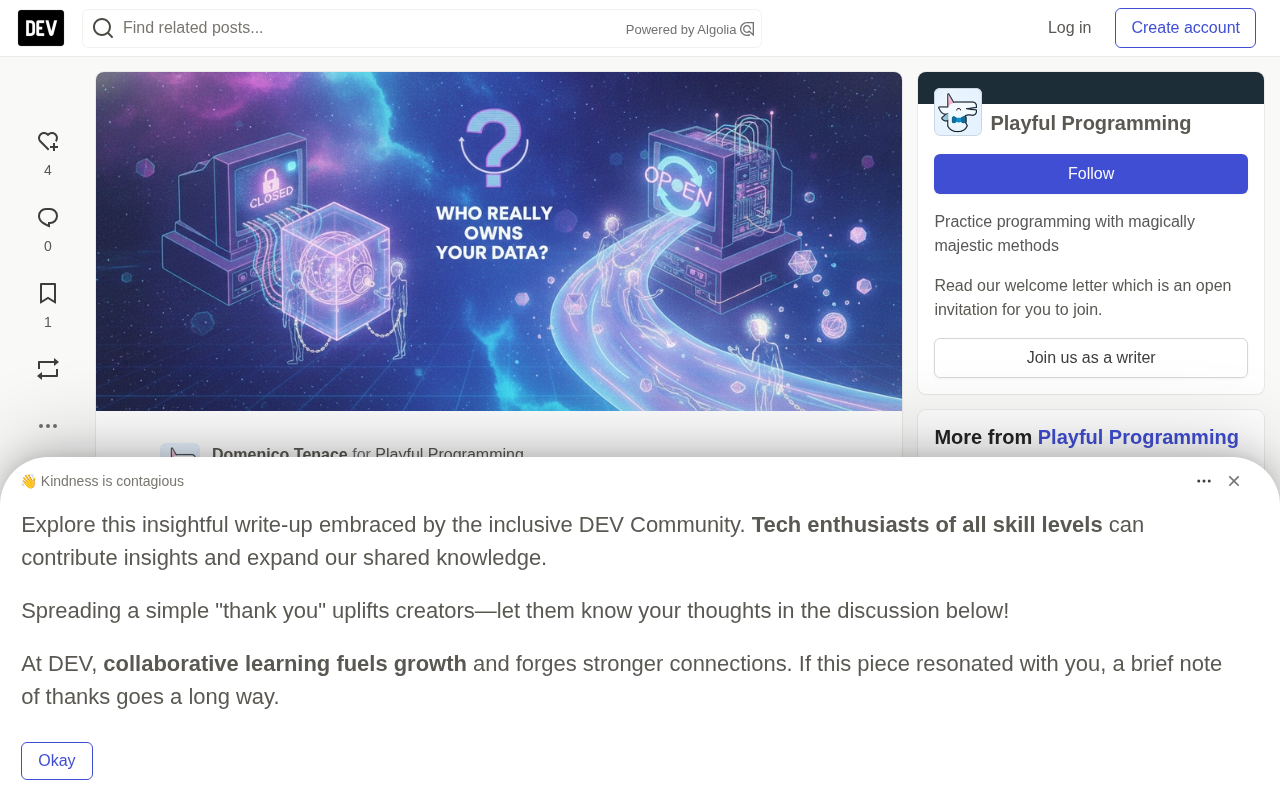
The distinction between "open weights" and "open source" deserves its own explanation. In traditional software, "open source" means the source code is public and freely usable, modifiable, and distributable — typically under standard licenses like GPL, MIT, or Apache. "Open weights" means only that the trained model parameters are available for download; it doesn't necessarily include training code or datasets, and it doesn't always permit commercial use or redistribution. Meta's Llama series, for instance, comes with a proprietary Llama Community License that prohibits use by products with more than 700 million monthly active users and requires derivative products to be labeled "Built with Llama." Some DeepSeek models restrict using their outputs to train competing models. In short, being able to download and run a model for free doesn't mean you can embed it in a commercial product or that you hold any intellectual property over its architecture. Reviewing the LICENSE file before building any model-centric product is non-negotiable legal due diligence.
Three Compelling Reasons to Take Open Source Seriously
Your Data Stays on Your Turf
With a self-hosted model, no data ever leaves your infrastructure. No customer data, no internal documents, no proprietary code gets sent to someone else's servers. If you operate in healthcare or finance, or simply have a legal team that runs on high alert, this point alone can end the conversation.
Data sovereignty is becoming a hard prerequisite for enterprise AI adoption. In regulated industries, "data doesn't leave the perimeter" isn't a nice-to-have — it's a precondition.
No Vendor Lock-In
Prices change. APIs get deprecated. Terms of service can be rewritten on a random Tuesday. If your entire product depends on a single vendor, every one of those changes becomes your problem — and you have no vote in the matter.
Open models give you control over your infrastructure, which means you can migrate, switch, or fork at any time. That freedom is enormously valuable over the long run, especially when AI is central to your product.
Vendor lock-in in the AI API context is more insidious than in traditional SaaS. When a product calls a large model's API directly, it's not just the interface format and parameter names that get tightly coupled to a vendor — more critically, the model's behavior, output style, and capability boundaries can shift with silent updates, usually without any SLA guarantees. There's historical precedent: OpenAI deprecated early GPT-3 model series without sufficient notice, causing widespread regressions in applications that relied on specific model behaviors. Some vendors have also adjusted content policies, causing previously valid use cases to suddenly trigger refusals. Maintaining a thin abstraction layer between your API calls and your business logic — such as middleware that encapsulates prompt construction and response parsing — can reduce switching costs from "rewrite the system" to "change a config file." It's the lowest-cost engineering practice for mitigating lock-in risk.
You Can Look Inside and Make It Your Own
No black box means you can inspect exactly what you're running. You can also fine-tune the model on your own domain and retain full ownership of the result. With a closed-source API, you'll quickly hit walls — hard limits you simply cannot cross.
The Costs of Open Source Can't Be Ignored
The honest take here is that open source comes with clear downsides:
- Running models costs real money — whether you're buying GPUs or renting cloud instances, the bill is tangible.
- Someone has to maintain it — updates, scaling, monitoring, security hardening. That someone is you.
- Top closed-source models still lead on the hardest tasks, even as the gap continues to narrow.
- Licenses vary enormously, and some come with restrictions you won't like.
The realistic conclusion: if you're a small team without infrastructure experience, a managed API is probably the smarter choice — at least to start.
Practical Strategy: Don't Pick a Side — Keep an Exit
For most teams, the right answer isn't "choose one" — it's "always preserve an exit." Here's a practical playbook:
- Use a closed-source API when you need to move fast. Don't sacrifice launch speed for architectural purity.
- Add a thin abstraction layer between your code and the model. That way, switching providers means changing config, not rewriting systems.
- Use open-source models for sensitive workloads — or for tasks where a smaller model is more than capable and significantly cheaper.
- Regularly test open-source alternatives. The landscape shifts every few weeks.
When does open source make the most sense? When privacy is non-negotiable, when your volume is large enough to amortize the cost of self-hosted infrastructure, and when you need deep customization. When does closed source make the most sense? When you want zero operational overhead and need the best raw performance available.
Fine-tuning is one of the core advantages open-weight models hold over closed-source APIs, and understanding what it actually means helps you decide when it's worth the investment. Fine-tuning means continuing to train a pre-trained model on domain-specific data, achieving performance on targeted tasks that far exceeds what prompt engineering alone can deliver — for example, teaching a model your company's internal documentation style, legal clause formatting, or medical coding conventions. The dominant efficient fine-tuning method today is LoRA (Low-Rank Adaptation), which updates only low-rank decompositions of the model's parameter matrices, dramatically reducing VRAM requirements and making it feasible to fine-tune a 7-billion-parameter model on a single consumer GPU. With open-weight models, the fine-tuned weights belong to you. With closed-source fine-tuning services (like OpenAI's fine-tuning offering), the model trained on your data still runs on their servers — the questions of data and model control remain unresolved.
This Isn't a Philosophy Debate — It's a Business Decision
The core point is this: it was never a philosophical discussion. It's an intensely practical engineering and business decision. The more central AI becomes to your product, the more it matters who controls it.
Open source also carries a broader significance — it's a critical counterforce against a handful of companies monopolizing the "cognitive infrastructure" that all of us increasingly depend on.
You don't have to go all-in on either side. What you do need is to ensure that when the rules change tomorrow, you still have somewhere to go. Preserving that exit path is the most resilient posture you can take as you navigate a rapidly evolving AI landscape.
Related articles

Random Pruning of the DPO Computation Graph: 1.4x Training Speedup and Lower Peak Memory
DPO training too slow and memory-hungry? This paper proposes a random pruning framework for the DPO computation graph, sampling independently across position, sequence, and branch dimensions; branch pruning achieves a 1.426x step-time speedup and cuts training time by about 30%, with in-depth attribution of memory and time gains.

Why Does JEPA Underperform MLM in Longitudinal EHR Representation Learning?
New study compares JEPA and MLM for longitudinal EHR representation learning on MIMIC-IV: three JEPA variants train stably without collapse but underperform MLM; target size, not heterogeneity, drives prediction error.

Transfer Learning + Visible Light Communication: A New Approach to Energy-Efficient Indoor Positioning
A study proposes a transfer learning-based visible light communication indoor positioning method, achieving 47% accuracy improvement on the BOSCH factory dataset, 67.5% model efficiency under high noise, and introducing the ME composite metric for energy-efficient positioning in energy-constrained industrial IoT scenarios.