Cloud GPU Platform Selection: A Practical Guide from HuggingFace to Cloud Reproduction

A practical guide to selecting cloud GPU platforms focused on reproducibility for open-source model testing.
This guide analyzes cloud GPU platform selection through five key dimensions—GitHub integration, Hugging Face caching, Docker support, access methods, and launch command reuse. Covering RunPod, Lambda, Paperspace, and Vast.ai, it emphasizes that building reproducible workflows with Docker and scripts matters more than raw GPU pricing for developers frequently testing open-source models.
The Overlooked Pain Point: From Local Testing to Cloud Reproduction
For developers who frequently test open-source models, the workflow often follows a familiar routine: start from a model page on Hugging Face, clone a demo repository on GitHub, run a notebook or launch script, and configure a few environment variables. The first local test usually goes smoothly—the truly headache-inducing part tends to emerge a few days later.
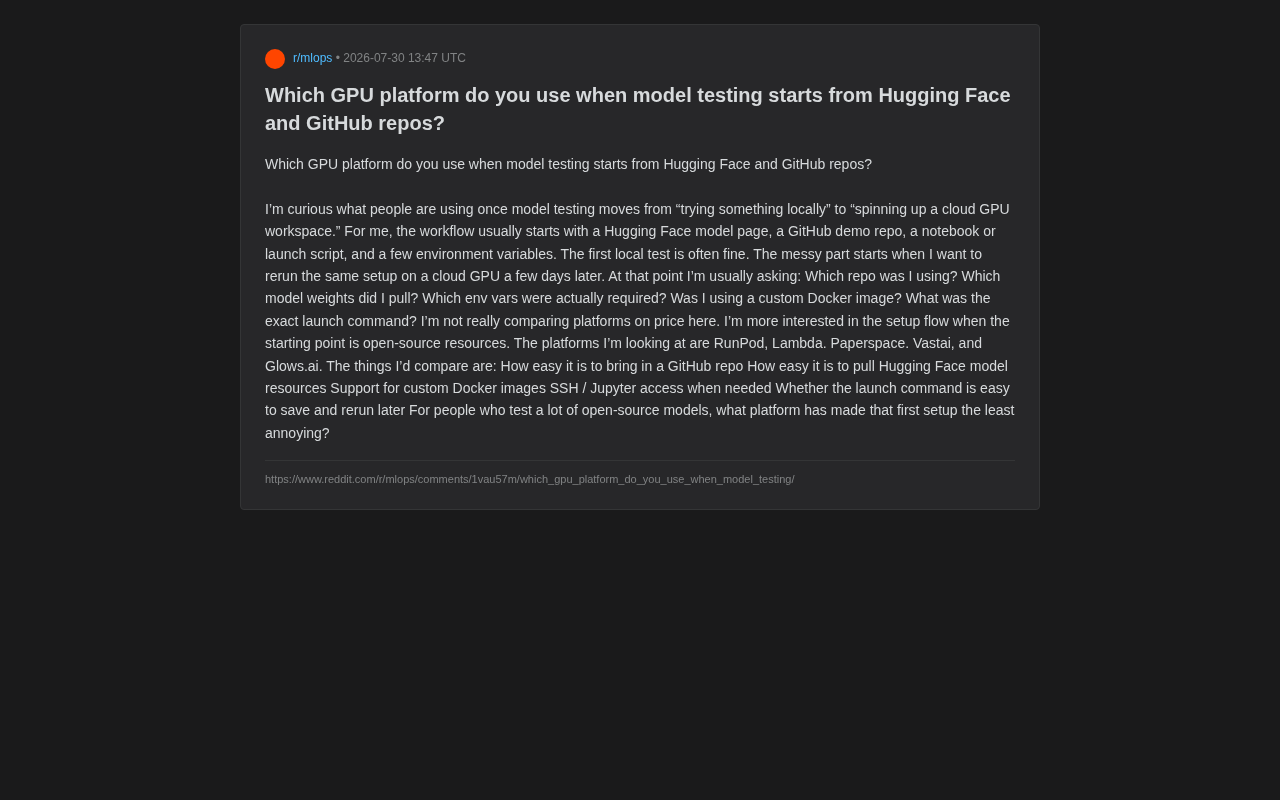
Recently, a Reddit user posted a highly relatable question in the community: When model testing escalates from "casually trying things locally" to "spinning up a cloud GPU workspace," which platform is everyone using? The core of this question isn't about price comparison—it's about how smooth the entire setup process is when the starting point is open-source resources.
The Core Challenge of Cloud Reproduction: Lack of Reproducibility
The original poster precisely described this dilemma. When they want to re-run the same setup on a cloud GPU a few days later, a barrage of questions floods their mind:
- Which repo was I using?
- Which version of model weights did I pull?
- Which environment variables were actually necessary?
- Did I use a custom Docker image?
- What was the exact launch command?
This series of questions fundamentally points to a long-underestimated problem: Reproducibility in open-source model testing. Reproducibility is a core principle in scientific computing and software engineering, referring to the ability to obtain the same results at different times and in different environments. In the machine learning domain, this problem is particularly acute because model behavior depends on multiple layers of factors: hardware (GPU model, CUDA version), software (Python version, dependency library versions), data (specific commit of model weights), and hyperparameter configurations. The NeurIPS 2019 conference formally introduced a reproducibility checklist, reflecting academia's recognition of this issue. However, in engineering practice, many developers still rely on the implicit assumption of "works on my machine" until cross-environment migration exposes the problems.
Local environments are often riddled with implicit dependencies—a library installed by chance, a temporarily set environment variable, a command typed off the cuff. This "tacit knowledge" is irrelevant during local testing, but once you switch to a fresh cloud environment, it becomes a roadblock.
This also explains why simply comparing GPU unit prices across platforms has limited value. For high-frequency testers, what truly consumes time and energy is the friction cost of environment setup and reproduction.
Five Key Dimensions for Cloud GPU Platform Selection
The original poster listed several mainstream candidates: RunPod, Lambda, Paperspace, Vast.ai, and Glows.ai, along with five pragmatic evaluation dimensions. This framework is highly valuable for any team that needs to frequently test open-source models.
Ease of GitHub Repository Integration
Ideally, a platform should support specifying a Git repository URL directly for cloning, or even auto-pulling at instance startup. RunPod's template mechanism and Paperspace's Gradient workspaces perform relatively well here, reducing the repetitive labor of manual git clone.
Hugging Face Model Weight Pulling Capability
Model weights often run into tens of gigabytes, and download speed plus caching mechanisms directly impact the experience. Hugging Face has become the de facto standard model repository for the open-source AI community, hosting over 500,000 models as of 2024. Its core distribution mechanism is based on Git LFS (Large File Storage), enabling version control for large model weight files. Models are automatically downloaded and cached to the local ~/.cache/huggingface/ directory through the transformers library's from_pretrained() interface.
While this design is very convenient for local development, it raises two critical issues in cloud environments: first, every new instance creation requires re-downloading the complete weights (a 70B parameter model can exceed 130GB); second, weights between different revisions/commits may differ, making reproduction impossible without precisely recording the version used.
Some platforms offer persistent storage volumes that can cache previously downloaded weights, avoiding re-downloads with every instance restart—a must-have for users who frequently switch between models.
Custom Docker Image Support
This is the core mechanism for solving reproducibility. Docker is an OS-level virtualization technology that achieves complete environment isolation and portability by packaging applications and all their dependencies into lightweight containers. In machine learning scenarios, Docker's value is particularly significant: a typical model inference environment may require specific versions of CUDA drivers, cuDNN libraries, PyTorch/TensorFlow frameworks, and dozens of Python dependency packages, with complex compatibility relationships between versions.
By declaratively defining these dependencies through a Dockerfile, developers can compress hours of environment debugging into a single docker pull operation. NVIDIA also provides the NGC (NVIDIA GPU Cloud) container registry with pre-optimized deep learning base images, further lowering the construction barrier. Solidifying the complete runtime environment as a Docker image means the environment is perfectly consistent whenever and wherever it's launched. Both Vast.ai and RunPod have excellent support for custom images, making "configure once, reproduce anywhere" possible.
SSH and Jupyter Access Methods
The debugging phase requires interactive access. Jupyter is suited for exploratory experiments, while SSH is better for scripted batch tasks. A mature cloud GPU platform should provide both, allowing users to switch freely based on the scenario.
Saving and Reusing Launch Commands
This is the point the poster cared most about, and also the feature most easily overlooked by platforms. Whether you can package "repo + image + environment variables + launch command" into a savable, one-click-restartable template directly determines the experience of subsequent use.
It's worth noting that in model testing workflows, environment variables typically carry sensitive information: Hugging Face API Tokens (for downloading gated models like the Llama series), Weights & Biases keys (for experiment tracking), and various API endpoint configurations. Hard-coding this information in scripts or casually recording it in notes not only makes reproduction difficult but also introduces security risks. The mature approach is to use .env files combined with .gitignore to exclude them from version control, or leverage platform-provided secret management services (such as RunPod's Secrets feature).
From Platform Selection to Reproducible Workflow Thinking
The real insight from this discussion actually transcends the platforms themselves. Rather than agonizing over which platform is "least annoying," it's better to proactively establish a set of reproducible workflow habits.
Solidifying environments with Docker is the most fundamental solution. Including the Dockerfile in version control alongside project code means environment dependencies are no longer "tacit knowledge." Recording launch procedures with scripts is equally important—writing model downloads, environment variable settings, and launch commands into a run.sh is essentially leaving a complete operation manual for your future self.
With this premise, the differences between cloud GPU platforms mainly manifest in the strength of their "templatization capability." Current cloud GPU platforms roughly fall into three architectural patterns: the first is the traditional IaaS model, providing pre-configured virtual machines where users get full system control; the second is the containerized on-demand model, where users specify a Docker image and the platform automatically schedules it to available GPU nodes, billing by actual usage time; the third is the managed workspace model, offering integrated development environments similar to JupyterLab. These architectural differences directly affect startup speed, persistent storage strategies, and automation capabilities.
Specifically regarding each platform's characteristics:
- RunPod: Adopts a containerized on-demand model, friendly for quick reproduction thanks to flexible templates and community image ecosystem. Its template system allows users to save complete configurations as reusable units.
- Vast.ai: Adopts a decentralized marketplace model where individual GPU owners can rent out idle compute, resulting in price fluctuations but often better cost-effectiveness. Excels in Docker flexibility, suitable for budget-sensitive developers.
- Lambda: Leans toward the traditional IaaS model, offering an out-of-the-box all-in-one experience with mainstream deep learning frameworks pre-installed, suitable for users who don't want to fuss with environments.
- Paperspace: Gradient workspaces belong to the managed workspace model, friendly for Jupyter users, offering persistent storage and team collaboration features.
Conclusion: Building a Good Workflow Beats Picking the Right Platform
This Reddit discussion reveals a common yet rarely systematically discussed reality: in today's highly prosperous AI open-source ecosystem, accessing models has never been easier, but reproducing environments remains difficult.
For developers who frequently test open-source models, choosing a cloud GPU platform shouldn't focus solely on compute unit prices. Instead, you should prioritize evaluating support for Git repository integration, Hugging Face caching, custom images, and command reuse. More importantly, developing the habit of solidifying workflows with Docker and scripts is the fundamental way to escape the recurring dilemma of "what exactly did I use a few days ago."
A best practices checklist worth referencing:
- Version Locking: Use
==inrequirements.txtto precisely specify each dependency's version number, rather than using>= - Model Version Recording: Use Hugging Face's
revisionparameter to specify a concrete commit hash, rather than the defaultmainbranch - Environment Encapsulation: Write a Dockerfile and include it in the project repository, choosing NVIDIA's NGC containers as base images
- Process Scripting: Write the complete launch procedure into
run.sh, including model downloads, environment checks, and service startup - Secret Separation: Use
.envfiles to manage sensitive configurations, and inject them through the platform's secret management features
Key Takeaways
Related articles

MosMos: An AI Voice Writing Tool Built for the Entire Meeting Lifecycle
MosMos is an AI voice writing tool built for the full meeting lifecycle — ranked #2 on Product Hunt. It goes beyond dictation with style-aware drafting, a personal glossary, web search, speaker diarization, and structured meeting notes.
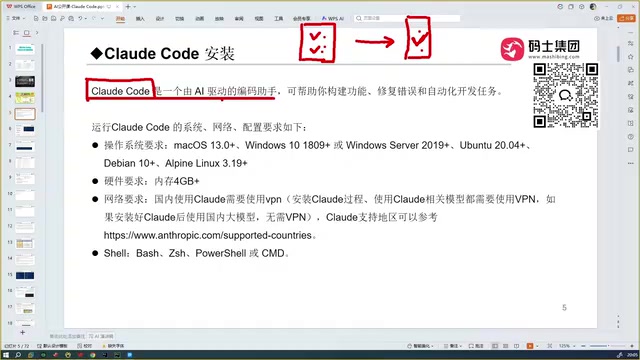
Getting Started with Claude Code: Capabilities and Installation Essentials for This AI Coding Assistant
Claude Code is Anthropic's AI coding agent that reads your full codebase, generates accurate code, and auto-debugs. Compare with Cursor, TRAE, Codex, plus key install requirements.

AINA: An AI Career Coach That Uses a Video Avatar to Uncover Your Job Search Blind Spots
AINA topped Product Hunt with its AI career coach that uses a video avatar to help job seekers find blind spots, polish their profile, and practice interviews.