Cloudflare OS: An AI Agent Workspace Built on Workers

Cloudflare open-sources an AI Agent Workspace on Workers, hitting 10K GitHub stars fast.
Cloudflare's open-source `cloudflare-os` project is an AI Agent Workspace built on Cloudflare Workers, unifying document management, application building, and AI agent execution in one platform. Its core value proposition is enabling AI agents to securely access enterprise context and internal systems. Developed in TypeScript and deeply integrated with Cloudflare's data products (R2, D1, KV, Durable Objects), it reduces the complexity of building agent infrastructure for teams already in the Cloudflare ecosystem — though at the cost of platform lock-in.
Cloudflare's recently open-sourced cloudflare-os project has quickly captured strong community interest, surpassing 10,000 GitHub stars with over 85 new stars added in a single day. Written in TypeScript, the project positions itself as an "Agent Workspace" — a platform that enables developers and enterprises to create documents, build applications, and run AI agents on Cloudflare Workers' edge computing infrastructure, all while integrating with their own internal context and systems.
What Is Cloudflare OS
Despite the name, Cloudflare OS is not a traditional operating system. It's an Agent Workspace running on top of Cloudflare Workers, designed to unify three common use cases on a single platform: authoring and managing documents, building business applications, and deploying and running AI agents.
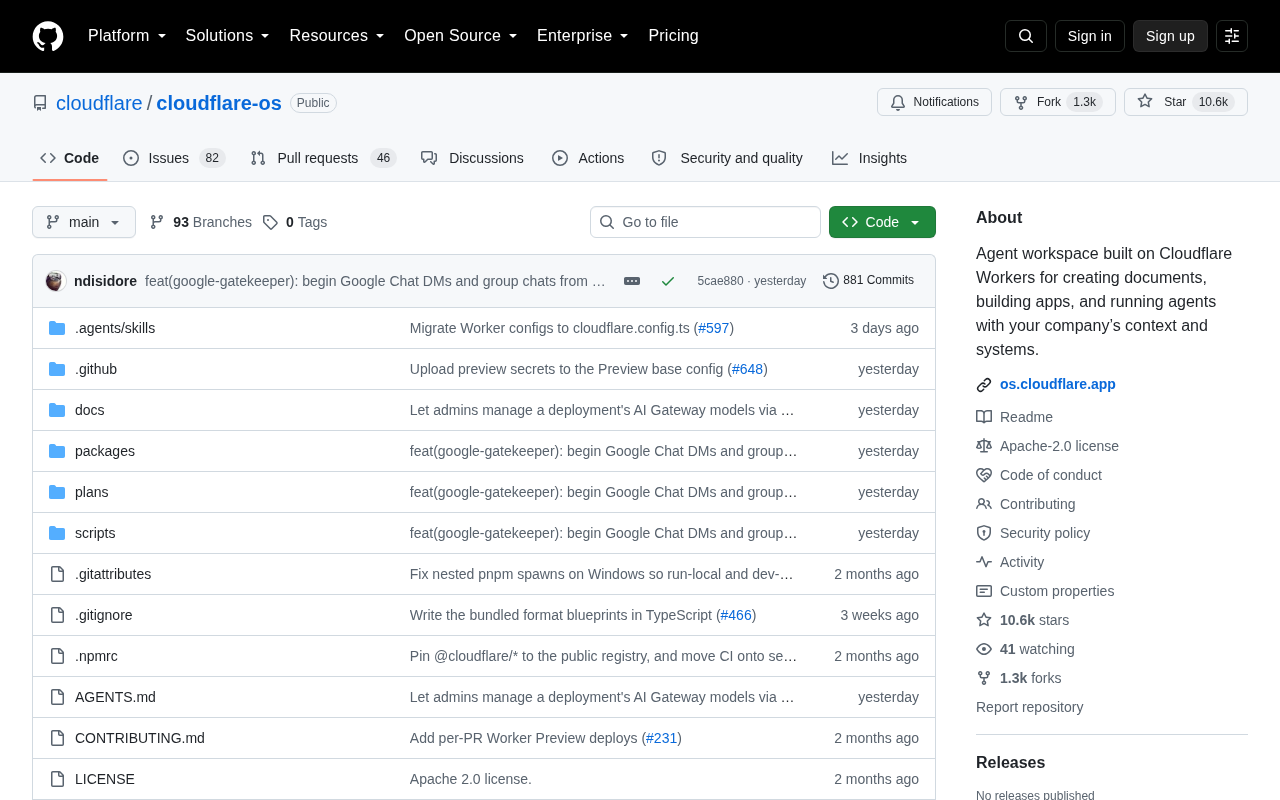
Unlike most standalone agent frameworks, Cloudflare OS emphasizes driving agents with "your company's context and systems." This means it isn't just a thin wrapper around LLM APIs — it aims to become a middleware layer connecting enterprise data, internal tools, and AI capabilities. For teams already operating within the Cloudflare ecosystem (Workers, R2, D1, KV, Durable Objects, etc.), this native integration can significantly reduce the complexity of building agent infrastructure from scratch.
Why Build on Cloudflare Workers
Workers is Cloudflare's edge serverless runtime, offering global distribution, near-instant cold starts, and per-request billing. Building an Agent Workspace on top of Workers provides several direct advantages.
Edge Deployment and Low Latency
Agent applications typically involve frequent API calls and multi-turn reasoning, making latency a critical concern. With Workers' global network, requests are handled at the nearest edge node, minimizing round-trip time.
Native Integration with the Data Layer
Cloudflare's own storage and data products — including R2 for object storage, D1 (a SQLite-compatible database), KV for key-value storage, and Durable Objects for stateful computation — integrate seamlessly with Workers. Agents need to persist session state, cache context, and read and write enterprise documents, and the Cloudflare ecosystem covers all of these needs.
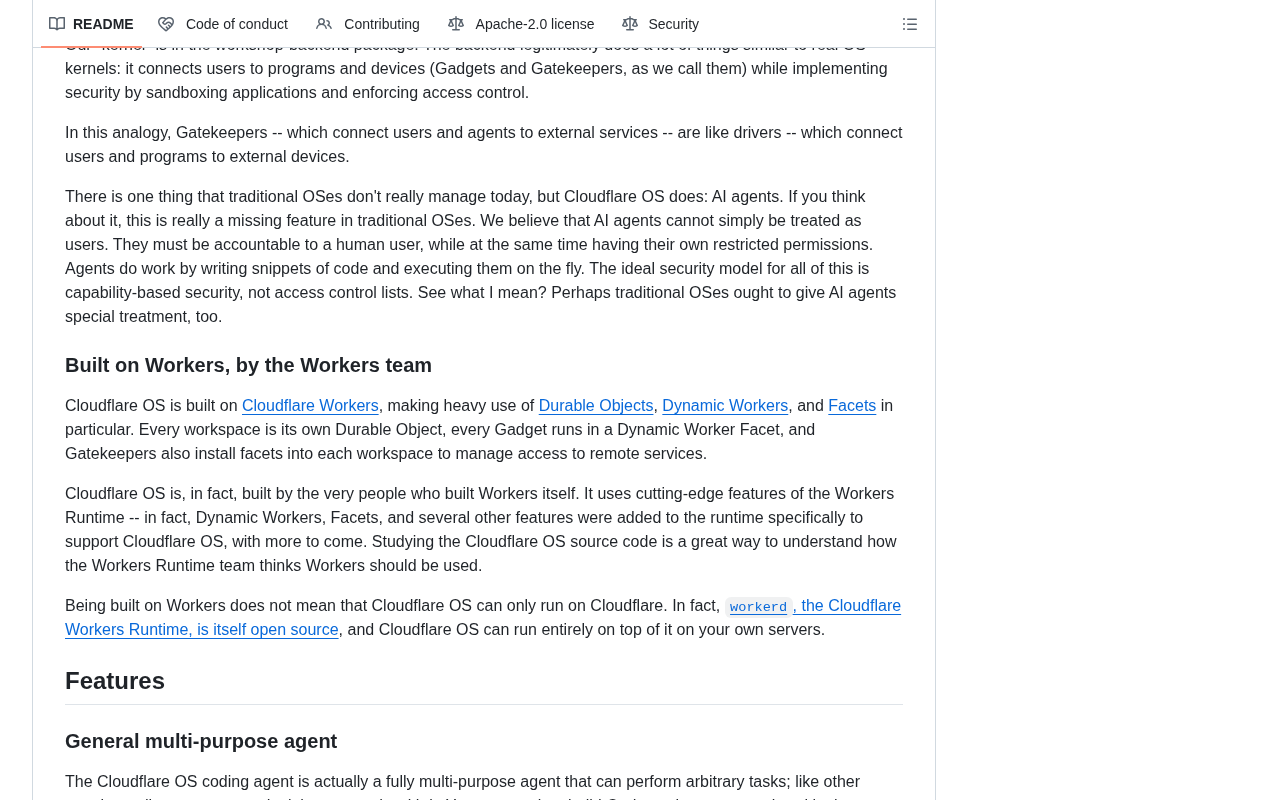
Durable Objects are a special computing primitive offered by Cloudflare. Each Durable Object instance has a unique ID and guarantees serialized access globally, enabling strongly consistent stateful computation within a serverless environment. This is especially important for agent use cases — traditional serverless functions are stateless, with each invocation being independent, making it difficult to maintain multi-turn conversation context or cross-request session memory. Durable Objects fill this gap, allowing each agent instance to function like a long-lived "lightweight process" that continuously persists conversation history, tool call state, and intermediate reasoning results — without requiring an external database to handle state management.
Unified Development and Operations Experience
For organizations already running workloads on Cloudflare, managing an Agent Workspace with the same toolchain (Wrangler, Workers deployment workflows) means a lower learning curve and reduced operational overhead, with no need to introduce a separate server cluster.
What Problem Does It Solve
One of the primary obstacles enterprises face when deploying AI agents is enabling agents to securely and reliably access internal context and systems. Many teams either expose sensitive data to external SaaS platforms or invest significant engineering effort building their own orchestration layer. By combining document management, application building, and agent execution on a single platform — and connecting it to enterprise systems — Cloudflare OS directly targets this "last-mile" integration challenge.
In other words, it aims to become an enterprise's AI operating hub: employees can write documents within it, developers can rapidly build internal tools, and agents can run in the background using the company's proprietary knowledge to execute tasks. This "workspace" positioning puts it closer to a complete product than a bare-bones Agent SDK.
In AI agent deployments, the "Orchestration Layer" refers to the middleware responsible for coordinating LLM calls, tool execution, memory retrieval, and multi-step reasoning chains. Frameworks like LangChain, LlamaIndex, and AutoGen already address this space, but they typically require developers to assemble their own vector databases, message queues, authentication systems, and deployment environments — resulting in complex, patchwork architectures. Cloudflare OS differentiates itself by attempting to unify the orchestration layer and the underlying infrastructure (storage, networking, runtime) within a single vendor ecosystem, reducing cross-system interface friction and security boundary concerns. The tradeoff, of course, is a deeper dependency on the Cloudflare platform.
What It Means for Developers
The project is built in TypeScript, making it highly accessible to frontend and full-stack developers, and it fits naturally within the JavaScript/TypeScript-centric Workers ecosystem. With over 10,000 stars and thousands of forks, the community has made its enthusiasm for a "Cloudflare-native agent platform" unmistakably clear.
For teams evaluating agent tech stacks, Cloudflare OS is worth considering because it consolidates infrastructure, data storage, and the agent runtime within a single vendor ecosystem — reducing the integration cost of stitching together multiple independent services. On the other hand, this also means significant platform lock-in, and teams will need to weigh convenience against portability.
Summary
Cloudflare OS represents a broader trend of infrastructure vendors moving up the stack to offer AI agent product layers directly. It combines the edge computing strengths of Workers, Cloudflare's data ecosystem, and enterprise demand for internal context integration into a relatively complete Agent Workspace solution. For developers already in the Cloudflare ecosystem, it offers a low-friction entry point. For the broader community, its ongoing evolution and real-world deployment capabilities are well worth watching.
Note: This article is based on publicly available project information. Please refer to the official repository documentation for the most accurate and up-to-date feature details.
Related articles

Gaussian Process Bandit Optimization: Exploration Strategies and Inference Regret Guarantees
Cumulative regret guarantees in Bayesian optimization fail to reflect final recommendation quality. This article examines a new study that provides inference regret guarantees for Gaussian process bandit optimization through exploration query strategies and fill distance analysis, validated on hyperparameter optimization and control tasks.

The Most Detailed Codex Guide on Bilibili: From Installation to Real-World Practice
The most detailed Codex guide on Bilibili: from app store installation to daily work mode configuration, with a real coffee shop project demonstrating file organization, data extraction, dashboard creation, and other practical tasks. Learn to use Plan Mode and desktop pets to leverage Codex efficiently.

Appearance Compensation in Volume Rendering: Why RGB Accuracy Cannot Guarantee Density Correctness
Volume rendering research reveals that volumetric data perfectly reproducing external RGB views may still contain density errors: appearance compensation can double central density and keep external rays unchanged even when L2 error exceeds 14.52%. Density recovery depends on appearance capacity, spatial resolution, and measurement design.