Cloudflare Wallets: Technical Analysis and Future Prospects of Programmable Wallets for AI Agents

Cloudflare Wallets brings programmable, rule-constrained payment capabilities to autonomous AI agents.
Cloudflare Wallets introduces programmable wallets designed for AI agents, enabling autonomous yet controlled payments through rule-driven authorization. By leveraging Cloudflare's edge infrastructure, it addresses the trust and efficiency challenges of the emerging agentic internet—where AI agents need to make payments without human confirmation while staying within strict, developer-defined boundaries.
When AI Agents Need to Spend Their Own Money
As large language models and autonomous AI agents rapidly evolve, a question that was rarely discussed seriously is now surfacing: When AI agents need to complete paid tasks on behalf of humans, how should they pay?
AI agents refer to artificial intelligence systems capable of perceiving their environment, formulating plans, and executing actions autonomously. Unlike traditional chatbots, agents possess tool use capabilities and can interact with external services through APIs. Current mainstream agent frameworks—such as LangChain's Agent, AutoGPT, and OpenAI's Function Calling—all allow large language models to invoke external tools like search engines, databases, and code executors during reasoning. This capability transforms AI from passively answering questions to actively completing complex tasks—and once those tasks involve paid services, the payment problem becomes unavoidable.
In the past, the internet's payment infrastructure was designed around humans—requiring people to click "confirm" buttons, enter verification codes, and review invoices. But in an "Agentic Internet" driven by AI agents, this human-centered payment flow is becoming a bottleneck. Cloudflare's newly launched Cloudflare Wallets targets precisely this gap, aiming to provide AI agents with a "programmable wallet" that enables machines to conduct autonomous transactions safely and controllably.
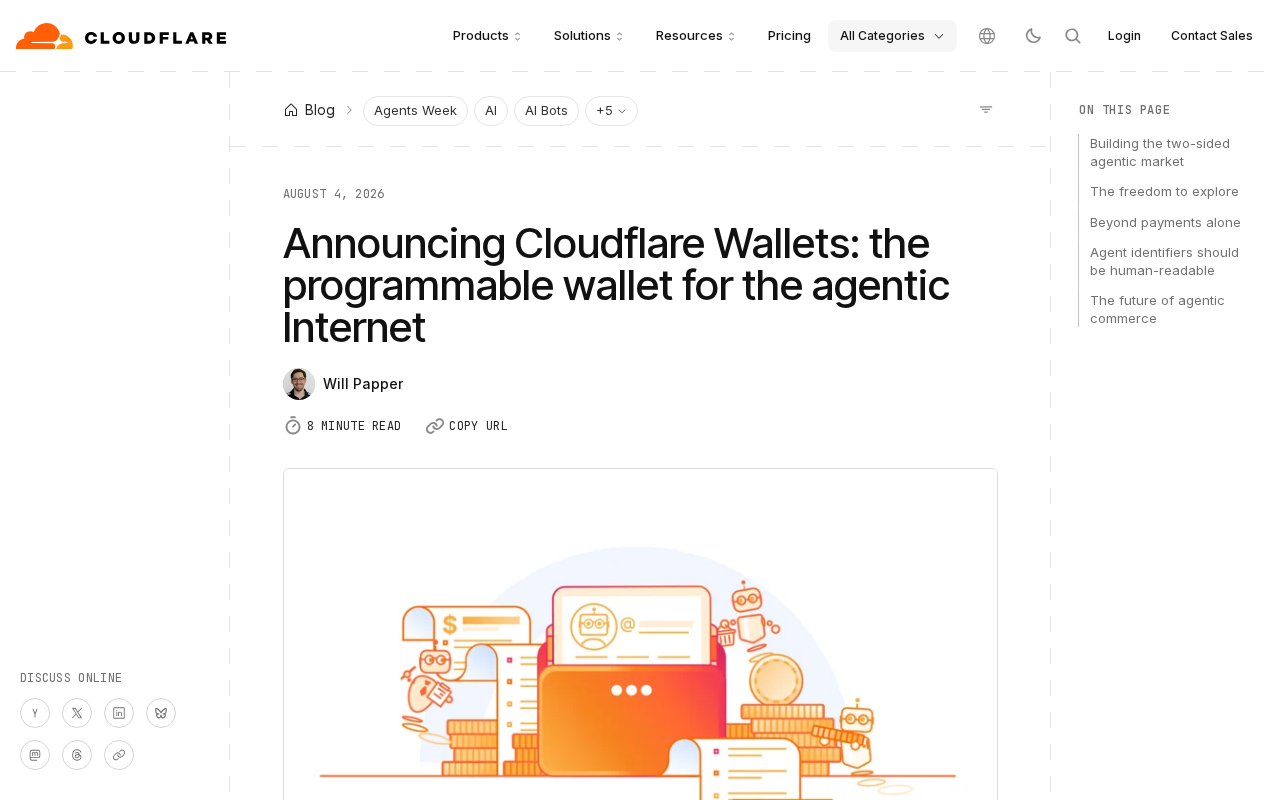
The Core Mechanism of Cloudflare Wallets: What Is a Programmable Wallet?
The essence of a "programmable wallet" lies in codifying payment authorization logic. Traditional wallets rely on manual judgment and confirmation for each transaction, while programmable wallets allow developers to predefine a set of rules that the system executes automatically.
From "Manual Confirmation" to "Rule-Driven" Payment Models
The design philosophy behind Cloudflare Wallets is: rather than giving an AI agent an "unlimited credit card," provide it with a strictly constrained payment account. Developers can set multi-dimensional restrictions on the wallet, such as:
- Per-transaction limits: Cap the maximum amount for each payment, preventing significant losses if an agent is maliciously induced or exhibits abnormal behavior;
- Cumulative spending caps: Set daily/weekly/monthly total expenditure limits;
- Whitelisted recipients: Restrict the agent to only pay specific services or merchants;
- Purpose constraints: Bind to specific API calls or service types.
This "rules-first" approach essentially seeks a balance between AI agent autonomy and human controllability—giving agents enough freedom of action to complete tasks while ensuring risk remains manageable through hard boundaries. From a security design perspective, this follows the Principle of Least Privilege—every component in a system should only receive the minimum set of permissions needed to complete its task.
Why Is Cloudflare Building AI Agent Wallets?
Cloudflare's entry into this space is no accident. As a global leader in edge networking and developer platform services, it naturally occupies critical nodes in internet traffic, while also having deep expertise in identity verification, security protection, and edge computing.
Natural Infrastructure Advantages
Cloudflare already possesses an entire developer-facing product matrix including Workers (edge computing) and Access (zero-trust identity verification). Workers is Cloudflare's serverless edge computing platform, allowing developers to deploy code across edge nodes in over 300 cities worldwide—code that runs in isolated V8 engine environments with extremely short cold start times. Cloudflare Access is built on a zero-trust security architecture whose core principle is "never trust, always verify"—regardless of whether a request originates from inside or outside the network, every access attempt must undergo authentication and authorization, replacing the perimeter defense model of traditional VPNs.
Embedding wallet capabilities into this system means that an AI agent's identity authentication, access control, and payment authorization can form a closed loop. When an agent initiates a payment request, the system can complete identity verification and rule validation at the network edge without relying on disparate third-party services. Deploying payment logic at the edge means transaction verification can be completed in milliseconds without routing back to a central server—critical for AI agent scenarios requiring high-frequency, low-latency transactions.
Furthermore, Cloudflare has always emphasized its product philosophy of "making it easier for developers to build." Wallets will likely be offered as a clean API, allowing developers to integrate controlled payment capabilities into their AI applications in just a few lines of code—consistent with Cloudflare's longstanding product style.
The Payment Trust Challenge in the Agentic Internet
To understand the value of Cloudflare Wallets, we need to first recognize the structural changes the "Agentic Internet" is bringing.
From Tools to Autonomous Actors
In the past, AI primarily played the role of a "tool"—it provided advice, and humans executed. Today's AI agents are evolving toward "autonomous actors": they can call APIs on their own, subscribe to services, purchase data, rent compute, and even complete e-commerce orders on behalf of users.
This brings two core challenges:
First, the trust problem. How do you ensure an autonomously running agent won't spend out of control? Once an AI is jailbroken or encounters a prompt injection attack, an agent with unlimited payment authority could cause incalculable economic losses. Prompt Injection is an attack method targeting large language models where attackers craft text inputs designed to override or bypass the model's system instructions. For example, when an AI agent visits a malicious webpage, hidden instructions on the page might induce the agent to perform unintended operations. More advanced Indirect Prompt Injection can even launch attacks through emails, documents, and other channels that the agent reads. If the agent has payment authority, the consequences of such attacks escalate from information leakage to direct financial loss—this is precisely the core risk scenario that programmable wallets are designed to prevent.
Second, the efficiency problem. If every payment requires human confirmation, the value of AI agents "autonomously executing tasks" is significantly diminished. True automation requires the payment layer to be automated as well.
Cloudflare Wallets attempts to address both points simultaneously: solving trust through programmable rules, and solving efficiency through automated execution.
Industry Impact and Unresolved Questions
From an industry trend perspective, Cloudflare Wallets reflects a consensus that is taking shape—AI agents need their own economic infrastructure. This includes not just payments, but may extend to identity, reputation, contracts, and a whole series of mechanisms. It's foreseeable that more and more infrastructure providers will expand into "machine-to-machine" (M2M) economic activity.
It's worth noting that machine-to-machine economics isn't an entirely new concept—the IoT era already envisioned automated settlement between devices. But AI agents bring entirely new complexity to M2M economics: unlike IoT devices executing preset programs, AI agents possess a degree of "decision-making autonomy" and their behavior isn't fully predictable. This makes the traditional API key + fixed rate model inadequate, requiring more flexible dynamic authorization mechanisms. Smart contracts in the Web3 space have attempted to solve similar problems, but on-chain transaction latency and gas fees limit practical application scenarios. Cloudflare Wallets takes a centralized but programmable route, which may be better suited to current-stage needs in terms of efficiency and controllability.
However, many questions remain unresolved in this direction:
- Auditing and traceability: When agents autonomously complete large volumes of transactions, how do you ensure each one is traceable and auditable? This involves not just technical logging but also compliance requirements for transaction record retention, especially in cross-border payment scenarios.
- Dispute resolution: If an AI agent makes an erroneous payment decision, how should liability attribution and refund mechanisms be designed? In traditional payments, consumers have clear revocation rights and dispute resolution processes, but when the "consumer" is an agent program, existing legal frameworks provide no clear guidance.
- Cross-platform standards: Can programmable wallets from different vendors form interoperable standards, or will they become isolated silos? Currently, no unified protocol comparable to credit card networks (Visa/Mastercard) exists to standardize payment interoperability between agents.
You may not have noticed, but discussion of this announcement in technical communities (Hacker News) is still in its early stages, and actual product details, pricing models, and real-world effectiveness await further official disclosure and genuine developer validation.
Conclusion
Cloudflare Wallets is an important piece of the puzzle in the grand narrative of the "Agentic Internet." It addresses the thorniest payment trust issue as AI transitions from "advisor" to "executor," offering a solution in Cloudflare's signature programmable, edge-native approach.
For developers building AI agent applications, the emergence of such tools means they can more confidently let agents "take action on their own" without worrying about loss of control. But for the industry as a whole, the rules, standards, and governance frameworks for autonomous machine economics are only just beginning to be written.
Related articles

Safety Architecture for Medical AI: A Hybrid Design Combining Rule Engines and Machine Learning
Exploring hybrid architecture design combining rule engines and machine learning in medical AI, analyzing how deterministic rules, CSP, and scoring mechanisms ensure safety in exercise prescription systems.

Higgsfield's Million-Dollar AI Film Contest and Open-Source Workflow: A Deep Dive
Higgsfield launches a $1M AI film contest, partners with Pixar co-founder, open-sources studio workflows, and offers unlimited Seedance 2.5 access—a deep analysis of its creator ecosystem strategy.

Auto-Generating Paper Slides with Local LLMs: Balancing Efficiency and Privacy
Explore how local LLMs automatically convert academic papers into presentation slides, protecting unpublished research privacy while dramatically boosting efficiency for researchers.