Higgsfield's Million-Dollar AI Film Contest and Open-Source Workflow: A Deep Dive

Higgsfield bets big on creators with a $1M AI film contest, Pixar partnership, and open-source workflows.
Higgsfield has unveiled a comprehensive creator-focused strategy including a $1 million AI film contest, collaboration with a Pixar co-founder, open-source studio-grade workflows, and 33 days of unlimited Seedance 2.5 access. This combination signals a shift in AI video competition from pure technology to ecosystem building, aiming to establish Higgsfield as the central platform for AI creators.
Higgsfield's All-in Creator Strategy
Competition in the AI video generation space is shifting from pure technological rivalry to a full-scale battle over creator ecosystems. The field has already formed a multi-tier competitive landscape: OpenAI's Sora, Runway's Gen series, Pika Labs, Stability AI's Stable Video Diffusion, and ByteDance's Dreamina each hold their own ground. While these platforms differ in technical approaches—some emphasizing Diffusion Models, others exploring Transformer architectures—they are rapidly converging in generation quality and duration, narrowing the window for pure technical differentiation.
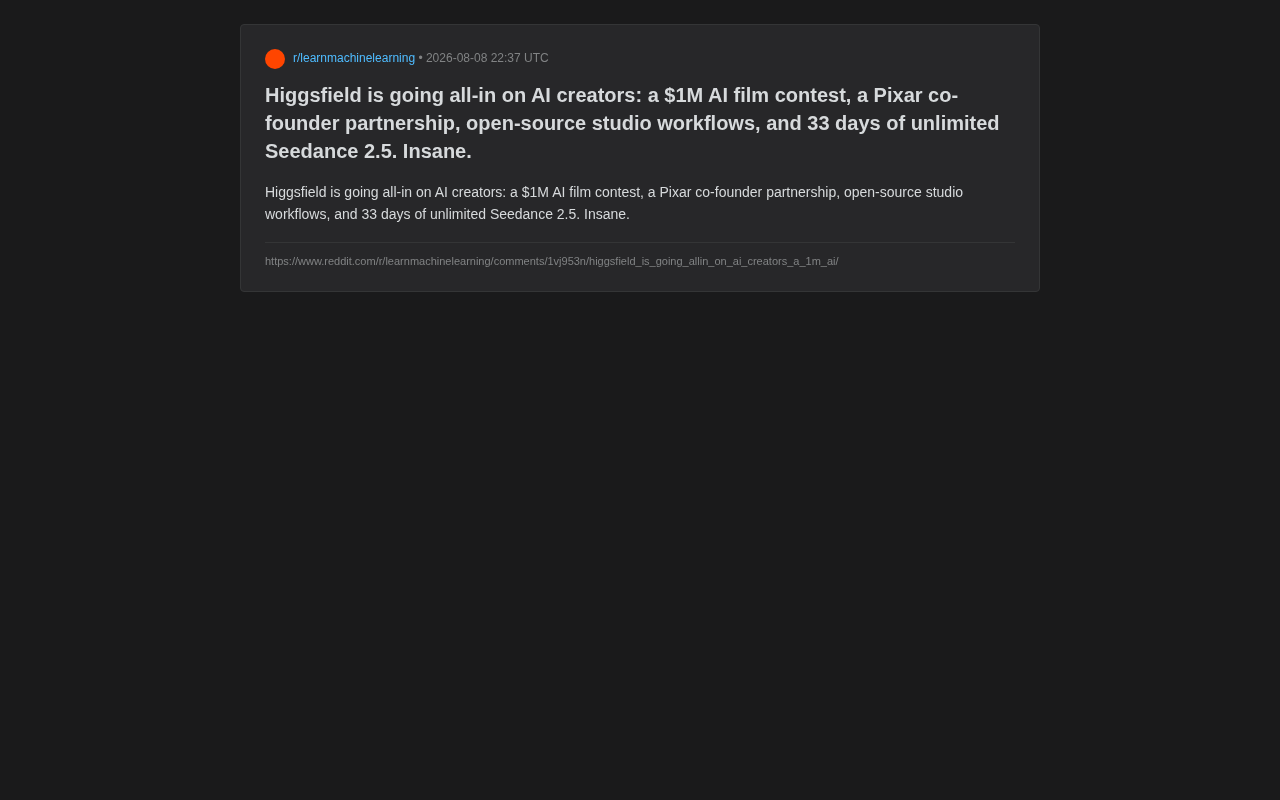
It's against this backdrop that AI content platform Higgsfield announced a series of major creator-focused initiatives, including a $1 million AI film contest, a collaboration with a Pixar co-founder, open-source studio-grade workflows, and 33 consecutive days of unlimited access to the Seedance 2.5 model.
Higgsfield was founded by former AI researchers from Snap (Snapchat's parent company). The company name references the "Higgs Field" in physics, hinting at its ambition to provide the foundational "field" for AI creation. The company secured significant funding in 2024 and has been gradually transforming from a standalone video generation tool into a comprehensive platform for creators.
The signal from this combination of moves is unmistakable: Higgsfield is no longer content with providing tools—it aims to become the central platform and community hub for AI creators. At a time when text-to-video and image-to-video technologies are maturing rapidly, whoever can first attract a critical mass of high-quality creators will likely seize the initiative in the next phase of competition.
The Million-Dollar AI Film Contest: Leveraging Real Money to Build a Content Ecosystem
The $1 million AI film contest is the most eye-catching component of this initiative. For AI video platforms, high-prize competitions carry multiple layers of strategic value.
An Efficient Content Crowdsourcing Mechanism
A large-scale AI film competition is essentially an efficient form of content crowdsourcing. This strategy has a long history among platform companies: YouTube's early Creator Partner Program incentivized content production, TikTok's Creator Fund attracted short-video talent, and Epic Games cultivated its game developer community through free Unreal Engine licensing and competitions. A million-dollar contest in the AI video space follows the same logic: using economic incentives to rapidly fill a platform's content library while building creator brand awareness and usage habits.
With prize money as motivation, platforms attract numerous creators to produce high-quality work. These pieces serve as both the best showcase of platform capabilities and highly shareable marketing materials. Compared to traditional advertising, this approach more authentically demonstrates the creative ceiling of AI video tools.
Building Creator Loyalty and Platform Stickiness
For independent creators and small studios, AI video tools dramatically lower the barriers to film production, while the million-dollar prize pool offers tangible monetization potential. This "tools + incentives" model helps Higgsfield lock in a core group of creators early on, fostering long-term platform stickiness.
Partnering with a Pixar Co-Founder: Traditional Film Meets AI Newcomer
The collaboration with a Pixar co-founder is a particularly noteworthy element worth examining closely. Pixar Animation Studios was founded by Edwin Catmull and Alvy Ray Smith in 1979 (originally as Lucasfilm's computer graphics division) and later became independent under Steve Jobs' investment. Pixar pioneered fully CG feature-length animation—1995's Toy Story was the first entirely computer-generated animated feature film in cinema history. Its core technologies include the RenderMan rendering engine and subsurface scattering algorithms, which profoundly influenced the entire digital film industry. More importantly, Pixar's methodology has always emphasized "technology in service of story"—a philosophy highly relevant to the current AI-generated content landscape.
Pixar represents the highest artistic and engineering standards of the digital animation era. A co-founder's involvement carries powerful symbolic significance for Higgsfield.
This collaboration conveys at least two messages:
- AI-generated content is gaining recognition from traditional film industry elites, indicating that the technology is approaching the critical threshold for professional creative use
- Higgsfield is leveraging industry authority and credibility to differentiate itself from "low-quality AI assembly-line content," shaping a brand image as a professional-grade AI creation platform
For long-time observers of the AI-film convergence, the union of a traditional animation master with an AI upstart is itself a metaphor for generational transition—one that may bring paradigm shifts in creation while inevitably sparking discussions about originality and job displacement. It's worth noting that Pixar itself was born from technological revolution—the transition from traditional hand-drawn animation to computer animation was equally controversial at the time, yet history proved that new technology ultimately expanded rather than replaced creative possibilities.
Open-Source Studio Workflows: Building a Long-Term Ecosystem Moat
Among all the initiatives, the open-source studio workflows may have the most far-reaching impact on the AI filmmaking industry.
Lowering the Barrier to Professional Film Production
In the past, a complete film production pipeline involved storyboarding, 3D modeling, rendering, compositing, and numerous other stages, requiring expensive software (such as Maya, Nuke, Houdini, etc., with annual license fees ranging from thousands to tens of thousands of dollars) and professional teams. By open-sourcing studio-grade workflows, Higgsfield enables independent creators to directly reuse proven production pipelines, quickly building near-professional output capabilities.
Open Ecosystem Over Walled Gardens
Choosing open source over complete closure reflects Higgsfield's deep understanding of ecosystem strategy. In the AI space, open source has repeatedly proven to be a powerful ecosystem-building tool: Meta's LLaMA series of open-source large models rapidly occupied the center of the open-source community, Stability AI's Stable Diffusion spawned an entire plugin and workflow ecosystem for AI image generation through open sourcing, and Hugging Face's Transformers library became the de facto standard for AI developers. The underlying logic is this: when tools themselves are no longer scarce resources, the ecosystem surrounding tools—including plugins, workflow templates, community knowledge, and data flywheels—becomes the true competitive barrier. Open sourcing also accelerates technological iteration, as community contributors discover and fix issues, expand use cases, and create positive feedback loops.
In a highly homogenized AI tools market, open workflows can attract developers and creators to build upon the platform through secondary development and content co-creation, forming an ecosystem moat that cannot be easily replicated by any single competitor.
33 Days of Unlimited Seedance 2.5 Access: Experience-Driven Conversion
33 consecutive days of unlimited Seedance 2.5 model usage is the most direct user growth tactic.
Seedance is ByteDance's AI video generation model series, with its technical foundation built on large-scale video-text alignment training. Compared to previous versions, Seedance 2.5 shows significant improvements in motion consistency, physical plausibility, and long-shot coherence. The model supports both text-to-video and image-to-video modes, with continuous breakthroughs in generation duration and resolution. Higgsfield's partnership with Seedance also reflects the increasingly tight collaboration between the platform layer and model layer—similar to the relationship between app stores and operating systems, where the frontend platform handles user experience and ecosystem operations while the backend model provides core generation capabilities.
The unlimited access period is a classic "experience-for-conversion" strategy: by removing usage quota limits, creators can fully test the model's performance in real projects, dramatically increasing the likelihood of paid conversion and retention. This strategy has been widely validated in the SaaS industry—when users deeply embed a tool into their workflow during a free period, switching costs rise significantly, and willingness to pay increases accordingly.
For creators, this unlimited period aligns perfectly with the million-dollar contest—enabling full commitment to contest submissions without worrying about quota consumption. This coupled design of contest, model, and time limit demonstrates Higgsfield's operational sophistication.
Implications for the AI Video Creation Ecosystem
Taken together, Higgsfield's combination of moves is not an isolated marketing event but a systematic bet on the creator ecosystem:
- The contest gathers attention and premium content
- The authority partnership establishes brand credibility
- Open-source workflows build a long-term ecosystem moat
- The unlimited access period drives user growth and conversion
This also signals that the competitive logic of the AI video space is evolving. Model parameters and image quality alone are no longer sufficient to form barriers—the true moat comes from establishing creator communities, content ecosystems, and workflow standards. This trend aligns closely with the classic principles of internet platform economics: when the infrastructure layer becomes homogenized, network effects and ecosystem lock-in become the key variables determining winners and losers. Whoever first becomes the de facto "home base" for AI creators will have the best chance of prevailing in this race.
It should be noted that the above information primarily comes from community discussions, and specific details (such as prize distribution rules and exact limitations of the unlimited access period) await further official confirmation. But regardless of the details, the "all-in on creators" strategic direction demonstrated by this series of moves is itself worthy of attention from the entire AI video industry.
Key Takeaways
Related articles

Amphibious Transforming Drone: Beyond 100x Power Savings, What Are the Real Needs?
Is the amphibious transforming drone just a gimmick? Starting from the 100x power difference of the M4 Morphobot, explore real application scenarios and thesis topic ideas, analyzing boundary conditions where pure drones and pure ground robots both fail.

Warhound Raises $200 Million: Genetically Engineered "War Dogs" Paired with Anduril Gear
Warhound raises $200M, backed by Ben Lamm and Palmer Luckey, to genetically engineer dogs for military and law enforcement use and equip them with Anduril gear. This article analyzes its technology direction, funding logic, and ethical controversy.

Claude API Comes to Google Cloud: IAM Integration and SDK Access Guide
Anthropic hosts the full Claude API on Google Cloud with IAM-controlled permissions and unified billing. This guide covers the Vertex AI and Anthropic-hosted entry points, IAM role configuration, and SDK access.