Safety Architecture for Medical AI: A Hybrid Design Combining Rule Engines and Machine Learning

Hybrid rule engine + ML architecture ensures both safety and intelligence in medical AI systems.
A Reddit open-source project highlights a critical approach in medical AI: combining deterministic rule engines, Constraint Satisfaction Problems (CSP), and scoring mechanisms with machine learning to build safe exercise prescription systems. This hybrid architecture ensures hard safety constraints are never violated while leveraging ML for personalization and optimization — a Neuro-Symbolic AI approach increasingly seen as the right path for high-risk AI deployment.
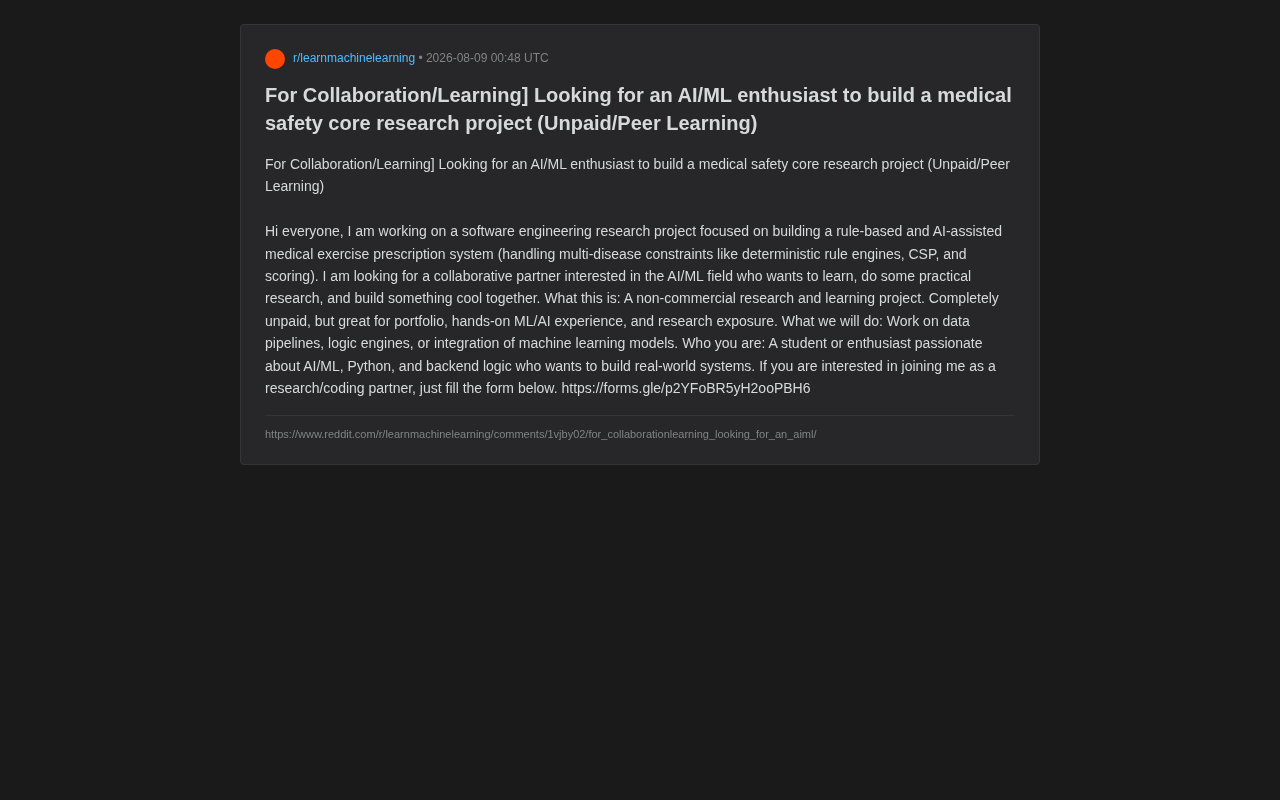
Recently, an open-source collaboration recruitment post on Reddit caught attention. A software engineering researcher is building an "exercise prescription system powered by rules and AI assistance," openly seeking partners passionate about AI/ML to participate. Though this non-commercial learning project is unpaid, it reflects a highly valuable technical direction in today's medical AI landscape: how to make AI both intelligent and safe in high-risk scenarios.
Safety-First Principles in Medical Scenarios
Healthcare is one of the domains where AI applications demand the utmost caution. Unlike entertainment or recommendation systems that have higher tolerance for errors, a wrong medical decision can directly endanger a patient's health or even their life. Globally, medical AI faces far stricter regulatory oversight than other fields — the U.S. FDA classifies AI/ML-driven software as "Software as a Medical Device" (SaMD), subject to tiered approval based on risk levels; the EU's Medical Device Regulation (MDR) similarly requires such systems to have a complete chain of clinical evidence and traceability. This is precisely why the project takes the "medical safety core" as its starting point — any AI system involved in clinical decision-making must first address regulatory requirements for safety and explainability.
According to the poster's description, the project aims to build an exercise prescription system that handles multi-disease constraints. Exercise Prescription is an important branch of sports medicine, with its core focus on developing personalized plans — including exercise type, intensity, frequency, and duration — based on an individual's physical condition, disease diagnosis, and functional assessment. Traditionally, this relies on the professional judgment of rehabilitation physicians, and this project attempts to systematize and automate that process.
In other words, the system needs to generate safe and reasonable exercise recommendations for users who may have multiple concurrent diseases. Such multimorbidity is extremely prevalent in today's society — globally, more than one-third of adults simultaneously have two or more chronic conditions, and among those over 65, this proportion exceeds 60%. For example, a user with both hypertension and knee joint disease needs an exercise plan that neither overburdens the cardiovascular system (e.g., avoiding high-intensity anaerobic sprints) nor risks joint injury (e.g., limiting deep squats and jumping movements). The stacking of such constraints is the core design challenge. Each additional comorbidity causes the constraint space to grow combinatorially, and the cognitive load of manual review increases sharply — this is exactly where automated systems prove their worth.
Technical Architecture: A Dual-Track Design of Deterministic Rule Engines and AI
The most noteworthy aspect of this project is that it doesn't blindly follow the "large models solve everything" trend. Instead, it adopts a rule engine + AI-assisted hybrid architecture. The poster explicitly mentioned three key technical terms: deterministic rule engines, Constraint Satisfaction Problems (CSP), and scoring mechanisms.
Why Medical AI Needs Deterministic Rule Engines
In medical safety scenarios, determinism is a critically important property. A deterministic rule engine means that given the same input, the system will invariably produce the same, explainable output. This stands in stark contrast to the probabilistic, black-box nature of large language models.
From a technical implementation perspective, the core of a rule engine is encoding domain knowledge as a set of "IF-THEN" production rules, with automated decision-making through inference mechanisms (such as forward chaining or backward chaining). The classic Rete algorithm efficiently matches conditions by constructing a rule network, avoiding the need to iterate through every rule individually — a performance guarantee for large-scale rule sets. Commonly used rule engine frameworks include Drools in the Java ecosystem, Clara Rules in the Clojure ecosystem, and Durable Rules and Experta in the Python ecosystem. It's worth noting that rule engines are not new to the medical field — as early as the 1970s, Stanford University's MYCIN system was already using production rules for antibiotic prescription recommendations. This approach continues today in Clinical Decision Support Systems (CDSS), widely deployed in Electronic Health Record (EHR) systems for drug interaction checking, diagnostic assistance, and other scenarios.
For hard constraints like "contraindications" — where a certain disease absolutely prohibits specific exercises — handling them with deterministic rules guarantees 100% reliability and auditability. When adverse events occur, regulators and clinical teams can precisely trace every step of the system's reasoning logic — a guarantee that no probabilistic model can provide. This also aligns with the stringent regulatory requirements for system explainability in healthcare.
CSP and Scoring Mechanisms: Handling Complex Multi-Disease Constraints
Constraint Satisfaction Problem (CSP) is a classic paradigm in artificial intelligence, specifically designed to find feasible solutions under multiple constraints. Formally, a CSP consists of three elements: a set of Variables, a Domain for each variable, and Constraints that must be satisfied between variables. In the exercise prescription scenario, variables might include exercise type, exercise intensity, single-session duration, weekly frequency, etc.; each variable has its own range of candidate values; and constraints derive from the user's disease diagnoses — for example, "heart failure patients must not exceed moderate exercise intensity" or "osteoporosis patients are prohibited from high-impact exercises."
Classic CSP solving methods include Backtracking Search, Arc Consistency algorithms (such as AC-3), and Constraint Propagation techniques. Backtracking search explores the solution space by incrementally assigning values to variables and backtracking when constraints are violated; arc consistency pre-prunes impossible values before the search begins, significantly reducing the search space; constraint propagation further leverages relationships between constraints for deduction, sometimes determining a unique solution or proving infeasibility without any search at all. When users have multiple diseases and physical limitations, CSP can systematically filter out all candidate plans that satisfy hard constraints, ensuring no contraindication is overlooked.
The subsequent scoring mechanism then performs optimization ranking among feasible solutions to select the exercise prescription best suited for the user. The scoring phase may involve multi-objective optimization — maximizing exercise benefits (e.g., cardiopulmonary function improvement) while minimizing risk exposure (e.g., joint load), and also considering user preferences and adherence. Common technical approaches include the weighted sum method (linearly combining objectives into a single score using weights) and Pareto optimality analysis (finding the set of solutions where no objective can be further improved without sacrificing another). This layered design of "first ensuring safety boundaries (rules/CSP), then performing intelligent optimization (scoring/ML)" is a mature engineering approach for high-risk AI systems.
The Role of Machine Learning: Assistive, Not Dominant
You might not have noticed, but the project positions machine learning as an "assistive" (AI-assisted) role. In the collaboration description, the poster listed three main areas of work: data pipelines, logic engines, and integration of ML models.
This positioning reflects a pragmatic technical judgment that also aligns closely with recent reflections across the medical AI industry. In the early days, the industry placed great hope in end-to-end deep learning solutions, expecting a single model to directly output clinical decisions from raw data. However, several high-profile cases exposed the fragility of this approach: IBM Watson for Oncology was reported to have given "unsafe and incorrect" cancer treatment recommendations, partly due to training data bias and inexplicable reasoning processes; Google Health's diabetic retinopathy screening system performed excellently in the lab but, when deployed to primary clinics in Thailand, rejected over 20% of images due to real-world factors like image quality and network latency, severely disrupting clinical workflows. These cases repeatedly confirmed a lesson: In medical scenarios, ML model accuracy is just one necessary condition for successful deployment — explainability, robustness, and compatibility with clinical workflows are equally critical.
Therefore, in medical safety scenarios, ML is better suited for "softer" tasks such as personalized recommendations, plan optimization, and outcome prediction — for example, predicting a user's adherence to a certain type of exercise based on their historical exercise data, or providing learning-based tuning for scoring weights based on population data — while leaving the safety baseline to deterministic rules. This philosophy of "Human-in-the-Loop" and layered decision-making has gradually become an industry consensus for responsible medical AI design. The system can enjoy the intelligence benefits of AI while using the rule engine to maintain safety floors, avoiding risks from model hallucination or anomalous outputs.
Practical Value for AI Learners
From its recruitment positioning, this is a peer learning project aimed at students and enthusiasts. The poster candidly states that the project is entirely unpaid but emphasizes its value for personal growth: building a portfolio, gaining hands-on ML/AI experience, and exposure to real research work.
For learners hoping to enter the AI/ML field, the appeal of such projects lies in their "authenticity." Compared to repeatedly practicing with toy datasets, participating in a complete system involving data pipelines, logic engines, and model integration is immensely beneficial for understanding the full engineering picture. Building a data pipeline involves a series of engineering practices including data collection, cleaning, feature engineering, and version management — a critical leap from "being able to run a Jupyter Notebook" to "being able to build maintainable production systems." Developing logic engines requires participants to deeply understand the formalized expression of domain knowledge, a capability dimension that's easily missing from purely data-driven learning paths. The recruiter requires participants to be proficient in Python and backend logic, with enthusiasm for building real-world systems.
Hybrid Architecture May Be the Right Path for Medical AI Deployment
Setting aside the recruitment nature of the project itself, the technical philosophy behind this post is quite inspiring. While the industry debates the capability boundaries of large models, high-risk fields like healthcare, finance, and autonomous driving are returning to a more cautious engineering philosophy — using deterministic rules to safeguard the safety baseline, and using AI to enhance intelligence.
This approach has a more formal name in academia: Neuro-Symbolic AI. It combines the precision of symbolic reasoning (logical rules, knowledge graphs) with the flexibility of neural networks (deep learning), and is regarded by institutions like MIT and IBM Research as one of the core directions of the third wave of AI. The fundamental idea is that symbolic systems excel at handling structured knowledge, logical reasoning, and constraint satisfaction, while neural networks excel at learning patterns from unstructured data and generalizing — the two are complementary and far more powerful than either paradigm alone.
In industry, hybrid architectures already have several successful deployment cases. In autonomous driving, Mobileye's RSS (Responsibility-Sensitive Safety) framework is a classic example: the perception layer is handled by neural networks (recognizing vehicles, pedestrians, lane markings), while the safety decision layer is constrained by a set of formalized mathematical rules (such as minimum safe distances and right-of-way logic), ensuring that even if the perception model makes errors, the system won't take dangerous actions. This mirrors the "rules as safety net + ML for optimization" approach of this project. The World Health Organization (WHO), in its 2021 "Ethics and Governance of Artificial Intelligence for Health" guidelines, also explicitly stated that digital health intervention tools should have transparency, explainability, and auditability — hybrid architecture provides a viable path to meeting these requirements.
Solutions that rely purely on end-to-end large models often struggle to pass safety audits and regulatory compliance in these fields. The hallucination problem of large language models (generating content that appears reasonable but is actually incorrect) is particularly dangerous in medical scenarios, and the non-reproducibility of their probabilistic outputs makes case-by-case auditing virtually impossible. While the hybrid architecture of rule engines and ML involves higher development costs and more complex design, it can achieve a balance between explainability, reliability, and intelligence. This may well be the mainstream path for medical AI deployment in the future.
Of course, as an unpaid hobbyist project, how far it can go remains unknown. But the technical direction it has chosen is worth pondering for every practitioner concerned with medical AI and responsible AI.
Related articles

LLaMA-Factory in Practice: A Complete No-Code Guide to Fine-Tuning Large Models
An introduction to LLaMA-Factory, the open-source fine-tuning tool: its 60.1K-star background, supported models and algorithms, local vs. cloud deployment, and CUDA setup steps.

Zeng Ming's Deep Retrospective: Why OpenAI May Not Be the Ultimate Winner — and Why the Corporate System Will Disappear
Zeng Ming's deep retrospective on the AI endgame: model companies are just infrastructure, OpenAI and Anthropic won't be the final winners; the next battle is the Agent entry point standard; the corporate system will disappear as AI restructures collaboration, and only mission-driven companies can survive the cycle.

OpenHands v1.28.0: OpenCode and PI Added as Built-in Agents, API Keys Requestable In-Conversation
OpenHands ships 5 releases in 21 days: v1.27.0 adds OpenCode and PI as built-in agents, v1.28.0 enables in-chat key requests. ACP integration, credential reuse, model list changes, and upgrade advice.