Co-Review: Use the Agent That Built Your Code to Understand the Entire Repository

Open-source Co-Review lets the Agent that built the code explain it, solving the explainability problem of AI-generated code.
Co-Review is an open-source tool on Product Hunt that tackles the explainability challenge of AI Agent-generated code that "runs but doesn't feel like your own." It turns the whole repository into a reviewable object, supports comments and questions at the line, file, and folder level, with the building Agent answering from repository context, and also covers diff, PR, and design mockup review. It is free, open source, and telemetry-free—friendly for sensitive code. Its value lies in shifting review from a person reading code to a person talking with an Agent, forming a loop of understanding. Effectiveness depends on the Agent's repository comprehension, and as an early-stage project, ecosystem and maintenance are to be watched.
When Code Is Written by Agents, Do You Still Understand It?
More and more developers are using AI Agents to generate code. Efficiency has certainly improved, but an awkward problem has come along with it: the code an Agent writes runs, but it no longer feels like your own code. It's hard to quickly understand its structure, intent, and potential risks. Co-Review, an open-source tool that just landed on Product Hunt, tries to solve this pain point. Its tagline is blunt: use the same Agent that built the code to understand the entire repository.
What Is Co-Review?
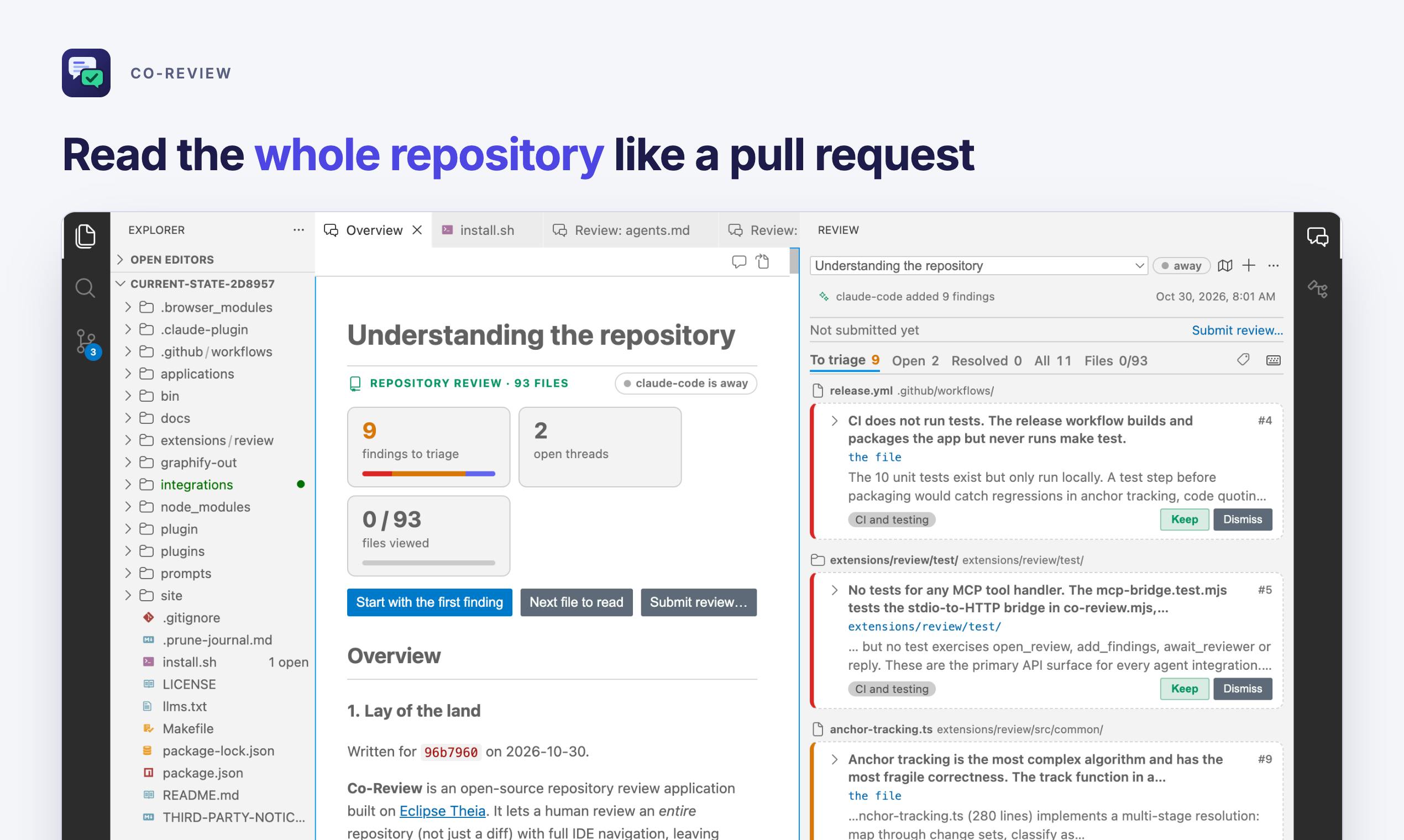
Co-Review turns the entire repository into a reviewable object. You can leave comments on any line of code, a file, or an entire folder and directly ask "why was this written this way," and the Agent will answer based on the code content. The review targets it supports aren't limited to the repository itself—they also include diffs, PRs, and design mockups. According to its Product Hunt page, the tool is free, open source, and collects no telemetry data.
This positioning hits a real need: AI-generated code often lacks "explainability." Traditional code review tools focus on syntax, style, and potential defects, whereas Co-Review focuses on understanding intent—having the Agent that built the code explain the code in turn, closing the loop.
Why Does Agent-Written Code Need a Dedicated Review Approach?
The process of an Agent generating code is usually a black box: you give a requirement, it outputs a result. The code may be logically correct and pass tests, but developers have little awareness of its internal decisions. Over time, the codebase turns into a gray zone that "runs but you're afraid to touch."
Co-Review's idea is to shift review from "a person reading code" to "a person talking with an Agent." You don't need to read line by line from start to finish; instead, you directly ask questions about the parts that seem suspicious or unfamiliar. The Agent answers based on a complete understanding of the repository, which gives it a context advantage over general-purpose code assistants—because it's the one that wrote the code.
AI Agents generating code typically rely on the large language model's context window mechanism: when generating each piece of code, the model can only "see" a limited token range. When the repository exceeds the window capacity, the Agent often approximates global understanding through retrieval augmentation (RAG) or summary compression, which causes context loss or bias and is one of the technical roots of "the code runs but I can't understand it." Co-Review claims the Agent can "read the entire repository," which in practice tests whether its indexing and retrieval strategy can maintain consistency across long contexts.
Code explainability in traditional software engineering is mainly ensured through comments, commit messages, and documentation; code generated by Agents lacks the process of humans writing these meta-information items. Therefore, Co-Review's conversational review is essentially building an explainability layer after the fact, letting developers reconstruct the decision chain through Q&A rather than relying on reasoning traces the Agent proactively leaves behind.
Feature Breakdown: Review Targets and Interaction Modes
Based on information disclosed on the product page, Co-Review's core capabilities cover three types of review scenarios:
- Repository-level review: leave comments and ask questions at the line, file, or folder granularity
- Change review: supports review of diffs and PRs, suitable for checks before code merging
- Design review: brings design mockups into the review scope as well, expanding the boundaries of "code review"
In terms of interaction, it uses comments as the entry point and the Agent as the responder. This asynchronous, on-demand interaction is lighter-weight than real-time pair programming and easier to fit into existing workflows.
Diff is a format in version control systems (such as Git) that represents the differences between two commits, usually presented as a comparison of added and deleted lines, and is one of the smallest units of code review. PR (Pull Request) is the workflow vehicle for initiating a merge request on a collaboration platform; reviewers can comment line by line in a PR and request changes. Co-Review's support for diff and PR review means it can be embedded in the key step of "pre-merge checks," rather than only tracing back after the fact.
Bringing design mockups into the review scope extends review from the code layer to the intent layer: design mockups express product goals, while code is the means of implementation, and comparing the two helps uncover problems where "the implementation deviates from the design." However, this also requires the tool to have cross-modal understanding capabilities, placing higher demands on the Agent's multimodal abilities.
Open Source and Privacy: A Foundation of Trust with No Telemetry
Co-Review explicitly labels itself as free, open source, and telemetry-free. For code review tools, this is especially critical—repositories often contain sensitive information, and developers are very sensitive about data being sent externally. Open source means you can audit the code yourself and self-host, while no telemetry eliminates usage concerns. This also explains one reason it gained attention on Product Hunt: in an environment where AI tools are generally paid and data policies are opaque, a transparent, self-hostable solution has natural appeal.
Who Is Co-Review For?
Developers who frequently use AI Agents to generate code are the primary target users. Next are team members who need to quickly take over an Agent-generated codebase—through question-based review, the onboarding cost is much lower than reading through the code. For open-source project maintainers, Co-Review's PR review capability can also come in handy.
However, it's important to recognize clearly that the value of this type of tool depends heavily on how deeply the Agent understands the repository. If answer quality is unstable, review becomes a formality. In addition, it is still an early-stage project, and its ecosystem integration and long-term maintenance remain to be seen.
Conclusion
Co-Review represents a direction worth watching: when the producer of code becomes an Agent, the review approach also needs to evolve accordingly. Letting the builder explain the build is logically coherent; whether it can be delivered in practice depends on the Agent's context capabilities and the degree of product polish. For developers "held hostage" by Agent-generated code, this is at least an open-source option worth trying.
One-line Summary
Open-source tool Co-Review lets the Agent that built the code explain the code in turn, solving the problem of AI-generated code being hard to understand.
Paragraph Summary
Co-Review is an open-source tool that just landed on Product Hunt, aimed at solving the explainability challenge of AI Agent-generated code that "runs but doesn't feel like your own code." It turns the entire repository into a reviewable object, supports leaving comments and asking questions at the line, file, and folder granularity, and has the Agent that built the code answer based on repository context. It also covers diff, PR, and design mockup review. The tool is free, open source, and telemetry-free, making it friendlier for code-sensitive scenarios. Its core value lies in shifting review from "a person reading code" to "a person talking with an Agent," forming a loop of understanding. But its effectiveness depends heavily on how deeply the Agent understands the repository, and as an early-stage project, its ecosystem integration and long-term maintenance remain to be seen.
Related articles

Gemini 4 Hydrogen Hands-On: Google's Fastest and Cheapest AI Model
Hands-on with Gemini 4 Hydrogen: the fastest, cheapest model in the Gemini 4 family. We break down the Carbon/Argon/Hydrogen split, API pricing traps, free-tier limits, and the cost trade-offs of four thinking levels—with a real bug-debugging demo.

Gemini 4 Hydrogen vs Sonnet Comparison Test: Uses Only 1% of Weekly Quota, Performance on Par
Hands-on test: Gemini 4 Hydrogen vs Sonnet on the same CRUD task—Hydrogen used only 1% weekly quota with comparable performance and better UI details, while Anthropic's model used 7%. Developer says daily tasks don't require expensive models.

Gemini 4 Neon Released: Beats Opus 5.5 on Multiple Benchmarks, Google Returns to the Top Tier
Google DeepMind releases Gemini 4 Neon: 61 on the Artificial Analysis intelligence index (3rd) and 1st on the coding index, beating Opus 5.5 on multiple benchmarks. $3/$15 per million tokens; available in the Gemini API and AI Studio.