Code Sesh: A Multi-AI Agent Session Management Tool That Lets You Instantly Recover a Fix From Three Weeks Ago

Code Sesh unifies sessions from 20 AI coding agents into one local workspace, with search, replay, and cost tracking.
The article notes that as developers use multiple AI coding agents simultaneously, session logs are scattered across separate hidden folders, making past fixes hard to trace — a "digital archaeology" dilemma. Code Sesh, a local workspace tool run via NPX, can search all agents' prompts, tool outputs, and edited files at once, and supports full reasoning replay, Markdown export, and one-click resume commands. It also offers token tracking and model comparison, generating session-level cost receipts to help teams clarify expenses in multi-agent environments. The article sees this as filling the management vacuum of multi-agent workflows, though the information comes from a single demo video, and actual parsing capability and search performance remain to be verified.
When AI Agents Become the Main Bug-Fixers, Session Logs Become the New Headache
Three weeks ago, one of your AI agents wrote what can only be called a miraculous bug fix. Today, production is down again — and you can no longer remember whether you used Claude, Codex, Cursor, or Gemini at the time. This isn't a joke; it's a real predicament that more and more developers are running into.
According to a demo video posted on a YouTube channel, every AI coding agent buries its conversation history in its own separate hidden dot-folder, scattered around like a squirrel hoarding nuts. When you need to trace back a past fix, you're forced to play "digital archaeologist," rummaging back and forth across different tools.
The cost of this fragmentation goes far beyond time. Different agents use inconsistent session data structures and produce tool outputs in different formats, making manual comparison nearly impossible to scale. The core pain point the video raises is straightforward: modern developers' AI usage history now spans multiple tools, but the way we manage it is still stuck in the single-tool era.
Code Sesh's Answer: Pull 20 AI Agents Into One Local Workspace
The tool featured in the video is called Code Sesh, positioned as a way to "scan 20 AI coding agents into one clean local workspace." Its core capabilities revolve around "retrieval" and "replay."
Unified Search: One Query Covers All History
Code Sesh lets developers run a single search that simultaneously queries every prompt, tool output, and edited file across all agents. In the demo scenario, after running NPX Code Sesh, that fix from three weeks ago is found immediately — complete with a full replay and the reasoning chain behind it.

This solves a key problem: a code fix is rarely an isolated diff; it's a decision-making process packed with contextual reasoning. Seeing only the final change without the thinking path behind it is of limited help when reproducing or understanding the intent of the fix.
Replay, Export, and One-Click Resume
Once you've found a past session, Code Sesh offers three ways to use it: replay the full session, export it to Markdown, or grab a one-click resume command to continue unfinished work. The video emphasizes that "the replay and the reasoning are included," meaning developers can see not just what changed, but why it changed.
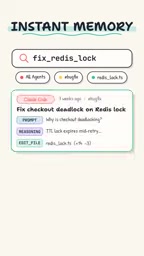
From a product-design standpoint, the one-click resume command is a relatively pragmatic feature — AI coding is rarely a one-shot affair, and continuity across sessions has always been a breaking point in multi-tool environments.
AI coding agents generally refer to intelligent agents capable of autonomously planning, invoking tools, and executing multi-step coding tasks, such as Claude, Codex, Cursor, Gemini, and others. They receive instructions through natural language conversation and internally maintain session state, including historical messages, tool-call records, and file-edit operations. This session data is typically stored in structured formats (such as JSON) in local hidden folders to support context continuation or debugging. Different agents vary in storage paths, data structures, and lifecycle management strategies, which makes cross-tool retrieval and reuse difficult. Code Sesh's core idea is precisely to scan these heterogeneous stores in a unified way and build a searchable, replayable local session index.
In the context of AI coding agents, "replay" means reconstructing the user–agent interaction step by step in the original chronological order of the session, including every prompt, the agent's reasoning steps, tool calls and their outputs, and file modifications. Unlike a simple diff comparison, replay preserves the causal chain of decisions, enabling developers to understand the intent behind a fix and the contextual constraints. Exporting to Markdown converts the session record into a highly readable document format, convenient for archiving or sharing. The one-click resume command is typically an executable CLI instruction that can reload session state and continue unfinished tasks, relying on complete parsing of the original session data and state reconstruction. Together, these features form the key capabilities of session-layer infrastructure.
Token Tracking and Model Comparison: The Economics on the Side
One refreshingly realistic detail in the video is cost tracking. Code Sesh tallies token consumption, compares the performance of different models, and prints a "session receipt," so developers can finally explain exactly where that $42 went.
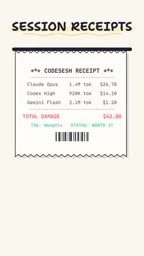
Tying token consumption to specific sessions has real value for teams. When multiple agents and multiple models are used in parallel, cost attribution often becomes a muddled mess. Session-level token records at least provide a traceable level of granularity. However, the video does not show the specific presentation format or precision of this tracking, so actual results remain to be verified.
The Management Vacuum in Multi-Agent Workflows Is Being Filled by Tools
Code Sesh's emergence reflects a trend: the number of AI coding tools is expanding rapidly, with Claude, Codex, Cursor, and Gemini each having their adherents, and developers often using several at once. Yet the accompanying "session layer" infrastructure clearly lags behind — most agents care only about the current conversation, not about the ownership and reuse of historical sessions.
The local workspace is one of Code Sesh's differentiating choices. The video emphasizes that all data is scanned and organized locally, which is a plus for scenarios sensitive to code privacy, but it also means cross-device sync may be limited — the exact capabilities depend on the actual product.
It should be noted that the above information comes primarily from a single YouTube product demo, lacking independent third-party reviews and cross-validation from user feedback. Whether the tool can reliably parse session formats across 20 agents, how search performance holds up, and how well it supports non-mainstream agents all remain to be tested in practice. For developers plagued by fragmented multi-agent sessions, Code Sesh offers an idea worth watching — but it's advisable to try it on a small scale before deciding whether to fold it into your workflow.
Related articles

A 19-Year-Old's Rental Horror Story: Ceiling Collapse, Bug Infestation, and the Lessons It Taught Me
At 19, my first off-campus rental brought bug infestations, no heat, a collapsed ceiling, and a ruined laptop with no renter's insurance. Here are the hard-won lessons for first-time student renters.

Veda Nurse's Cranial Nerve Exam: Why ASMR Role-Play Is Going Viral
Bilibili creator Veda's cranial nerve exam ASMR video goes viral, blending humor and sensory triggers through nurse role-play. This article analyzes its unique appeal and the audience psychology behind ASMR role-play.

LG Cinebeam AI Review: 120-Inch Giant Screen + 3000 Lumens, a New Choice for the Living Room Theater
LG Cinebeam AI projector review: 3000 ANSI lumens, 4K, 100 inches from about 8 cm and 120 inches from about 18 cm. Built-in webOS, AI Concierge voice recommendations, AI Sound Pro 11.1.2 virtual surround, and Game Optimizer—positioned for fixed living room installation, complementing the portable Cinebeam S.