Codex Beginner's Guide: Getting Started with OpenAI's AI Coding Assistant

A practical intro to OpenAI Codex: its value, comparison with Claude Code, and DeepSeek integration pitfalls.
This article, based on a creator's livestream, covers the basics of OpenAI's Codex AI coding assistant. Codex uses natural language to handle coding, testing, and ops tasks, and its user base has grown beyond developers. Some companies now track AI code generation rates as a KPI, making tool proficiency a hiring factor. The creator recommends Codex over Claude Code, and offers a key practical tip: pairing Codex with DeepSeek is highly unstable — use Claude Code instead if DeepSeek is your goal. The guide targets complete beginners.
What Is Codex, Exactly?
Codex is an AI coding assistant launched by OpenAI — essentially an intelligent agent tool that accepts natural language instructions and carries out development tasks on your behalf. You simply tell it what you want in plain language, and it handles the rest. For example, you can say "write a feature in Java" or "generate a page in HTML," and it will produce the code even if you're not fluent in that language.
This is precisely why Codex's user base has expanded well beyond professional developers. On platforms like Douyin (Chinese TikTok), creators without technical backgrounds are already making content about using Codex with AI avatars and automated workflows. The barrier to entry keeps falling, and whether or not you can put these tools to work is increasingly becoming a dividing line for personal productivity.
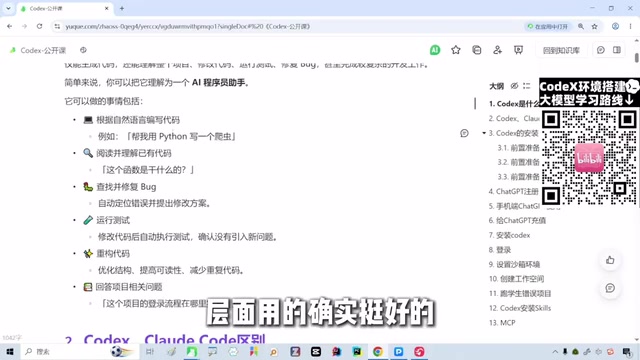
From a technical architecture standpoint, Codex is far more than a simple code completion tool. It's an Agent framework built on large language models — capable of understanding task intent, breaking problems into sub-steps, invoking the file system or terminal to execute operations, and adjusting subsequent actions based on intermediate results. This is fundamentally different from the early GitHub Copilot, which only did inline completion. OpenAI originally released the Codex model in 2021; its capabilities were later progressively integrated into the GPT-4 series, and it's now available externally as Codex CLI or as an Agent within ChatGPT. Claude Code is Anthropic's competing product in the same space. Both belong to the emerging category of "AI coding agents in the terminal/IDE" — distinct from products like Cursor, which focus more on editor integration.
Why You Need to Start Using It Now
One creator repeatedly emphasized a blunt reality in their livestream: many developers with eight or nine years of experience have never used tools like Codex or Claude Code. At this point in time, that's essentially the same as being out of step with the times.
The pressure is even more immediate when it comes to hiring and performance reviews. According to shared experiences, some companies now open job interviews by asking, "Have you used Claude Code or Codex?" — and if the answer is no, candidates can get screened out on the spot. Some companies have even started setting hard targets for AI code generation rates, with one learner reporting that their company requires AI-generated code to account for over 90% of output, with performance penalties for falling below that threshold.
That said, the creator also pointed out that this kind of evaluation has obvious flaws. Some managers without deep technical knowledge directly measure AI usage by lines of code generated — which is inherently unfair to front-end vs. back-end developers. Front-end work naturally produces more lines of code, while back-end logic tends to be denser but shorter. Using a single line-count metric across the board clearly misses the point.
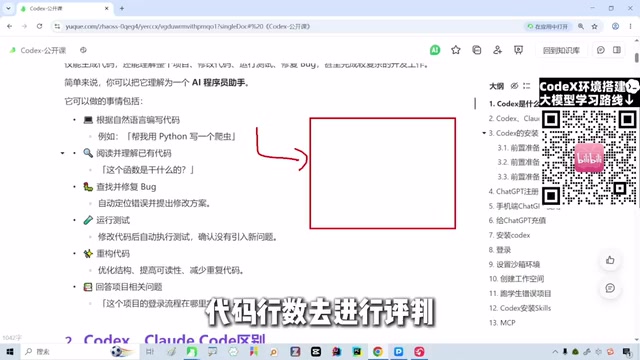
Regardless of how sound the evaluation methods are, the value of the tools themselves is real: from writing code and running tests to supporting operations and maintenance, once you're proficient with Codex, it genuinely replaces a significant portion of repetitive productivity work.
AI code generation rate typically refers to the proportion of lines generated (or co-generated) by AI tools out of the total lines of code committed over a given period. Some companies include this as an R&D efficiency KPI, with the original intent of quantifying how well AI tools have been adopted in practice. However, the metric has clear shortcomings: it incentivizes quantity over quality, potentially encouraging developers to have AI generate redundant code just to inflate the numbers. It also completely fails to capture high-value work like code deletion, refactoring, and architectural design. The metric is widely debated in the industry, and no broadly accepted superior alternative has emerged yet.
Choosing Between Codex and Claude Code
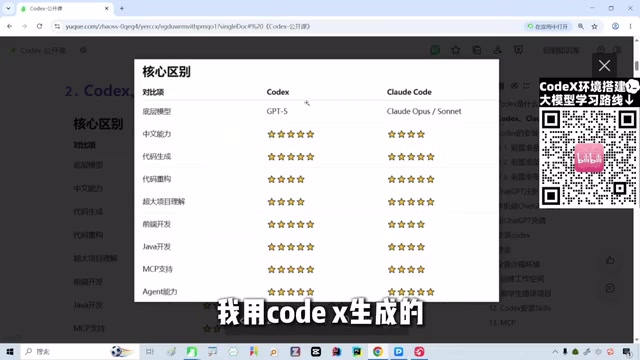
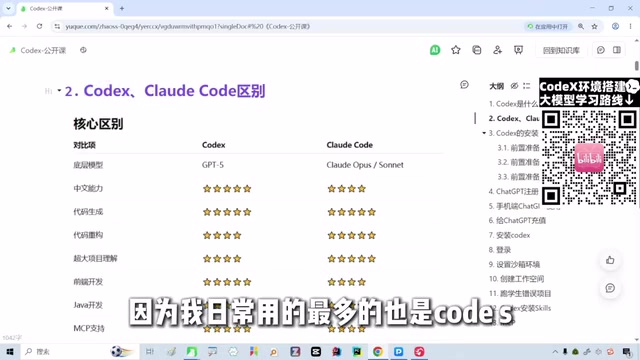
There are several comparable tools on the market — Cursor, Claude Code, and Codex among them. Based on hands-on, high-frequency usage, the creator offered a clear personal preference: Codex is the recommendation.
The intuitive takeaway was that given the same requirement, Codex tends to produce better results than Claude Code. The creator openly acknowledged this is a subjective judgment and that the landscape may have shifted as models continue to iterate.
Additionally, Claude Code has been experiencing significant account ban issues recently, pushing many users to configure third-party models (such as the DeepSeekAd series) as alternatives.
Practical Advice on Configuring DeepSeek
Here's a highly practical tip from real-world testing. There are plenty of tutorials online about "connecting Codex to DeepSeek," but the hands-on conclusion is clear: if you want to use that combination, don't try to pair Codex with DeepSeek.
The reason is terrible stability — the creator tried numerous tutorials without success, and students frequently reported that the connection "works sometimes and breaks other times," with completely random success rates. Some people get it working; others never do, no matter what they try.
The suspected reason is that Codex and GPT have been merged: when Codex detects that you're trying to connect an external model, the official platform apparently doesn't want you to do that. While the Codex website mentions support for some third-party models, DeepSeek is notably absent from that list — whether this is intentional to block domestic Chinese models is unclear.
The recommended alternative: if you must use DeepSeek, connecting it through Claude Code is far smoother and more likely to succeed. And if your goal is to use GPT, just stick with Codex's native setup — don't bother with third-party workarounds.
A relay/proxy station (中转站) refers to a third-party proxy service that converts OpenAI or Anthropic API interfaces into compatible formats, allowing models like DeepSeek to be "disguised" as GPT and connected to clients that don't natively support them. CCSwitch is a community-developed configuration switching tool designed specifically for Claude Code, enabling quick switching between different models or API endpoints. These approaches inherently rely on unofficial interfaces and are vulnerable to upstream service changes — official updates can block these workarounds at any time. For this reason, beginners are advised not to rely on such methods as their primary setup.
Who This Guide Is For
This tutorial is primarily aimed at users who have never touched Codex before, covering the full workflow from environment setup and account registration to API integration and context management. For advanced and unstable techniques like third-party model integration, the practical stance is straightforward: there are plenty of tutorials online you can try on your own (relay proxies, CCSwitch, etc.), but since the creator wasn't able to get them working personally, they won't teach what they haven't verified.
For developers just starting out and professionals looking to boost their efficiency, spending time wrestling with complex model integrations is far less worthwhile than getting genuinely proficient with Codex's native capabilities — that's the most practical entry point right now.
Related articles

Random Pruning of the DPO Computation Graph: 1.4x Training Speedup and Lower Peak Memory
DPO training too slow and memory-hungry? This paper proposes a random pruning framework for the DPO computation graph, sampling independently across position, sequence, and branch dimensions; branch pruning achieves a 1.426x step-time speedup and cuts training time by about 30%, with in-depth attribution of memory and time gains.

Why Does JEPA Underperform MLM in Longitudinal EHR Representation Learning?
New study compares JEPA and MLM for longitudinal EHR representation learning on MIMIC-IV: three JEPA variants train stably without collapse but underperform MLM; target size, not heterogeneity, drives prediction error.

Transfer Learning + Visible Light Communication: A New Approach to Energy-Efficient Indoor Positioning
A study proposes a transfer learning-based visible light communication indoor positioning method, achieving 47% accuracy improvement on the BOSCH factory dataset, 67.5% model efficiency under high noise, and introducing the ME composite metric for energy-efficient positioning in energy-constrained industrial IoT scenarios.