Codex Complete Beginner's Guide: From Environment Setup to Integrating Chinese LLMs

Learn to build reusable AI workflows with Codex — not just use AI tools in isolation.
This Codex hands-on course argues that AI's true value lies in acting as a collaborative Agent across complete workflows, not just answering one-off questions. Starting from environment setup, AGENTS.MD configuration, and integrating Chinese LLMs like DeepSeek, the course covers AI Skill packaging, office automation (Excel/PPT/Lark), e-commerce visual and video production, and personal knowledge bases with Obsidian. The core methodology is an engineering mindset: decompose goals, design workflows, extract repeatable steps, and encapsulate them into reusable assets — rather than relying on one-time prompts or chasing full automation.
It's Not Just Learning Another Tool — It's Learning a New Way of Working
Many people have used AI tools. They know AI can write copy, generate images, and run analysis — but the moment they try to fit it into their real personal workflow, problems emerge: too many tools, scattered methods, learning something today and forgetting it tomorrow, occasionally getting a result but never being able to replicate it. The more common frustration is this: you know AI is powerful, but you have no idea how to actually embed it into your work.
This Codex hands-on course isn't about learning yet another piece of software or picking up a few prompt tricks. It's about developing an engineering mindset — one that lets AI genuinely participate in real tasks, help you get things done, connect your tools, build workflows, and distill all of that into reusable capabilities. As the course puts it: "From now on, it's not about getting AI to answer a question — it's about getting AI to complete an entire job."
Take producing a short video as an example. In the old way, you'd pick a topic, write a script, find images, edit, and export — opening countless apps and repeating countless steps. With Codex, you can break the process apart and have it assist with topic selection, script generation, bulk asset creation, dynamic video production, and finally auto-assemble an editing draft. At that point, Codex is no longer a chat tool — it's a collaborative work partner.
Codex is a code generation and task execution model from OpenAI. It was originally known for code completion, but its core capabilities have long surpassed writing code alone. In Agent mode, Codex can understand goals described in natural language, autonomously break them into subtasks, call external tools (such as browsers, file systems, and API endpoints), and continue executing across multi-step workflows until the entire job is done. This is fundamentally different from traditional "question-and-answer AI": one gives suggestions in a single exchange; the other takes multi-turn autonomous action to actually complete the task. AGENTS.MD is a configuration document read by the Codex Agent at runtime — essentially an "operations manual" written for the AI — that defines task boundaries, tool permissions, and behavioral guidelines. It is the key infrastructure for building reusable workflows.
Why You Should Systematically Learn Codex Right Now
The course gives three core reasons.
The Way We Work Is Changing
In the past, it was about who could work faster or who had more experience. Increasingly, it's about who collaborates better with AI and who designs better processes. Take building a slide deck: some people spend half a day going through research, structure, and polish step by step. A more effective approach is having AI scaffold the content framework so you can focus your energy on "Is this structure accurate? Is this decision correct?" The point is no longer to rely on manual effort alone — it's to hand your working experience to AI and let it become a force multiplier.
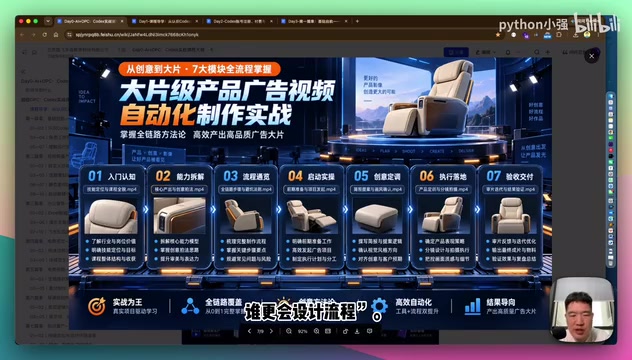
Using Tools in Isolation Is No Longer Enough
One tool for writing copy, another for generating images, yet another for editing video — and materials scattered across your computer, cloud drives, and Lark. What actually kills efficiency isn't that you don't know how to use a particular tool; it's that none of these tools are connected to each other. Codex's value lies precisely in helping you decompose tasks and string different tools together into a single, coherent workflow.

Repetitive Work Shouldn't Be Rebuilt From Scratch Every Time
Anything you do weekly or monthly with relatively fixed steps should be organized into templates, Skills, or automated workflows. The next time a similar task comes up, you only need to plug in new content and run it — no need to start from zero.
An AI Skill is the practice of packaging a reusable AI workflow into a standardized module. Analogous to a function in programming or a macro in software, a Skill locks in "what parameters go in, what steps are taken, and what results come out" — so that next time you encounter a similar task, you simply fill in new variables (a new product name, a new topic) and run it again without redesigning the process. At its core, this approach transforms personal experience and best practices into executable workflow assets. That's why the course emphasizes an engineering mindset over simply learning prompts: a prompt is a one-time thing, while a well-packaged Skill is a capability that keeps delivering value.
Five Real Problems the Course Solves
Unlike traditional AI tool tutorials that only teach "how to ask AI," this course is broken into five modules based on real business scenarios.
First: Solving installation, configuration, and deployment issues. The course starts with setting up the Codex environment, using the workspace, common commands and shortcuts, different entry points, and moves into AGENTS.MD base instructions and document configuration. Many people don't avoid using AI because they don't want to — they get stuck at step one: how to install the tool, how to set up the environment, how to integrate Chinese LLMs like DeepSeekAd, and how to troubleshoot when things go wrong. The course gets the foundational environment running first and establishes the right usage habits.
Second: Solving repetitive work. The course walks you through building your own AI Skills to encapsulate repetitive tasks like image creation, video production, and copywriting. Using short video production as an example: from topic planning and script generation to bulk asset sourcing, and from static to dynamic material creation, you end up with an editing draft. The point isn't just to get a finished cut — it's to distill a reusable "video production skill / workflow."
Third: Solving low office productivity. For common tasks like Excel chart analysis, slide deck creation, and content organization, the course teaches how to use Codex for data analysis, identifying key metrics, and extracting data insights — as well as how to use AI to generate presentations, organize speeches and talking points, and optimize both content and visual design. Lark, a major workplace collaboration product, is integrated into the curriculum to simulate more realistic office scenarios.
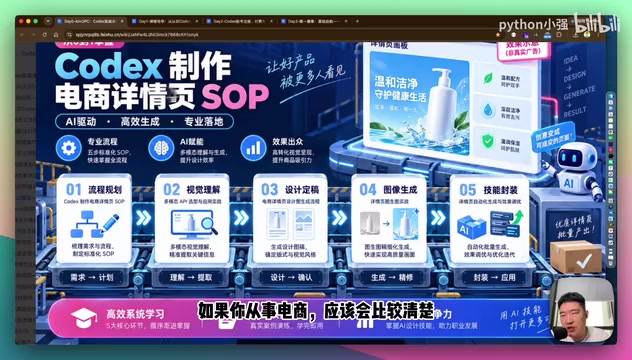
Fourth: Visual and video production for e-commerce. Detail pages, product images, outfit shots, and marketing videos all need to be produced repeatedly and adapted for different products. The course includes dedicated modules on e-commerce visuals and e-commerce video.
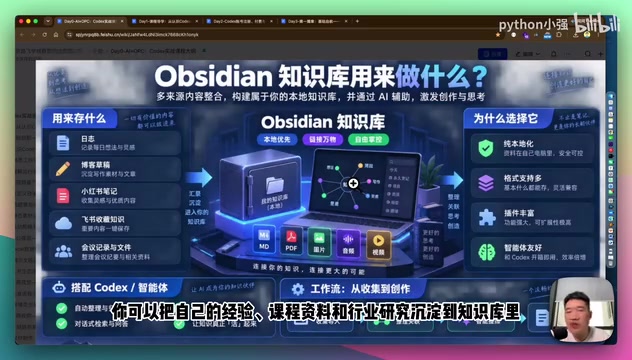
Fifth: Knowledge management and personal IP. Combined with Obsidian, the course covers building a personal knowledge base that connects content collection, knowledge organization, industry analysis, and content production. It also covers voiceover script rewriting, dubbing, subtitle processing, video rendering, and batch production — along with extracting copy from Douyin videos, voice cloning, and digital avatar customization — to help people who want to build a personal brand solve the challenge of sustained, consistent output.
Who This Is For — and Where the Boundaries Are
The course targets five groups: content creators and independent media producers who need standardized processes for topics, scripts, assets, and editing; e-commerce practitioners, brand teams, and marketing departments who repeatedly produce product images and marketing materials; enterprise operations, marketing, and management staff who regularly do data analysis, presentation reports, document organization, and use Lark for collaboration; instructors, consultants, and knowledge creators who want to deposit their expertise into a knowledge base and maintain consistent output; and individuals looking to build a side income or a personal brand.
The course is clear about two important boundaries: completing it doesn't mean everything can be automated, and it doesn't mean a few button clicks will solve every problem. What you truly need to master is the engineering mindset behind AI Coding / Codex Agent — when facing a task, start by breaking down the goal, designing the workflow, and identifying the repeatable steps that can be reused.
What You'll Walk Away With
By the end of the course, you should be able to set up the Codex environment, operate the workspace, use common commands, package Skills, and run a range of office automation and content production workflows. The value isn't in how many concepts you understood — it's in whether you can actually use AI to solve your own problems. As the instructor puts it, the recommendation is to "learn and do simultaneously, and document as you go," because the capabilities that truly belong to you depend on how much you've put into practice.
Background Notes
Obsidian is a knowledge management tool based on local Markdown files, known for its bidirectional linking and graph view — ideal for building a personal knowledge network. Unlike cloud-based note apps, Obsidian stores data entirely on your local machine, making it naturally suited for integration with locally-run AI models for privacy-sensitive knowledge processing. Voice Cloning technology trains on a small audio sample to generate synthetic speech that closely resembles the original voice, commonly used for batch dubbing or digital avatar production. Digital avatar customization goes further, packaging a real person's appearance, voice, and expression style into a reusable virtual persona — a core technical path for personal IP creators who want to produce content continuously without appearing on camera every time. Combined with a knowledge base, these two capabilities form a complete personal IP workflow loop: knowledge input → content production → automated distribution.
Related articles

Amphibious Transforming Drone: Beyond 100x Power Savings, What Are the Real Needs?
Is the amphibious transforming drone just a gimmick? Starting from the 100x power difference of the M4 Morphobot, explore real application scenarios and thesis topic ideas, analyzing boundary conditions where pure drones and pure ground robots both fail.

Warhound Raises $200 Million: Genetically Engineered "War Dogs" Paired with Anduril Gear
Warhound raises $200M, backed by Ben Lamm and Palmer Luckey, to genetically engineer dogs for military and law enforcement use and equip them with Anduril gear. This article analyzes its technology direction, funding logic, and ethical controversy.

Claude API Comes to Google Cloud: IAM Integration and SDK Access Guide
Anthropic hosts the full Claude API on Google Cloud with IAM-controlled permissions and unified billing. This guide covers the Vertex AI and Anthropic-hosted entry points, IAM role configuration, and SDK access.