Codex Hands-On Tutorial: A Complete Guide from Installation to Enterprise-Level AI Programming

A complete guide to OpenAI Codex from installation to enterprise-level multi-agent AI programming.
This article provides a systematic walkthrough of OpenAI Codex, covering installation, CLI interaction, agents.md configuration, Rules-based code governance, MCP protocol integration, multi-agent collaboration with Sabor Agents, and a hands-on RAG intelligent customer service project — helping developers build enterprise-grade AI programming workflows.
Introduction
As one of the most powerful AI programming tools available today, OpenAI Codex is redefining how developers work. However, most developers are still stuck at the simple code completion stage, far from unlocking its true engineering potential. Based on a systematic Codex hands-on tutorial, this article covers the complete knowledge framework from basic installation to enterprise-level applications, helping developers truly integrate AI programming into their daily workflows.
Codex Core Capabilities and Engineering Design Philosophy
Codex is far more than a code generation tool — its core value lies in putting engineering design philosophy into practice. Understanding this is a prerequisite for using Codex effectively.
The technical foundation of OpenAI Codex can be traced back to the evolution of the GPT series of large language models. While the early GPT-3 demonstrated some code comprehension ability, its training data was primarily natural language, limiting the accuracy and engineering practicality of its code generation. OpenAI subsequently released the Codex model, specifically fine-tuned on massive open-source code repositories (including billions of lines of public code on GitHub), achieving a quantum leap in tasks like code completion, function generation, and cross-language translation. Today's Codex is deeply integrated into ChatGPT and API services, supporting dozens of programming languages and understanding project-level code context — a fundamental departure from earlier tools that could only handle individual code snippets. Traditional IDE code assistance (such as IntelliSense and Snippet templates) is essentially pattern matching based on syntax rules and static analysis, whereas Codex performs probabilistic reasoning based on deep understanding of code semantics. This means it can handle ambiguous requirements, infer developer intent, and even generate reasonable implementations without explicit instructions.
Codex's capability boundaries include:
- Code generation and completion
- Code review and refactoring suggestions
- Natural language to code conversion
- Multi-file project context understanding
- Project-level intelligent collaboration based on agents.md
The key to engineering design is not having AI replace developers, but building a human-AI collaborative development paradigm where Codex produces output efficiently under clear specifications and constraints. The core philosophy of this paradigm draws from the software engineering principle of "Convention over Configuration" — by predefining project specifications and behavioral constraints, AI creativity is channeled onto a predictable, auditable track, achieving an optimal balance between efficiency and quality.
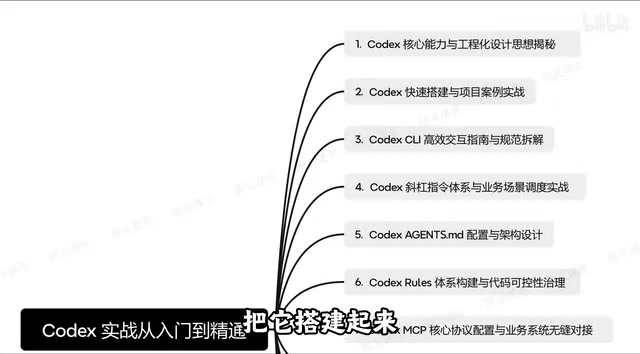
Codex Installation, Configuration, and Project Setup
Environment Configuration Steps
Installing the Codex CLI is the starting point for the entire hands-on process. Through the command-line tool, developers can interact with Codex directly in the terminal to build projects from scratch. The installation process requires attention to several key aspects:
- Applying for and configuring API keys
- Selecting the model version (matched to task complexity)
- Setting up local development environment compatibility
It's worth noting that model version selection directly impacts usage costs and output quality. OpenAI offers models with different parameter scales and capability tiers. Lightweight models are suitable for simple code completion and formatting tasks, with fast response times and low Token consumption, while high-parameter models perform better in complex logical reasoning, multi-file refactoring, and architecture design scenarios. Developers should dynamically select models based on actual task complexity to avoid unnecessary API expenses from using overkill solutions.
Building a Project from Scratch
The tutorial emphasizes a core methodology: define the project architecture first, then use Codex to progressively fill in implementation details. This "skeleton-first" development approach maximizes AI's code generation capabilities while maintaining overall project controllability.
Codex CLI Efficient Interaction Guide
Interaction Modes and Usage Standards
The Codex CLI offers multiple interaction modes, including single Q&A, continuous conversation, and batch task processing. The keys to efficient usage are:
- Precise Prompt Design: Provide clear context and constraints. In code generation scenarios, Prompt Engineering differs significantly from general conversation. Code Prompts need to focus on three dimensions: technical context (programming language, framework version, dependency libraries), functional constraints (input/output formats, error handling requirements, performance metrics), and style specifications (naming conventions, commenting requirements, design pattern preferences). Additionally, since large language models have Context Window length limitations, developers need to master "context management" — carefully selecting the most relevant code snippets and descriptive information to pass to the model within a limited Token budget, rather than simply stuffing the entire codebase into the Prompt. Few-shot strategies (providing a small number of input/output examples in the Prompt) are particularly effective in code generation — a well-crafted example often helps the model understand the expected code style and implementation patterns better than lengthy descriptions.
- Step-by-Step Task Decomposition: Break complex requirements into small, verifiable steps
- Timely Feedback and Correction: Quickly evaluate generated results and iterate
Built-in Slash Command System
Codex has a complete built-in slash command system, and integrating these commands with business scenarios is key to improving efficiency. By combining commands strategically, developers can automate the chaining of code generation, test writing, documentation updates, and other operations. Slash commands are essentially high-level abstractions of common development operations, compressing multi-step interaction flows into single commands and reducing the cognitive load on developers in the "describe requirements → wait for generation → evaluate results → correct instructions" cycle.
agents.md Configuration and Architecture Design
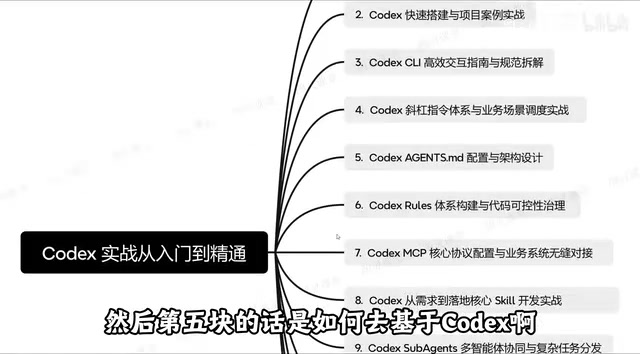
The Role and Purpose of agents.md
agents.md is the core file for Codex project-level configuration. It defines the AI assistant's behavioral standards, technology stack constraints, and code style requirements for the current project. Writing a good agents.md is like equipping the AI with a comprehensive "project handbook."
At its essence, agents.md solves the "consistency" challenge in AI code generation. Without explicit constraints, an AI model may generate code with wildly different styles across different conversation turns — within the same project, you might see camelCase and snake_case mixed together, different error handling patterns coexisting, or even third-party libraries being introduced that the project doesn't use. agents.md delivers the team's engineering standards to the model in a structured way, ensuring it "remembers" and follows project conventions with every code generation. This is especially critical in team development with multiple collaborators.
Architecture Design Best Practices
An excellent agents.md should include:
- Project technology stack declaration
- Code standards and naming conventions
- Directory structure documentation
- Dependency management strategy
- Testing requirements and coverage standards
- Security constraints
This configuration-driven development approach ensures that AI-generated code consistently meets team standards, significantly reducing the cost of later reviews and refactoring.
Rules System and Code Controllability Governance
Codex's Rules system is an important mechanism for ensuring code quality. By defining clear rule sets, developers can:
- Constrain the complexity of generated code
- Enforce specific design patterns
- Avoid known anti-patterns
- Ensure secure coding practices
The core philosophy of code controllability governance is: AI's freedom should operate within a predictable range. Overly loose constraints lead to chaotic code styles, while overly strict ones limit AI's creativity. Finding the balance is a key challenge in engineering practice.
This philosophy aligns with "defensive programming" and "code governance" in software engineering. In traditional development, teams use tools like ESLint, Prettier, and SonarQube for static analysis and standards checking on human-written code. In AI-assisted development, the Rules system serves a similar "front-gate guardian" role — rather than checking for issues after code generation, it injects constraints into the model's reasoning chain during generation, reducing the probability of non-compliant code at the source. This "Shift Left" quality control strategy is particularly important in the scaled application of AI code generation.
MCP Protocol Configuration and Business System Integration
MCP (Model Context Protocol) is the core protocol for seamless integration between Codex and external systems. MCP was designed to solve the "context silo" problem that AI tools face in enterprise environments. Traditional AI programming assistants can only reason based on information manually entered by users or currently open code files, lacking awareness of the project's global state, external dependencies, and business context. MCP defines a standardized protocol interface that enables AI models to proactively retrieve structured context information from external data sources, making more precise, business-aligned code decisions. The emergence of this protocol marks a paradigm shift in AI programming tools from "passive response" to "active awareness," and represents an important step by companies like Anthropic in driving AI tool ecosystem standardization.
Through MCP configuration, Codex can:
- Access internal enterprise API documentation
- Read database Schema information
- Interface with CI/CD pipelines
- Integrate with project management tools
This capability elevates Codex from an isolated code generation tool to an intelligent node integrated into the enterprise R&D ecosystem. In actual deployment, MCP configuration requires special attention to data security and access control — internal API documentation, database structures, and similar information are sensitive assets. MCP access strategies need to be deeply integrated with the enterprise's existing identity authentication and access control systems (such as OAuth 2.0, RBAC) to ensure the AI model can only access the context scope it's authorized for.
Multi-Agent Collaboration and Complex Task Distribution
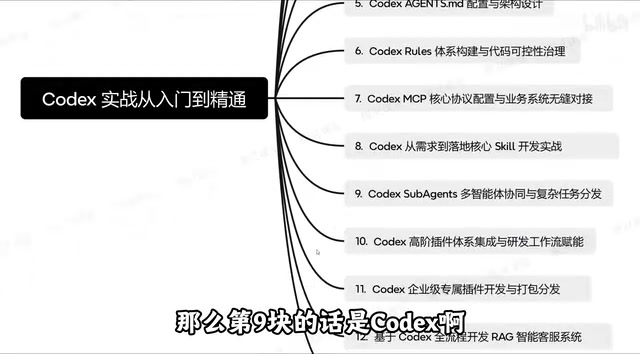
Sabor Agents Architecture Analysis
When facing complex enterprise-level development tasks, a single Agent often falls short. Codex's Sabor Agents mechanism supports multi-agent collaboration, with each Agent responsible for a specific functional domain.
Multi-Agent Systems (MAS) are a classic research area in artificial intelligence, with the core idea originating from distributed AI: decomposing a complex problem into multiple sub-problems, handled by specialized agents separately, then integrating results through coordination mechanisms. In software engineering, this philosophy aligns closely with microservices architecture design — each Agent is like an independent microservice with clear responsibility boundaries and interface contracts. The innovation of the Sabor Agents architecture lies in bringing this multi-agent collaboration pattern from academic research into actual software development workflows, transforming AI from a single-point tool into a "virtual development team" capable of division of labor and collaboration.
The functional division of each Agent is as follows:
- Architecture Agent: Responsible for system design and module partitioning
- Coding Agent: Responsible for specific feature implementation
- Testing Agent: Responsible for test case writing and quality assurance
- Documentation Agent: Responsible for API documentation and comment generation
Task Distribution Strategy
Distributing complex tasks requires considering dependency relationships, priorities, and resource constraints. A well-designed distribution strategy enables parallel development, significantly shortening project delivery cycles. In practice, the core challenges of task orchestration include: information synchronization between Agents (e.g., the Coding Agent needs to wait for the Architecture Agent to complete module partitioning before starting work), conflict resolution (merge strategies when multiple Agents modify the same file simultaneously), and quality feedback loops (how defects discovered by the Testing Agent are efficiently relayed back to the Coding Agent for fixes). Solutions to these problems directly determine the actual efficiency of multi-agent collaboration.
Enterprise Applications: Scale Development and RAG Intelligent Customer Service in Practice
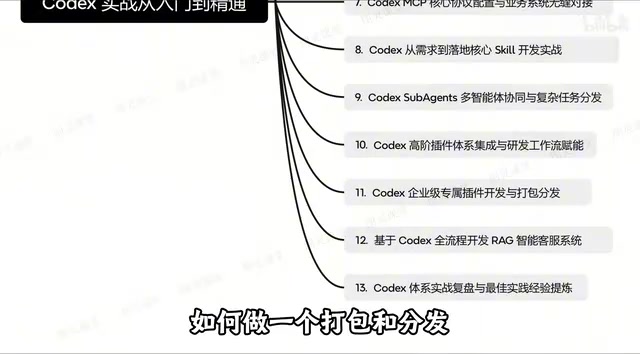
Scale Development Practice
From requirements analysis to final deployment, the workflow for developing enterprise-level Scale applications with Codex includes: requirements decomposition → architecture design → module development → integration testing → deployment. Each stage has corresponding Codex best practices.
RAG Intelligent Customer Service System Development
The tutorial's ultimate hands-on project is building a RAG (Retrieval-Augmented Generation) intelligent customer service system from scratch.
RAG (Retrieval-Augmented Generation) is one of the most mainstream technical architectures in enterprise AI applications today. Its core principle combines traditional information retrieval systems with the generative capabilities of large language models: when a user asks a question, the system first retrieves the most relevant text fragments from an external knowledge base (such as enterprise documents, FAQ databases, product manuals), then injects these fragments as context into the large language model's Prompt, where the model generates a final answer based on the retrieved factual information. Compared to purely generative approaches, RAG's core advantage is significantly reducing the "Hallucination" problem — the model no longer relies entirely on knowledge memorized during training but reasons based on reliably retrieved real-time information, which is crucial for enterprise customer service scenarios requiring high accuracy. A typical RAG system architecture contains three core components: Vector Database (such as Pinecone, Milvus, Weaviate, for storing semantic vector representations of documents), Embedding Model (converting text into high-dimensional vectors to support semantic retrieval), and Generation Model (generating natural language answers based on retrieval results).
This project comprehensively applies all the previously covered skills:
- Using agents.md to define project specifications
- Connecting to knowledge bases via MCP
- Multi-Agent collaboration to complete front-end and back-end development
- Rules system to ensure code quality
- Plugin system to extend functional boundaries
Plugin Development and Distribution
Customized enterprise plugin development is an important direction for advanced Codex applications. After development, packaging standards and distribution mechanisms also need to be considered so that plugins can be reused within teams or across broader contexts. The maturity of the plugin ecosystem often determines the long-term vitality of an AI development tool — just as VS Code's success is largely attributed to its rich extension marketplace, Codex's plugin system is also evolving toward standardization and composability.
Summary and Best Practices
The key to truly integrating Codex into your work lies in establishing a systematic usage methodology:
- Configuration First: Invest time in writing good agents.md and Rules — subsequent development will be twice as effective with half the effort
- Gradual Adoption: Start with simple tasks and progressively expand to complex scenarios
- Continuous Optimization: Continuously adjust configurations and Prompt strategies based on actual output quality
- Team Collaboration: Include Codex configurations in version control to ensure team consistency
The value of AI programming tools lies not in how many lines of code they can generate, but in how much they can improve the efficiency and quality of the entire R&D system. Mastering the engineering-oriented use of Codex is the core competitive advantage for developers in the AI era. From a broader perspective, the AI-assisted programming trend represented by Codex is driving software engineering's transition from the "manual coding" era to the "human-AI collaborative programming" era. In this new paradigm, a developer's core value is no longer just the ability to write code, but a comprehensive demonstration of architectural thinking, requirements understanding, quality judgment, and AI collaboration skills. Developers who can skillfully leverage AI tools and establish efficient human-AI collaborative workflows will hold a significant advantage in future technological competition.
Key Takeaways
Related articles

Alibaba Launches Happy Shrimp: AI-Powered One-Click Complete Song Generation
Alibaba launches Happy Shrimp, an AI music generation tool that creates complete songs with lyrics, melody, arrangement, and vocals from natural language descriptions. In-depth analysis of its core features, differentiation from competitors like Suno, and industry impact.
GPT Sol Ultra vs Grok 4.6: Real-World Task Completion Benchmark in Reasoning Mode
Developer benchmark reveals GPT Sol Ultra completes draw.io scientific diagrams in one iteration while Grok 4.6 fails to converge despite maximum reasoning mode, exposing that reasoning depth ≠ task delivery capability.

OpenAI Authorship Dispute: The Battle Over Academic Boundaries in the AI Era
OpenAI disputes authorship with mathematician Tristan Buckmaster over Navier-Stokes research, raising ethical questions about AI involvement in science.