Codex in Practice: A Complete Learning Path from Installation to Enterprise-Grade Agent Systems

A complete Codex learning path from core concepts to enterprise-grade multi-agent and RAG system deployment.
This article maps out a complete learning path for Codex based on a Bilibili course outline, from beginner to enterprise deployment. It argues that Codex's real value lies in embedding AI coding into engineering workflows. The progression covers core design philosophy, environment setup, CLI interaction conventions, slash commands, AGENTS.md configuration, MCP protocol integration, Sub Agents multi-agent collaboration, and a capstone RAG customer service project. The article also notes that the course overview is light on technical detail and that claims like "double your salary" are marketing language — real skill growth requires hands-on practice.
How to Learn Codex Systematically
Codex tutorials on Bilibili are growing in number, but most stay at the shallow "install and you're good to go" level of demonstration. A truly valuable learning path should start from the tool's core capabilities and extend all the way to enterprise-level project deployment. Based on the outline of a Codex hands-on course from Bilibili, this article maps out a relatively complete progression — helping developers who want to go deep build a solid conceptual framework.
It's worth noting that the source material is essentially a course overview, focused on presenting "what to learn and in what order" rather than technical details. This article leans more toward a learning map than an operational manual.
Understanding Codex's Design Philosophy Through Its Core Capabilities
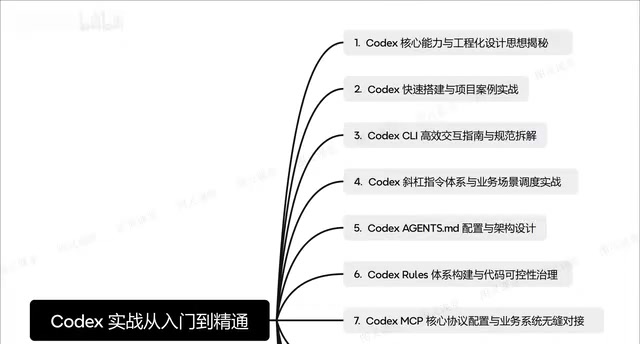
The course opens by emphasizing Codex's core capabilities and its engineering-oriented design philosophy. This point deserves to stand on its own: many people treat Codex as "a chat box that can write code," but its real value lies in embedding AI coding into an engineered workflow.
Understanding the design philosophy means getting clear on the role Codex plays in project development — it doesn't replace developers, but rather handles multiple stages from requirements decomposition and code generation to workflow integration. Approaching later topics like CLI interaction, slash commands, and the plugin ecosystem with this perspective prevents them from feeling scattered.
Environment Setup and Building a Project from Scratch
The second section gets hands-on: quickly installing Codex, setting up the development environment, and demonstrating through a project case how to take something from zero to one. This is the most critical step in the beginner phase, because environment configuration is often the first hurdle where newcomers give up.
The course then covers a guide to efficient Codex CLI interaction and usage conventions. The quality of CLI interaction directly determines the user experience — how to write prompts, how to provide context, how to define conventions. These details determine the consistency of AI output. Treating interaction as a skill that requires deliberate practice rather than casual conversation is the dividing line between beginner and intermediate users.
Slash Commands and the AGENTS.md Configuration System
The middle section of the course focuses on Codex's built-in slash command system and how it integrates with specific business scenarios. Slash commands essentially solidify common operations into reusable commands — a practical tool for boosting development efficiency.
Next comes AGENTS.md configuration and architecture design. This is an increasingly important piece of the AI coding tool ecosystem: AGENTS.md is essentially an "instruction manual" that defines project rules, constraints, and context for the AI. Writing it well is what allows the AI to understand project structure and follow team conventions. The course's emphasis on "how to write a good AGENTS.md" signals that it has moved from an optional extra to a necessary capability for engineering-grade deployment.
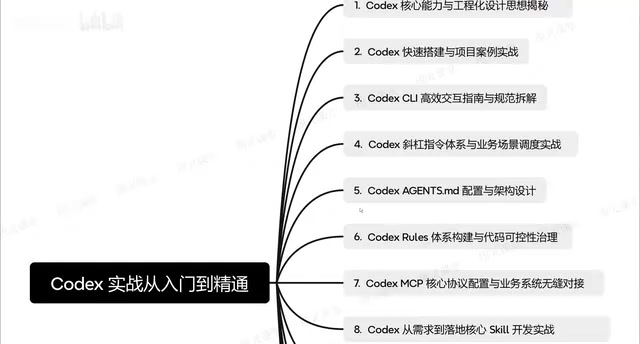
The course also covers building Codex's rule system and governing code controllability — both ultimately solving the same problem: how to make AI-generated code controllable, maintainable, and aligned with team standards, rather than producing a pile of hard-to-manage "black box code."
AGENTS.md is a project-level configuration file introduced by OpenAI Codex and some other AI coding tools, functioning like a "project constitution" for the AI. Typically placed in the root directory of a code repository, it uses natural language to describe the project's tech stack, directory conventions, code style requirements, prohibited operations, and more. When an AI Agent executes tasks within the project, it reads the instructions in AGENTS.md first, ensuring that generated code aligns with the team's existing standards. The significance of this mechanism is that it transforms "prompt engineering" from temporary, per-conversation input into a version-controllable, team-shareable engineering artifact. As AI coding tools penetrate deeper into team collaboration, maintaining a well-written AGENTS.md is gradually becoming part of engineering standards — on par with configuration files like .eslintrc and .prettierrc.
MCP Protocol and Business System Integration
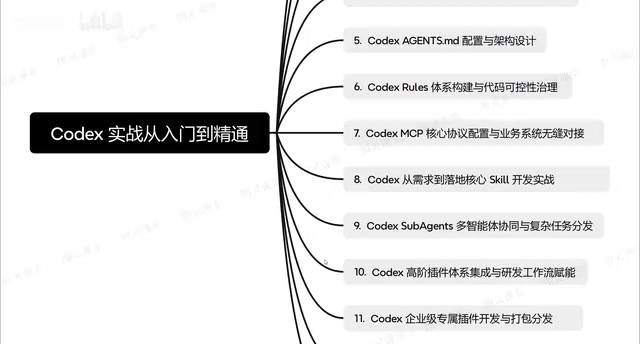
The latter half of the course gets more technically demanding: core MCP protocol configuration for Codex, and how to use it to transform business systems and achieve seamless integration. MCP (Model Context Protocol) has been gaining significant traction in the AI tool ecosystem, enabling AI to connect to external data sources and tools in a standardized way.
For enterprises, MCP's significance lies in breaking down the barriers between AI and existing systems. Mastering this section is what allows you to upgrade Codex from a personal productivity tool to team-level infrastructure.
MCP (Model Context Protocol) is a standardized protocol proposed and open-sourced by Anthropic in late 2024, designed to solve the fragmentation problem in integrating large language models with external tools and data sources. Before MCP, every AI application that needed to connect to a database, file system, or third-party API required a custom adapter — costly to build and hard to reuse. MCP defines unified interface specifications for "tool calls" and "resource access," allowing any compliant client (such as Codex CLI) to directly invoke registered MCP Servers without redundant integration work. For enterprise scenarios, this means internal knowledge bases, code repositories, and project management systems can be packaged as MCP Servers, letting AI coding tools query business context in real time during code generation — greatly improving the relevance and accuracy of the output.
Enterprise Deployment: From Requirements to Multi-Agent Collaboration
The course then steps up to enterprise-grade practice: how to build scalable systems starting from requirements, and how to develop enterprise applications. The course specifically highlights Sub Agents multi-agent collaboration for distributing complex tasks. This represents a frontier direction in AI coding — tasks too complex for a single Agent are completed through division of labor across multiple agents.
Advanced plugin integration, custom enterprise plugin development, and plugin packaging and distribution form a complete closed loop for workflow empowerment. These topics extend Codex's capabilities from "writing code" to "integrating into the R&D workflow," making them especially relevant for team collaboration scenarios.
RAG Intelligent Customer Service System and Project Retrospective
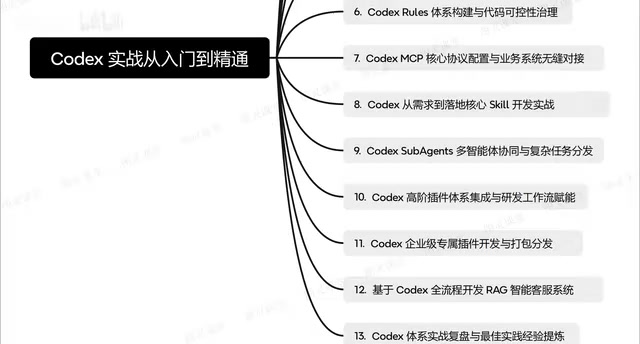
The capstone project is developing a RAG-based intelligent customer service system using the full Codex workflow, followed by a systematic retrospective and distillation of best practices. Choosing a RAG customer service system as the comprehensive project is quite fitting: it simultaneously tests data ingestion, retrieval augmentation, Agent coordination, and engineering deployment — a genuine proving ground for everything covered before.
RAG (Retrieval-Augmented Generation) is one of the most mainstream technical approaches for enterprise deployment of large model applications. The core idea is: when a user asks a question, first retrieve the most relevant segments from an external knowledge base (vector databases, document libraries, etc.), then feed the retrieved results along with the original question into the large model to generate a response. This overcomes the limitation of the model's training data cutoff date and avoids the high cost of direct fine-tuning. Intelligent customer service is the most typical RAG application scenario — enterprises vectorize product manuals, FAQs, and ticket records into a database, allowing the system to retrieve and generate precise answers in real time when customers ask questions. Using this as the capstone project means learners must integrate data preprocessing, vector retrieval, Agent scheduling, and engineering deployment — a horizontal validation of all knowledge points across the entire course.
The Value and Limitations of This Learning Map
Overall, the value of this outline lies in providing a relatively complete progression path: core capabilities → environment setup → interaction conventions → configuration governance → protocol integration → enterprise deployment → comprehensive project. This structure, moving from shallow to deep, is a useful reference for developers who want to systematically master Codex.
That said, it's worth being objective: as a promotional course overview, it offers limited depth on specific technical implementations, and phrases like "double your salary" in the title are largely marketing language. Learners should view such claims with appropriate skepticism. Real capability growth still depends on hands-on practice and project experience — not just finishing a course.
Related articles

Random Pruning of the DPO Computation Graph: 1.4x Training Speedup and Lower Peak Memory
DPO training too slow and memory-hungry? This paper proposes a random pruning framework for the DPO computation graph, sampling independently across position, sequence, and branch dimensions; branch pruning achieves a 1.426x step-time speedup and cuts training time by about 30%, with in-depth attribution of memory and time gains.

Why Does JEPA Underperform MLM in Longitudinal EHR Representation Learning?
New study compares JEPA and MLM for longitudinal EHR representation learning on MIMIC-IV: three JEPA variants train stably without collapse but underperform MLM; target size, not heterogeneity, drives prediction error.

Transfer Learning + Visible Light Communication: A New Approach to Energy-Efficient Indoor Positioning
A study proposes a transfer learning-based visible light communication indoor positioning method, achieving 47% accuracy improvement on the BOSCH factory dataset, 67.5% model efficiency under high noise, and introducing the ME composite metric for energy-efficient positioning in energy-constrained industrial IoT scenarios.