Codex in Practice: From Installation and Configuration to Multi-Agent Collaboration
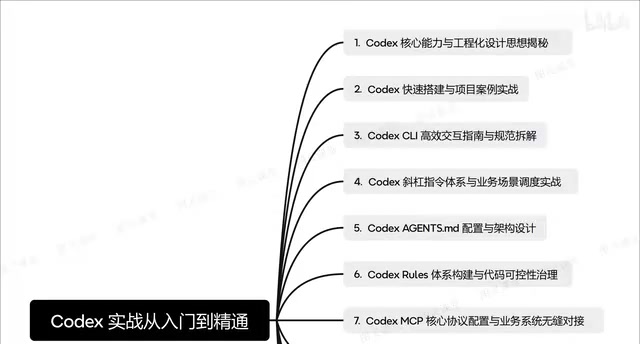
Bilibili Codex course overview: from installation to agents.md, MCP, multi-agent, and enterprise plugins
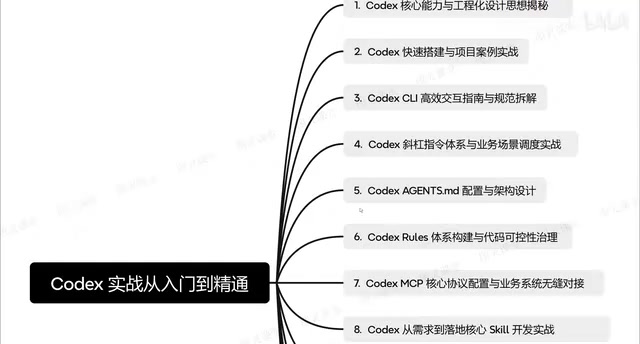
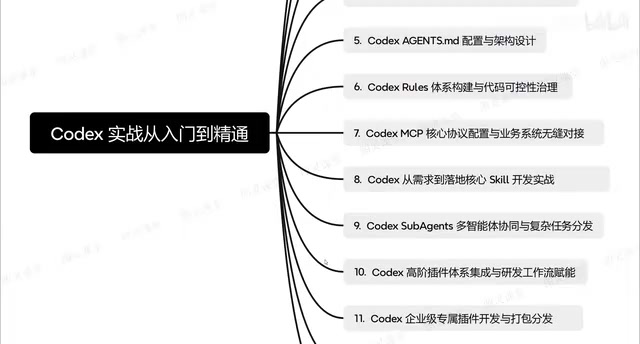
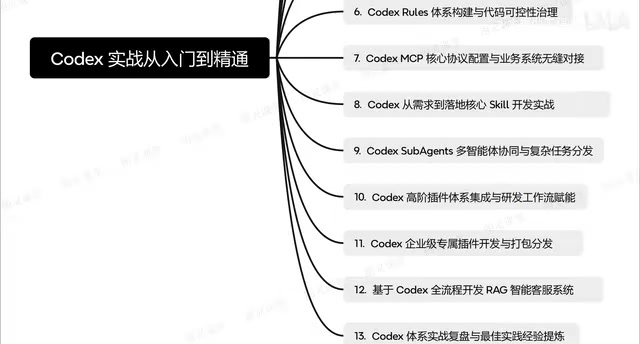
This article is based on the overview of a Codex hands-on course on Bilibili, outlining the learning path for AI coding assistants from installation to engineered collaboration. The course covers Codex core capabilities and design philosophy, quick installation, agents.md context configuration, CLI interaction and slash commands, MCP protocol integration, enterprise-grade scale building, Subagents multi-agent collaboration, as well as plugin customization/distribution and an intelligent customer service system practical project. The author points out that context file design, command workflow-ization, and standardized tool integration are key to deployment, while pluginization and multi-agent are relatively rare aspects of the course. Overall, the content is better suited for developers with engineering experience; beginners need to supplement their understanding of project structure. The depth of explanation is still subject to the actual course.
AI coding assistants are evolving from "assisted completion" toward "engineered collaboration." A Codex hands-on course on Bilibili aims to cover the entire journey from installation to enterprise-grade deployment through a complete learning path. Although the course itself leans toward an outline-style overview, the modules it lists happen to map out the key stages that any AI coding tool must go through when being deployed today.
1. What Problem Does Codex Actually Solve?
The course opens by putting Codex's core capabilities and engineering design philosophy front and center, and that ordering is worth noting. Many tutorials jump straight into shortcuts and prompts, but the real value of a tool like Codex isn't the quality of a single code generation—it's whether it can be embedded into an existing engineering workflow.
Looking at the course outline, the subsequent modules on CLI interaction standards, the slash command system, agents.md configuration, and MCP protocol integration all essentially answer the same question: how do you get an AI assistant to understand a project's context and constraints, rather than starting from scratch guessing every conversation? According to the Bilibili course description, this content covers the full development flow from project analysis to code generation and error troubleshooting, though the specific implementation details are not expanded upon in the overview.
Codex originally referred to a code generation model that OpenAI fine-tuned from GPT-3 and trained on public GitHub code. It was released as an API in 2021 and served as an important foundation for GitHub Copilot's early capabilities. OpenAI later phased out standalone service for that model series, folding the relevant capabilities into newer general-purpose models. Therefore, "Codex" as mentioned in this article should be understood more as a class of AI coding assistants/agents with code understanding and execution capabilities, rather than a fixed model. Such tools typically support reading and writing files, running commands, executing tests from the local command line, and collaborating with toolchains like Git and package managers. Understanding this background helps distinguish "code completion" from "agentic programming": the former only predicts the next chunk of code, while the latter must plan multi-step operations within a project context and be accountable for the results.
2. Installation and Configuration Are Just the Start—Context Is the Hard Part
The second section covers quickly installing Codex and getting project development running. This part directly helps beginners, but what really determines the experience is the later agents.md configuration section.
The course lists agents.md architecture design as a standalone module, showing the instructor recognizes the importance of context files. agents.md is essentially a behavioral contract for the AI assistant—project structure, coding standards, prohibited operations, common commands. The clearer this information is written, the lower the probability the assistant goes off track in subsequent tasks. The course mentions it will cover "how to write a good agents.md," which is one of the more practical parts of the entire learning path.
agents.md can be understood as an "AI assistant manual" placed in the project repository. It is usually written in Markdown and describes project structure, tech stack, build and test commands, code style, directory conventions, files or branches that must not be modified, commit standards, and so on. Mainstream AI coding tools will prioritize reading this file and inject it as part of the system prompt into the conversation, so the assistant automatically receives project constraints at the start of each task, reducing repeated explanations and accidental code changes. The key to writing a good agents.md is to be specific, executable, and verifiable: commands should be directly copy-pasteable and runnable, and rules should state "what to do" rather than abstract principles; it should also be continuously updated as the project evolves to avoid documentation drifting from the real engineering reality. It doesn't guarantee the model will comply, but it can significantly reduce the probability of going off track.
3. CLI and Slash Commands: Turning Interaction into Workflow
The third and fourth sections focus on the Codex CLI efficient interaction guide and the built-in slash command system. This part is most useful for developers who use it most frequently day to day.
The advantage of command-line interaction is that it can be chained with other toolchains, while slash commands solidify common operations to reduce repetitive input. The course mentions integrating slash commands with business scenarios, which is the right direction—simply memorizing a list of commands isn't very meaningful; the key is knowing which command to use in which scenario and what tasks can be accomplished by combining commands. However, the course overview doesn't provide specific command examples or scenario cases, so the actual value depends on the main content.
4. MCP and Multi-Agent: Extending Toward Engineered Collaboration
The latter half of the course covers several more architecture-oriented topics: MCP core protocol configuration, building enterprise-grade scale (presumably scaffolding or service framework), Codex Subagents multi-agent collaboration, and complex task distribution.
The value of the MCP protocol lies in enabling AI assistants to access external tools and data sources in a standardized way. The course mentions how to transform business systems for seamless integration, which is a key issue at the deployment level. Multi-agent collaboration points toward more complex task decomposition—splitting a large task among multiple agents with different responsibilities, then having a scheduling layer aggregate the results. This content is relatively rare in current teaching materials for AI coding tools, and if explained in enough detail, it would be a differentiating highlight of this course.
MCP (Model Context Protocol) is a protocol proposed and open-sourced by Anthropic at the end of 2024 to standardize connections between AI applications and external tools and data sources. It uses a client-server architecture: AI applications that support MCP act as clients, connecting to MCP servers that provide capabilities such as file systems, databases, APIs, and internal systems, with servers declaring available tools and resources in a unified format. Its value lies in turning "write a separate plugin for each tool" into "integrate according to the protocol," reducing integration costs and improving reusability. "Transforming business systems for seamless integration" in the article usually refers to writing MCP servers for internal services, allowing the assistant to query data or trigger operations in a controlled manner. Note that MCP only specifies interfaces and capability descriptions; permission control, auditing, and confirmation of sensitive operations still need to be designed on the engineering side.
Subagents refers to a collaboration pattern where a main agent splits a complex task into several subtasks, dispatches them to subagents with different responsibilities, contexts, or tool permissions for parallel or sequential execution, and finally has the main agent aggregate the results. A common approach is to set independent prompts and tool sets for subagents, such as "code retrieval agent," "test fix agent," and "documentation agent," to reduce the context burden on a single agent and minimize mutual interference. From an engineering perspective, attention must be paid to task boundary division, result merging and conflict handling, failure retries, and cost control. It is a different layer of mechanism from MCP: MCP solves "how to connect external capabilities," while multi-agent solves "how to organize multiple executors," and the two can be combined.
5. Plugin System and Practical Review
The final sections of the course cover custom development, packaging, and distribution of enterprise-exclusive plugins, as well as a from-scratch intelligent customer service system practical project. Pluginization is an inevitable path for AI assistants moving toward team collaboration—only by packaging team-internal standards, tools, and templates into plugins can all members use consistent assistant capabilities.
The course ends with a project review and extraction of best practices, which is a reasonable way to wrap up. Learning AI coding tools is never about memorizing feature lists, but about repeatedly adjusting context, commands, and processes in real projects, and ultimately distilling a set of usage patterns that suit your own team.
Who Is This Course For?
Judging from the outline structure, this content is better suited for developers who already have some development experience and want to bring AI assistants into team workflows, rather than complete beginners. Beginners can follow along to complete installation and simple code generation, but modules like agents.md design, MCP integration, and multi-agent scheduling require readers to have a basic understanding of project engineering structure.
It should be noted that the above analysis is based on the course overview content, and the depth of explanation and the proportion of hands-on practice for each module still need to be judged based on the actual course.
Related articles
Claude Code Installation and Model Switching Guide for Users in China
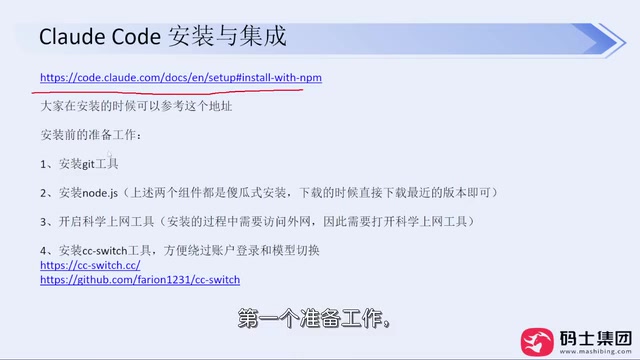
How can developers in China install Claude Code reliably? This article compiles a Bilibili creator's hands-on solution: install via NPM, skip official login, use CC Switch to configure API Keys and freely switch between DeepSeek, Kimi, and other models to avoid account bans.
AI Supply Chain Security: What Canary Tokens Reveal
Starting from a Hacker News discussion, this article analyzes the role of canary tokens in AI supply chain security: how they detect abnormal access to model weights, training data, and credentials, as well as coverage blind spots and cost constraints during implementation.

Backblaze Privacy Policy Sparks Debate: Where Are the Boundaries of Cloud Storage Privacy?
Backblaze's privacy policy and collection notice sparked debate on Hacker News with 237 points and 87 comments. This analysis examines cloud storage privacy boundaries, policy readability, and privacy evaluation points for developers choosing services.