Codex Reset Rolls Out, Gemini 4 Hydrogen Released: AI Daily Brief

OpenAI starts Codex quota reset, Google releases Gemini 4 Hydrogen, Doubao Work integrates three third-party models.
Today's AI product updates center on two threads: compute quotas and model choice. OpenAI's Codex reserve reset has begun and is rolling into user accounts in batches, with some users already receiving reset cards; ChatGPT's Dot assistant also got an experience-layer polish. Google officially released Gemini 4 Hydrogen across four entry points, 2.5x faster than Gemini 3.8 Flash at the default high thinking tier, with API pricing at $1.5 per million input tokens and $7.5 per million output tokens; however, Artificial Analysis's Intelligence Index shows it scoring 54 at its highest thinking tier, just below Cloud Sonnet 5.5 and GPT 6.1 Sol at 55. Domestically, Doubao Work integrated Kimi K 3.1 Pro, GLM 5.3, and DeepSeek V 4.1 Flash, using quota multipliers to let users choose models by cost. The Chrome sidebar lets Gemini ask questions directly with the current webpage as context.
OpenAI's Codex quota reset is finally landing, Google has thrown down a new card with Gemini 4 Hydrogen, and Doubao Work has integrated three third-party models in one go. Today's updates center on two keywords: "compute quota" and "model choice."
Codex Reset Kicks Off, Users Receive Quota Cards in Waves
OpenAI's Teebo confirmed that the Codex reserve reset has begun and will roll into user accounts in batches. Users in the Chinese VR EX community have already posted about receiving reset cards, while others report they haven't arrived yet — the batch rollout means there's a timing gap between accounts, and not having received one yet doesn't mean you've been missed.
In the same update, Teebo also mentioned that ChatGPT's Dot assistant received an experience-layer update: faster replies, less jargon-stacking, and improved adherence to custom instructions. Changes like these don't touch the model's underlying capabilities, but they directly affect how smooth daily use feels.

Gemini 4 Hydrogen Released, 2.5x Faster Than Gemini 3.8 Flash
Google officially released Gemini 4 Hydrogen and simultaneously brought the model to four entry points: the Gemini app, Google Search, AI Studio, and the Gemini API. The headline number from the official announcement: at the default high thinking tier, Hydrogen completes tasks 2.5x faster than Gemini 3.8 Flash.
On pricing, the API costs $1.5 per million input tokens and $7.5 per million output tokens.
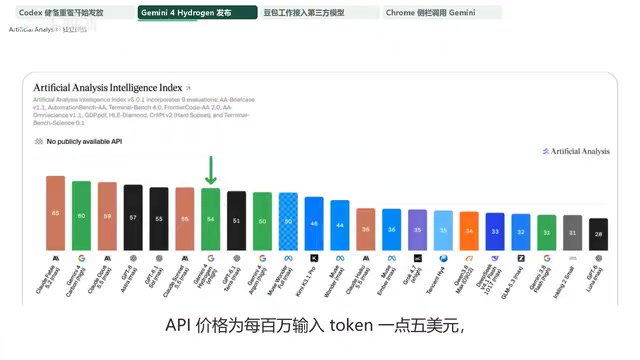
Independent evaluator Artificial Analysis's Intelligence Index offers a more sober reference point: Hydrogen scores 54 at its highest thinking tier, while Cloud Sonnet 5.5 and GPT 6.1 Sol both score 55. The speed advantage is clear, but on the composite intelligence dimension, Hydrogen sits roughly in the same tier as the top competitors — just one point lower. In other words, this is a model that trades on speed for specific use cases, suited to tasks sensitive to response latency rather than pure benchmark-chasing scenarios.
Thinking Budget is an important tuning parameter in large model inference. It controls how many internal reasoning tokens the model can consume to "think" before generating its final answer — for multi-step reasoning tasks like math, code, or complex analysis, a higher thinking tier usually yields more accurate answers, at the cost of increased latency and expense. Gemini 4 Hydrogen's claimed 2.5x speed advantage is achieved at the "default high thinking tier," meaning it compresses time while maintaining relatively deep reasoning, rather than trading away thinking quality for speed. Understanding this is crucial: different vendors define "default tier" inconsistently, so when comparing speed head-to-head, you must confirm both sides' thinking budgets are aligned — otherwise the numbers can easily become misleading.
The Artificial Analysis Intelligence Index is a model capability scoring system maintained by third-party evaluator Artificial Analysis. It scores mainstream large models across a set of standardized benchmark tasks (covering knowledge Q&A, reasoning, math, coding, and more) and presents them as a single index for easy horizontal comparison. The index is characterized by frequent updates and broad model coverage, and is often used to quickly gauge where a new model stands on the "composite intelligence" dimension. Note, however, that a single index masks differences in model strengths across task types — Hydrogen scoring 54 versus competitors' 55, a one-point gap, doesn't mean the two perform equivalently in all scenarios; the gap on specific tasks could be far larger than this total score difference.
Doubao Work Integrates Kimi, GLM, DeepSeek — Models as a Shelf
On the domestic front, Doubao Work announced on November 12 that it has integrated third-party models including Kimi K 3.1 Pro, GLM 5.3, and DeepSeekAd V 4.1 Flash. The model selection interface displays quota multipliers, with discounts on some models during specified time windows and free small tasks; new users logging in on desktop can also claim 30 days of subscription benefits.
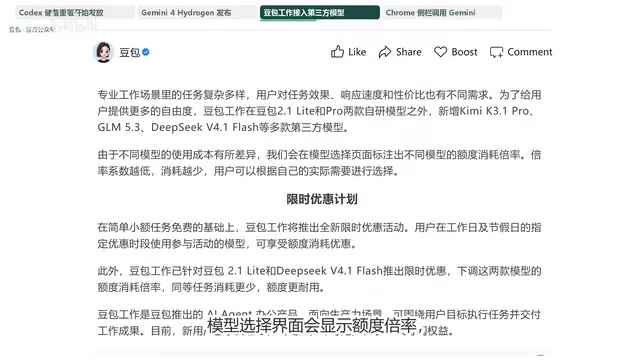
The interesting part of this move isn't that a few more models were added, but the "quota multiplier" design — it puts the invocation cost of different models directly in front of users, letting them choose models by task value rather than defaulting to the most expensive one. For users who want to compare how the same task performs across different models, Doubao Work provides a ready-made entry point and current quota lookup. The platform shifting from a "single-model outlet" to a "model shelf" is still uncommon among domestic products.
Quota multiplier is a billing design that makes model invocation costs explicit: the platform sets a relative multiplier for each model, and invocations deduct from the user's quota at "base quota × multiplier." A higher multiplier means each invocation of that model is "more expensive," while a lower multiplier is "cheaper." The value of this mechanism is that it surfaces cost differences that were previously hidden in the backend, pushing users to choose models based on the actual value of the task — low-multiplier models for simple tasks, high-multiplier models only for complex ones. Compared to flat pricing or per-token billing, the multiplier system is more intuitive, but it also requires users to have a basic sense of task difficulty, or they may easily rack up unnecessary consumption on high-multiplier models.
Chrome Sidebar: Gemini Enters the Browsing Context
Google also published a guide on using Gemini in Chrome: click the Gemini icon in the browser toolbar to open the sidebar and ask questions about the current webpage — summarizing long reports, comparing product details, or explaining complex content — all without leaving the page you're browsing.

Putting AI in a sidebar with the current webpage as context is essentially about capturing the "first reaction while reading" — in the past, users would copy content into a chat window; now the asking action is compressed to a single click. The frequency lift from entry points like this is often more direct than another tier of model improvement.
Browsing Context refers to an AI assistant being able to directly read the content of the current webpage as background for a question, without the user manually copying and pasting. Technically, this typically involves a browser extension or native integration capturing the page's DOM text and passing it to the model as part of the prompt. Compared to copying content into a separate chat window, browsing context has the advantage of preserving page structure information (headings, lists, tables) and compressing the asking action to a single click. But it also raises privacy and permission questions: which page content gets read, whether it's uploaded to servers, and whether users can authorize page by page — all questions this kind of entry point design must answer.
Today's Observation
Three developments point in the same direction: the competitive focus of AI products is shifting from "how strong is the model" to "how are quotas allocated, how are models chosen, where do entry points live." The Codex reset is a quota question, Doubao's multi-model shelf is a choice question, and the Chrome sidebar is an entry-point question. Model capabilities are still improving, but what increasingly determines user retention is these product-layer details.
One-line Summary
OpenAI kicks off Codex quota reset, Google releases Gemini 4 Hydrogen, Doubao Work integrates three third-party models.
Related articles

OMLX 0.7.1 Integrates Splash: Major Speedup for MLX Model Inference on Mac
OMLX 0.7.1 adds Splash as an external engine, letting standard MLX models (Qwen 3.6 35B) match Splash custom setups at 92.8 tokens/s. Setup, D-Flash2 requirements, and M1/M2 compatibility explained.

Running Uncensored AI Locally on Your Phone: LFM3 Hands-On Test and Guide
Learn how to run Liquid AI's LFM3 1.7B uncensored model locally on iPhone and Android—no GPU or network needed. Includes On Device LLM and Layla steps, speed tests, and privacy benefits.

Claude Launches Collaborative Sheets and Whiteboards, Taking On Microsoft and Google Directly
Anthropic rolls out beta Claude Sheets and Whiteboards to paid users, enabling one-prompt spreadsheets with formulas and turning verbal plans into collaborative boards—taking on Microsoft and Google directly.