Running Uncensored AI Locally on Your Phone: LFM3 Hands-On Test and Guide

Liquid AI's LFM3 1.7B open-source uncensored multimodal model runs locally on phones without a high-end GPU.
The article introduces LFM3, an open-source multimodal model with just 1.7B parameters from Liquid AI that runs locally on phones or low-end computers without an expensive GPU or cloud server. The author argues that being uncensored and local delivers zero restrictions and zero data leakage. iPhone users can use the On Device LLM app and Android users the Layla app to download Atomic Chat's GGUF version from Hugging Face. In testing on an iPhone 16 Pro Max, generation speed was about 26 tokens/second, and iPhone 11 and newer models can run it. The article also notes that the 1.7B model has limited capabilities, making it suitable as a private lightweight assistant but difficult to fully replace large cloud models.
Uncensored AI models are rapidly growing in popularity, but there has always been a barrier: running them locally typically requires a powerful GPU. That's now changing. According to a YouTube creator, Liquid AI's LFM3 series includes a small model with just 1.7B parameters that can run directly on a phone or low-end computer—no expensive graphics card, no cloud server, and not even an internet connection required.
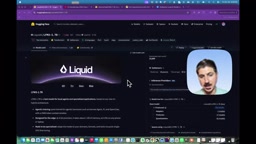
Why Uncensored and Local Running Matter
"Uncensored AI" refers to models that don't give refusal-style responses to user requests. The video's author argues that mainstream models like ChatGPT, Claude, Gemini, and Grok impose various restrictions on information output, many of which he considers overly broad and disruptive to normal use.
Another benefit of running locally is privacy. The author emphasizes that using cloud models means data is sent to big companies' servers, and past lawsuits have proven that this data gets stored. When running locally, data never leaves the device, works offline, and there's no concern about data leaks.
Together, these two points form the core appeal of uncensored local AI: zero restrictions, zero data leakage, and availability at any time.
LFM3 1.7B: A Small Multimodal Model
The model the author focuses on is LFM3 1.7B, part of the LFM3 series released by Liquid AI. The series consists of multimodal open-source models that can process image, video, and audio input, and also support voice interaction.

From the video demo, the model can identify buildings in a street scene and answer related questions, and it also has the ability to act as an agent executing tasks. Being open source means users can download and use it for free. The author specifically notes that the model has very low hardware requirements: a low-end computer with unified memory or a GPU with 6GB of VRAM can run it well, and phones are equally capable.
GGUF format: GGUF (GPT-Generated Unified Format) is a model file format introduced by the llama.cpp project, designed specifically for efficiently running large language models on consumer-grade hardware. It supports storing model weights at different precisions (such as Q4_K_M, Q5_K_M, etc.), thereby greatly compressing model size and reducing memory usage while preserving output quality as much as possible. GGUF files typically contain model weights, tokenizer configuration, and metadata, and can be loaded directly by various inference frameworks (such as llama.cpp, Ollama, LM Studio). The "Atomic Chat LFM3 1.7B uncensored GGUF" mentioned in the article refers to an uncensored version fine-tuned by the Atomic Chat community and converted to GGUF format, making it easy to download and run directly in phone apps (such as On Device LLM).
Unified Memory: Unified Memory is a memory architecture used in Apple's M-series chips and some mobile SoCs, where the CPU and GPU share the same physical memory pool without needing to copy data between them. This design is especially advantageous for running large models locally: model weights only need to be loaded once, and both CPU and GPU can access them directly, reducing data transfer overhead and VRAM bottlenecks. Therefore, low-end computers equipped with unified memory (such as an 8GB MacBook Air) can also run 1.7B-class models, whereas traditional discrete GPU setups require enough VRAM to hold the model weights. "Low-end computers with unified memory" in the article refers to such devices.
Deployment Steps for iPhone and Android
The iPhone process is fairly straightforward. First, search for and install the "On Device LLM" app from the App Store. After opening the app, first select any model to complete initial setup, then go to the model selection screen, search for "Atomic Chat LFM3 1.7B uncensored GGUF" via "Search online for Hugging Face" and download it. Once the download is complete, return to the assistant screen and select that model to start chatting.
Android users need to use a different app called Layla, and the subsequent steps are basically the same as on iPhone. In the video, the author mentions that although Atomic Chat has its own app, it doesn't work properly with this model, so he switched to On Device LLM to complete the demo.
The app also offers other locally runnable model options, such as Qwen 3 1.7B and Qwen 3 4B, which users can choose based on their device's performance.
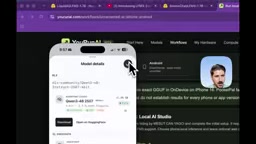
Hugging Face: Hugging Face is an open-source community platform for machine learning models and datasets, hosting hundreds of thousands of pretrained models covering text, image, audio, and other modalities. Users can search for and download model files through the platform, and view model cards to learn about their purpose, license, and limitations. The "Search online for Hugging Face" feature built into the On Device LLM app allows users to search for GGUF models on Hugging Face directly within the app and download them locally, eliminating the need to manually transfer files. The LFM3 1.7B uncensored version released by Atomic Chat is hosted on this platform.
Real-World Performance and User Experience
The author tested the model on an iPhone 16 Pro Max and got a generation speed of about 26 tokens per second, which he described as "quite fast." He believes that iPhone 11 and newer models can run this model well.
Beyond text chat, the app also supports uploading images and asking the model questions about them, similar to how ChatGPT works. The author says he has often sent data he didn't want shared to ChatGPT in the past and was unhappy about it, and the local uncensored model solves exactly this pain point; he plans to use it daily on his phone.
Note that the performance data shown in the video comes from a single device and a single model configuration, and actual performance will vary across different phones. Users who want to reproduce the results can visit the guide page mentioned by the author and follow the steps.
Editorial View
The fact that small local models can run smoothly on phones reflects a clear trend: advances in model compression and on-device inference are pushing tasks that once required cloud computing power down to personal devices. For privacy-sensitive users or those with special content needs, this offers a new option.
But it's also important to recognize that 1.7B-class models can't match large cloud models in knowledge depth and reasoning ability, and "uncensored" also means output quality is entirely up to the user to judge. Treating it as a private, offline, unrestricted lightweight assistant is reasonable; expecting it to fully replace mainstream models is unrealistic.
One-line Summary
Liquid AI's LFM3 1.7B open-source uncensored multimodal model runs locally on phones without a high-end GPU.
Paragraph Summary
The article introduces LFM3, an open-source multimodal model with just 1.7B parameters released by Liquid AI, which can run locally on a phone or low-end computer without an expensive graphics card or cloud server. The author argues that being uncensored and running locally delivers zero restrictions and zero data leakage. iPhone users can use the On Device LLM app and Android users the Layla app to download Atomic Chat's GGUF version from Hugging Face. In testing on an iPhone 16 Pro Max, generation speed was about 26 tokens/second, and iPhone 11 and newer models can run it. The article also notes that the 1.7B small model has limited capabilities, making it suitable as a private lightweight assistant but difficult to fully replace large cloud models.
Related articles

OpenAI to Shut Down Agent Builder and Two Other Services on November 30, Developers Must Migrate Urgently
OpenAI will shut down Agent Builder, the evals dashboard, and reusable prompts on November 30; evals is already read-only. Here's the scope, OpenAI's migration paths (Agent SDK, PromptFu, your own code), and what developers should export and rebuild this week.

RankSpot: A Pay-Per-Use SEO & AI Search Execution Layer That Lets Agents Write, Publish, and Build Backlinks for You
RankSpot is an SEO & AI search execution layer for AI Agents. Connect via MCP to Claude or ChatGPT to write, publish & build backlinks. Pay-per-use, $3/article.

Appxiom: Giving AI Coding Assistants Production Context
Appxiom gives AI coding agents production context—crashes, jank, memory leaks, failed network calls—across Android, iOS, Flutter, KMP, and Web, ranking bugs by Goal Friction Impact.