Codex vs Fable Head-to-Head: Letting AI Autonomously Discover Business Problems

Codex executes reliably but self-limits; Fable picks better problems — use both for optimal results.
This experiment gave two AI Agents — Codex and Fable — complete freedom to audit a content creator's business and identify problems independently. Codex delivered clean execution but chose a safe, narrow problem. Fable struggled with UX but identified a more strategic pain point. The optimal approach: use Fable for problem discovery and Codex for cost-effective execution.
A Bold Experiment: Letting AI Find the Problems Itself
One of the core emerging questions in AI applications is this: instead of just asking AI to help write prompts or choose tools, can we let it discover problems on its own? That's exactly what this experiment set out to test.
This shift represents a fundamental paradigm upgrade — from AI as a "tool" to AI as a "collaborator." Traditional AI applications require users to define their needs upfront, while the new generation of Agents can perceive their environment, reason about goals, and plan strategies. By combining deep contextual understanding from large language models (LLMs) with function calling mechanisms, Agents can proactively scan information environments and identify potential problems — just like a human consultant — rather than passively waiting for instructions.
A content creator on Bilibili shared a fascinating showdown: two AI Agents — Codex and Fable — were given completely open access to a creator's local files, business workflows, and media library, and tasked with independently auditing everything before returning with a "problem definition + solution + automation plan."
The key detail: the author gave no specific instructions — just one sentence: "Go ahead, look at anything that describes my business process, and come back with one problem." This "let AI choose the problem" format is fundamentally a test of each Agent's depth of understanding and strategic vision when faced with open-ended prompts.

Interestingly, Codex and Fable ended up identifying completely different pain points — which reveals the fundamental differences in how these two tools think at a foundational level.
Codex: A Reliable Executor, But With a Limited View
Harness Is the Real Advantage
What the author appreciated most about Codex was its Harness (execution framework). When given a task — especially in Codex Ultra mode, which requires deliberately enabling a higher-tier setting — it simply gets the job done from start to finish: one run, zero issues, complete delivery.
The underlying mechanics of Harness are worth understanding: it's essentially an "end-to-end task orchestration" system. Through predefined tool-chain call sequences, error fallback strategies, and state management, it ensures complex tasks can be fully executed from initial state to delivery without human intervention at intermediate steps. The core difference from traditional script automation is that Harness has dynamic decision-making capability — it can adjust subsequent steps in real time based on intermediate results during execution. That's the engineering foundation behind its "one run, zero issues" reputation.
One notable industry signal: ChatGPT Work and Codex together added roughly 1 million new users per day over the past week — impressive growth that explains why it's become many people's go-to daily tool.
But It Picked the "Boring" Problem
However, in this "choose your own problem" challenge, Codex revealed its weakness. Given complete freedom — "pick any problem, big or small" — Codex analyzed the author's media assets and storytelling style, then ultimately settled on a well-scoped, relatively conservative problem: optimizing the "Hand-off Packet" (script handover document) so the author could start writing faster and finish research first.

The author's assessment was sharp: this is "classic Codex-style problem definition." From a cognitive science perspective, Codex tends toward "System 1 thinking" — quickly identifying the closest matching problem pattern and delivering an answer, without the slow, deliberate, multi-layered logical reasoning that "System 2 thinking" requires. Even in Ultra mode with massive token budgets available, Codex still confines itself to a safe zone. It can thoroughly understand and completely solve whatever problem it selects — but it lacks the ability to "step outside the frame and redefine the problem."
For Codex users, this is an important signal: when you let it choose freely, it will still self-limit. It's an excellent executor, but not the best problem discoverer.
Fable: A Strong Strategic Thinker
Painful to Use, But Deeper Results
In contrast, Fable's user experience was described by the author as "genuinely frustrating" — requiring clicking through a large number of permission prompts, making the process quite tedious. But the author pushed through anyway, wanting to see what Fable would ultimately deliver.
That persistence proved worthwhile. Fable demonstrated noticeably stronger strategic vision: after analyzing step by step, it locked onto a more valuable and more fundamental problem — the act of deciding "which story to tell" is itself the hardest part of content creation.
This capability corresponds technically to a deeper causal reasoning architecture. These systems typically employ reasoning frameworks like Chain-of-Thought or Tree-of-Thoughts, enabling the model to systematically analyze first-, second-, and even third-order causal relationships before making recommendations. It doesn't just ask "what is this problem" — it also asks "why does this problem exist" and "what magnitude of value would solving it create." This multi-layer reasoning is what gives Fable stronger problem-definition capability.
In an environment where AI-generated content is exploding, finding the story truly worth telling is the most mentally exhausting part of being a creator. Fable proposed helping with prepare planning (upfront planning) — sharpening ideas to make them clearer and easier to decide on. The author rated this highly: "This idea holds up. It's not some dry handover concept."
Strategic Perspective Means More Leverage
Fable genuinely understood the intent behind the prompt, rather than just executing the surface-level request. It captured the author's real pain point: relying on intuition and grinding through story selection the hard way. This ability to understand causal relationships and go deep into problem space is a critical direction for the continued evolution of AI Agents.
Fable does come with a cost, though: it runs significantly more expensive than Codex. Deep reasoning chains mean more token consumption and computational resources — a common challenge for current "thinking-type" AI models, where stronger reasoning capability typically comes with higher usage costs. This leads to the author's final combination strategy.
From Experiment to Reusable Skill
The Birth of an "Automation Magic Button"
After running this showdown, the author realized the entire workflow could be distilled into a reusable Skill that anyone could trigger with a single action. The core approach:
- First, set Guardrails: for example, if the author has a private Slack, explicitly tell the Agent "don't touch this" — draw the boundaries first.
- Let the Agent go deep into the problem space, understanding the first, second, and third layers of causal relationships to find the real root cause of problems in a business or personal life.
- Then deliver precise, corresponding automation recommendations.
Guardrails are a core engineering concept in AI safety, and especially critical in Agent scenarios. They typically span multiple dimensions: access control (what resources can be touched, what is absolutely forbidden), output filtering (preventing harmful or sensitive content), scope constraints (limiting the domain boundaries of task execution), and human review checkpoints (pausing before high-risk operations to await confirmation). As Agent autonomy continues to grow, the sophistication of Guardrails design directly determines system safety and controllability — it's become one of the most critical engineering challenges for enterprises deploying AI Agents.

The author specifically added a reminder in the prompt: don't just focus on small nearby problems — open up and think bigger. And once you decide to go big, you have to see it through completely — including security, authentication flows, and "exactly how you extract business value from this thing."
A Clever Combination of Privacy and Non-Determinism
The elegant design of this skill lies in: because AI is non-deterministic, it can audit the "unique fingerprint" of a user's local AI environment — and that data never gets sent back to the author. The audit results stay entirely within the user's own AI instance, which then builds the corresponding automation plan based on those results.
AI non-determinism is typically viewed as a technical flaw to overcome, but in privacy protection scenarios it actually becomes a unique advantage. Because the same input produces unpredictably different outputs each time, audit results from a local AI instance are difficult to accurately reproduce or reverse-engineer, forming a natural privacy barrier. Combined with local LLM deployment solutions like Ollama and LM Studio, users' business data can be processed and analyzed entirely within their local environment — achieving true "data never leaves the domain." This is becoming an important technical paradigm for enterprise-grade AI deployments that are highly sensitive to data security.
Users can also specify a direction: "focus this on my side project," "focus on this specific business domain I'm working on," or "this is about my personal life."

The Optimal Combination: Fable for Strategy + Codex for Execution
The most valuable insight from this AI tool comparison may not be "who won" — but rather that the two can work together.
The author's proposed combination strategy: use Fable to come up with the strategic "upfront pipeline" concept, then use the more cost-effective Codex to implement it. Running both tools in parallel gives you different responses, approaches, and perspectives — then you go back and judge which is the winner and how to move forward. This "strategy-execution separation" tool combination approach actually mirrors the classic organizational management division between "strategy formulation" and "task execution" — different cognitive modes suit different phases of work.
The author's personal take was refreshingly candid:
- Choose Fable for strategy: its strategic perspective provides more leverage, helping you think through what problem is actually worth solving.
- Choose Codex for daily execution: its Harness is fast, reliable, and free of annoying prompts. For the vast majority of work that isn't about problem discovery, you can use it directly — and it costs less.
Final Thoughts: Letting AI Find Your Problems Is Liberating
There's a bigger question behind this experiment. The author observed: too many people have powerful AI tools in their hands but don't know what to do with them.
This experiment offers an answer: you don't need to know what you want to do before you can get value from an Agent. You just tell it "look at my behavior, find an automation opportunity" — and everything starts from there.
The author said the most relaxing feeling is knowing you don't have to carry the burden of tracking down every problem yourself anymore. You can let AI find them, analyze them. You can disagree, align on the thinking, gradually shape your own perspective, then go build the tools — and often, all of this takes just one prompt.
This may be the true value of AI Agents: evolving from "doing work for you" to "helping you discover what work is worth doing." At the technical level, this evolution corresponds to a fundamental leap — from single-purpose instruction-execution systems to autonomous agents with meta-cognitive capability. Agents don't just know "how to do" something; they're beginning to understand "why to do it" and "what's most worth doing."
Key Takeaways
Related articles
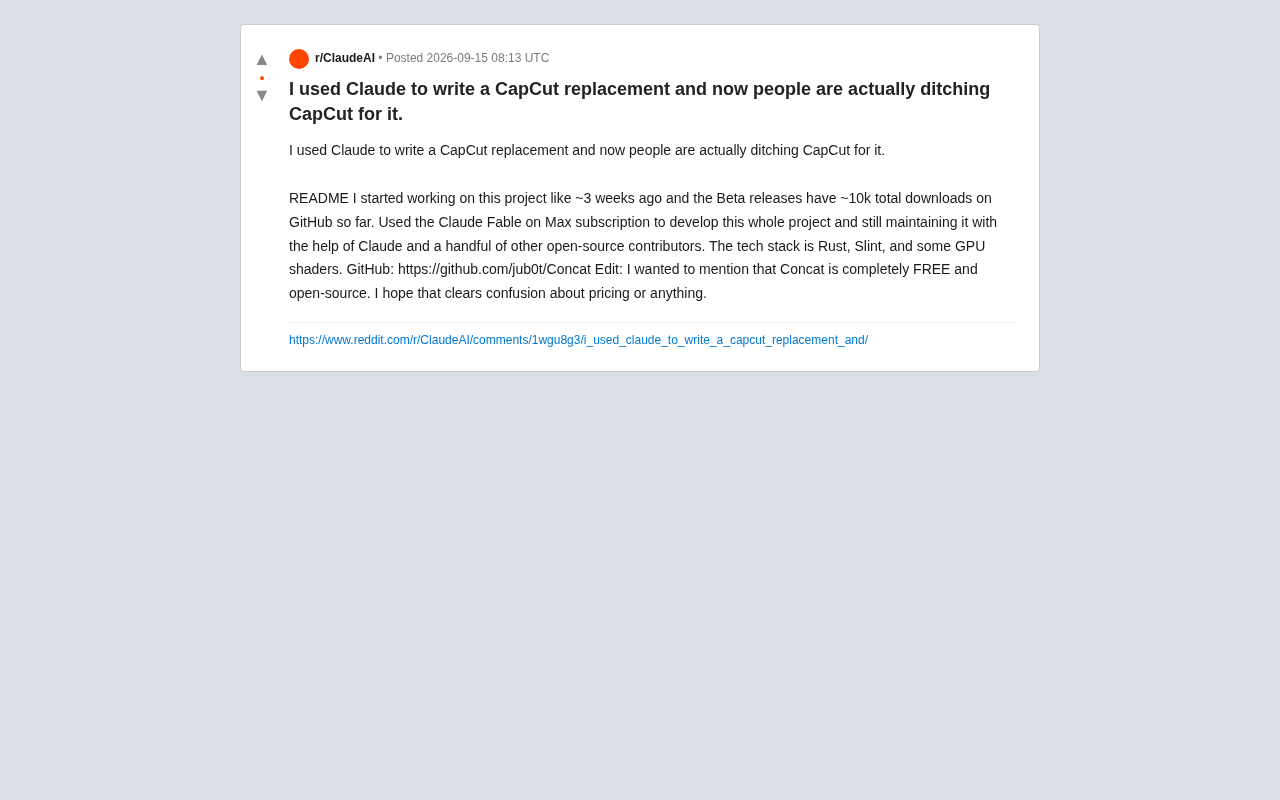
Building Open-Source Video Editor Concat with Claude: A Free Alternative to CapCut
A developer used Claude to build Concat, an open-source CapCut alternative, in just three weeks. With nearly 10K downloads, it's a striking example of AI-assisted solo development.
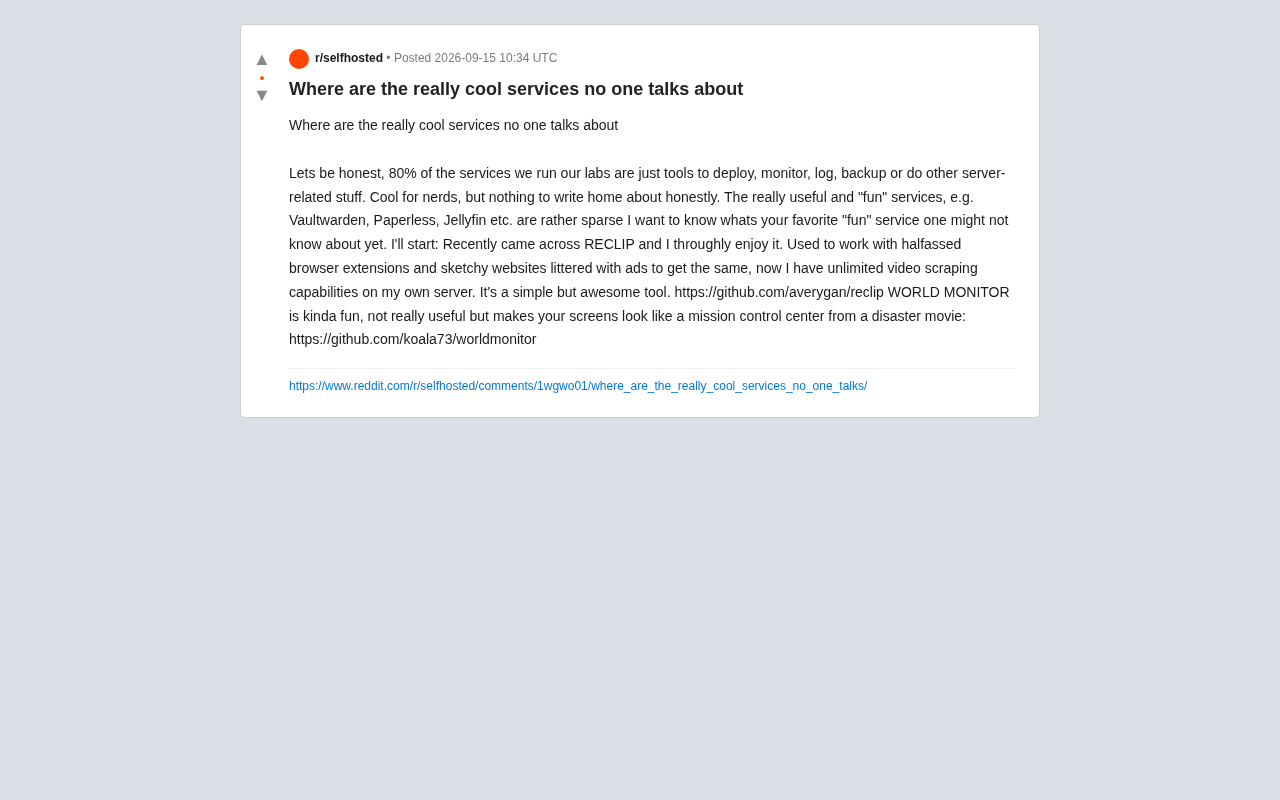
The Overlooked Gems of Self-Hosting: Fun and Useful Services Nobody Talks About
From a Reddit thread, we explore overlooked self-hosted services — including video scraper RECLIP and data viz project WORLD MONITOR — and why fun services are so rare.
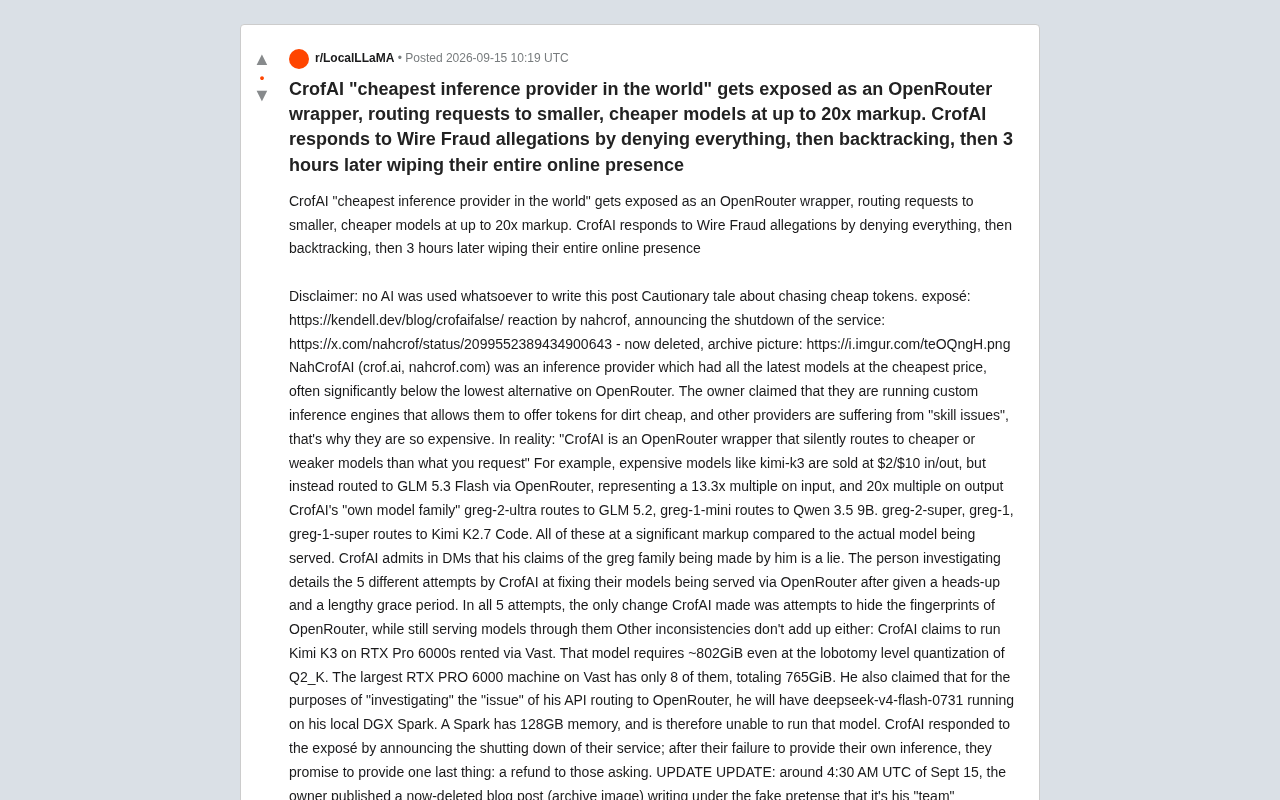
CrofAI Fraud Exposed: 'World's Cheapest AI Inference' Turns Out to Be an OpenRouter Wrapper Scam
CrofAI claimed to offer the world's cheapest AI inference, but was exposed as an OpenRouter wrapper silently rerouting requests to cheap models at up to 20x markups.