Coding Agent Performance Optimization: Three Caching Pitfalls and Their Fixes
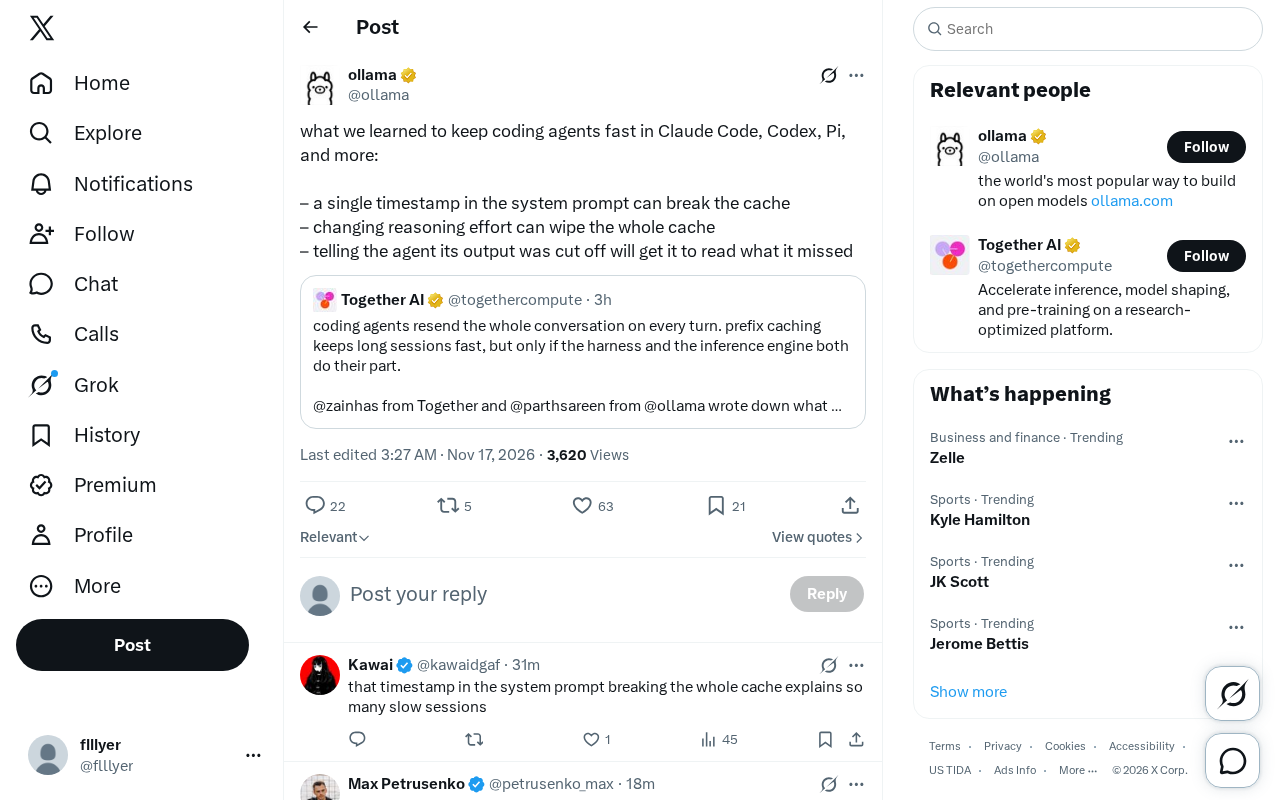
Coding Agent performance bottlenecks often hide in caching details: timestamps, reasoning intensity, and truncation signals all affect speed.
The article summarizes three key details from Twitter practice that affect coding Agent response speed. First, a single timestamp in the system prompt is enough to invalidate the cache, because caching relies on complete input consistency; it is recommended to keep prompts static and move dynamic information out of the core prompt. Second, adjusting reasoning effort clears the entire cache, as different reasoning intensities correspond to different computation paths that cannot be reused across configurations, so it should be treated as a session-level configuration rather than switched frequently. Third, telling the Agent that output was truncated can prompt it to actively read the missing content—a behavior guidance technique that reduces manual intervention in long-output scenarios, though its effect varies by tool. The author notes that these observations corroborate other Agent performance discussions, and that understanding underlying caching mechanisms brings more immediate speed improvements than simply upgrading models.
In coding scenarios, an Agent's response speed directly affects the development experience. A practical summary from Twitter reveals three key details that affect performance in tools like Claude Code, Codex, and Pi. These findings come from observations of multiple coding Agents, highlighting the subtle relationship between system prompts and caching mechanisms.
A Timestamp in the System Prompt Breaks the Cache
The most surprising finding: a single timestamp in the system prompt is enough to invalidate the cache. Caching mechanisms typically rely on complete consistency of the input content—once the timestamp changes, the entire cache can no longer be hit. This means every request may trigger the full computation pipeline rather than reusing existing results. For frequently invoked coding Agents, this overhead can significantly slow down response times.
From an engineering perspective, this reminds us: system prompts should be kept as static as possible. Moving dynamic information (such as time and session state) out of the core prompt, or placing it outside the cache boundary, is an effective strategy for avoiding performance loss.
Prompt Caching is a key optimization mechanism offered by current mainstream large model APIs (such as Anthropic Claude and the OpenAI GPT series): the server saves the intermediate computation results (KV Cache) of prompt prefixes it has already processed, and when the prefix of a subsequent request matches the cached content token-by-token exactly, it directly reuses those computation results, thereby skipping the repeated prefill stage. Its billing is also typically far lower than regular input tokens, and latency can be reduced several-fold.
Cache hit determination is prefix-level exact matching: as long as any single character in the prefix differs, all cache from that position onward is invalidated. Therefore, dynamic fields such as the current time, random IDs, and request sequence numbers embedded in the system prompt will make each request's prefix different, rendering the cache useless. A common engineering practice is to move dynamic information into the user message, place it after the static prefix, or simply omit it.
Adjusting Reasoning Effort Clears the Entire Cache
Another easily overlooked pitfall is adjusting reasoning effort. When developers change an Agent's reasoning intensity, the cache is cleared entirely. The logic behind this is not hard to understand: different reasoning efforts correspond to different computation paths and output distributions, and the cache cannot be reused across configurations. But in practice, frequently switching reasoning intensity may cause the cache to be repeatedly invalidated, thereby affecting overall efficiency.
For scenarios requiring stable performance, it is recommended to treat reasoning effort as a session-level configuration and avoid repeatedly adjusting it within a single task. If switching is necessary, one should also be aware of the cost of cache rebuilding.
Reasoning effort is an adjustable parameter exposed by reasoning models (such as OpenAI's o series and Claude's extended thinking), used to control the budget ceiling for the model's internal chain-of-thought computation before giving an answer, with common values of low / medium / high. The higher the intensity, the more thinking tokens the model generates, and the higher the accuracy on complex tasks is usually, but latency and cost rise accordingly.
It should be noted that reasoning effort is often not merely a sampling parameter—it affects the system configuration and computation graph the model actually uses, so cache entries produced under different values cannot be reused by one another. Treating it as a fixed session-level configuration and pre-selecting it by task type (e.g., low for simple completions, high for complex refactoring), rather than repeatedly switching within the same conversation, is a practical principle that balances quality and speed.
When Output Is Truncated, Have the Agent Actively Read Further
The third finding is more of a technique: telling the Agent that its output was truncated can prompt it to actively read the missing content. This is not performance optimization per se, but a form of behavior guidance—by clearly informing it that the output is incomplete, the Agent re-examines the context and fills in the missing parts. This method is especially useful in long-output scenarios and can reduce manual intervention.
However, this technique relies on the Agent's ability to understand the "truncation" signal, and responses may differ across tools. In practice, it can be used flexibly in combination with the behavioral characteristics of the specific Agent.
When reading files, coding Agents generally adopt a chunked reading strategy: due to context window and token cost constraints, a single read typically returns only the first several lines (e.g., 2000 lines) or the first several KB, and appends a prompt like "the file has been truncated, please use the offset parameter to continue reading" at the end of the result. Whether the Agent can correctly recognize such signals depends on whether the tool description and system prompt explicitly specify the pagination semantics.
If a tool silently truncates without notifying, the model often mistakenly assumes it has seen the complete content, thereby making modifications based on incomplete context and causing errors that are hard to troubleshoot. Therefore, when building your own Agent, explicitly returning a structured marker such as truncated: true and clearly stating the continuation method in the tool description is more reliable than relying on the model to guess on its own.
Consensus on Cache Optimization from Multiple Perspectives
The above three points come from a single source of observation, but they echo other performance discussions about coding Agents. The high sensitivity of caching mechanisms to input consistency is a common feature of multiple tools; and the relationship between reasoning effort and caching reflects the importance of configuration management in Agent performance. For developers, understanding these underlying mechanisms can bring immediate speed improvements more effectively than simply pursuing model upgrades.
When building or using coding Agents, it is recommended to regularly review the dynamic content of system prompts, incorporate configuration changes into performance considerations, and make good use of behavior guidance techniques. Although these details are small, they can accumulate into considerable efficiency differences in high-frequency use.
Related articles

The Gemini 4 Trio and 3.8 Flash: A Full Comparison of Positioning, Pricing, and Benchmarks
A comparison of Gemini 4 Neon, Carbon, Argon, and Gemini 3.8 Flash: positioning, context, API pricing, Artificial Analysis and Arena benchmark scores, and available entry points.

AI Coding Model Leaderboard: Opus 5.5 Crowned, Gemini Neon Stages a Comeback
Tech blogger Matthew Berman releases an AI coding model tier list: Claude Opus 5.5 holds S-tier, Gemini Neon surprises with A-tier, OpenAI Astra lands B-tier. How do open-source models like DeepSeek fare? We break down the scoring logic and practical takeaways.

New Jersey Joe Sandwich: Meat and Coleslaw on Triple-Decker Rye
New Jersey Sloppy Joe isn't a ground beef burger—it's triple-decker rye bread with meat, Swiss cheese, and coleslaw, plus Russian dressing. Learn the authentic Essex County method and family recipe.