Coding Agents from Prototype to Production: Infrastructure Is the Real Challenge

The core challenge of scaling coding agents has shifted from model capability to inference cost, scheduling, and security isolation.
Coding AI agents are rapidly moving out of the lab into real production environments, but a massive engineering gap separates demo prototypes from systems that reliably serve large numbers of users. Using an upcoming AI Conference session featuring experts from Ollama and Together AI as a starting point, the article outlines the key challenges of running coding agents at scale: inference costs amplified by dozens of model calls per task, bursty GPU workloads that complicate scheduling, stateful execution requiring persistence and fault tolerance, and mandatory sandboxed code execution. As more teams move past prototypes, the competitive focus is shifting from model selection to infrastructure engineering — and mature open-source models are giving organizations new options to control deployment, privacy, and cost.
Coding AI agents are moving from the lab to real production environments at a remarkable pace. When model capability is no longer the only bottleneck, a trickier question emerges: how do you actually run coding agents at scale? This is not just an algorithms problem — it's a systems engineering problem.
The Gap Between Prototype and Production
Building a coding agent that works in a demo is not hard — give it a task, let it write some code, and the results are often impressive. But turning that prototype into a production system that reliably serves large numbers of users and handles complex, real-world codebases is an entirely different challenge.
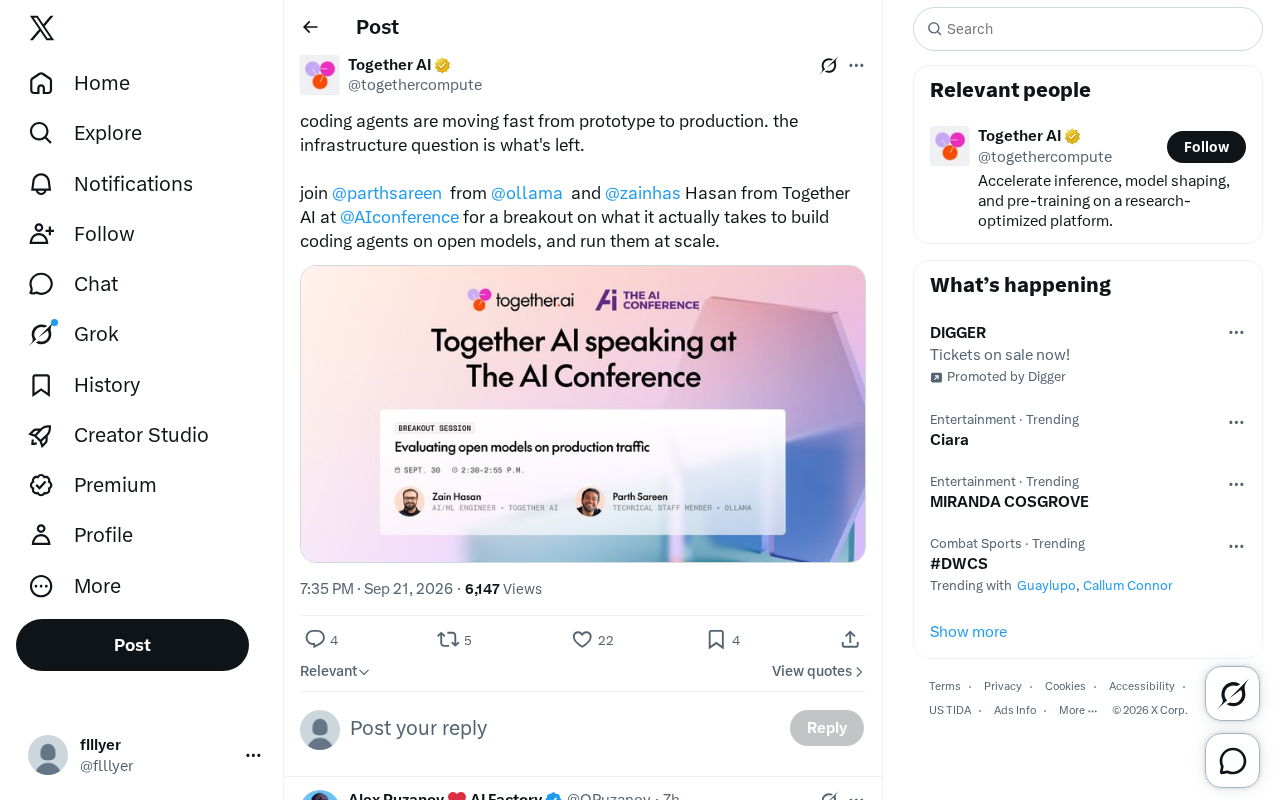
@parthsareen from Ollama and Zain Hasan from Together AI will explore exactly this topic at a dedicated session at the AI Conference: what it actually takes to build coding agents on top of open-source models and run them in scaled production environments.
The value of this discussion lies in shifting the focus from "model capability" to "deployment engineering." For the past two years, the industry has been obsessed with benchmarking model coding performance. What actually determines success now is the infrastructure surrounding the model.
Why Infrastructure Has Become the Critical Factor
Coding agents are fundamentally different from conversational AI. They require multi-step reasoning, tool calls, code execution, file system access, long context management, and often parallel handling of multiple subtasks. These characteristics impose demanding requirements on the underlying infrastructure.
Inference Cost and Latency
Coding agents typically need to invoke a model repeatedly for planning, generation, verification, and correction. A single complete task might trigger dozens or even hundreds of model inference calls. This means inference costs and latency are dramatically amplified — optimizing throughput and reducing per-inference cost directly determines whether a product is commercially viable.
To manage the cost pressure of high-frequency inference, engineering teams typically employ several optimization techniques. Speculative decoding uses a small draft model to generate candidate tokens first, which the main model then verifies in batch — significantly boosting throughput without sacrificing quality. KV cache reuse targets the large amount of repeated prefix context across an agent's multi-turn interactions, avoiding redundant attention computation on each inference call and substantially reducing latency. At the serving layer, continuous batching allows inference servers to dynamically merge token generation steps from different requests, dramatically improving GPU utilization. The combination of these techniques is a core reason why inference providers like Together AI can support large-scale agent workloads at competitive per-unit pricing.
The Role of Open-Source Models
Notably, both speakers come from companies — Ollama and Together AI — that are deeply focused on deploying and running open-source models. Choosing open-source models for building coding agents means organizations can control how models run on their own infrastructure, manage data privacy, and own their cost structure, rather than depending entirely on closed-source APIs.
Ollama specializes in making open-source models easy to run locally across various environments, while Together AI focuses on large-scale inference serving. Together, their perspectives cover the full spectrum from lightweight local deployment to massive cloud-scale serving.
Ollama is a tool that lets developers run open-source LLMs like Llama, Mistral, and Qwen locally — on Mac, Linux, and Windows — with minimal friction. Its core value is packaging model quantization, runtime dependencies, and API interfaces into a single executable, dramatically lowering the barrier to private deployment. Together AI provides high-performance cloud inference APIs with deep system-level optimizations for open-source models, supporting high-throughput outputs of thousands of tokens per second. The two represent two archetypal paths for deploying open-source models: the former emphasizes local self-hosting and data sovereignty, while the latter emphasizes elastic scaling and zero operational overhead — corresponding to the different needs of individual developers versus large-scale enterprise deployments.
The Real-World Challenges of Running at Scale
Getting a coding agent "running" and getting it "running at scale" are two completely different propositions. As user volume and task complexity grow, a wave of engineering problems surface simultaneously.
Resource scheduling is the first major challenge. Coding agent workloads tend to be bursty and uneven — one task might suddenly consume enormous compute, while others sit idle. Efficiently scheduling limited GPU resources is central to scaling.
State management is equally tricky. As an agent executes a task, it accumulates large amounts of intermediate state and context. Deciding how to persist that state, how to recover after failures, and how to prevent context bloat from degrading performance all require careful design.
Then there are security and isolation concerns. Coding agents execute code, which inherently introduces security risks. They must run inside sandboxed environments with strict controls over file access and network requests.
In production, secure isolation for code execution typically relies on container sandboxes (such as gVisor or Firecracker microVMs) or dedicated code execution services (such as E2B or Modal). These solutions strike a balance between lightweight virtualization and strong isolation: Firecracker can launch a microVM with its own independent kernel in milliseconds, preventing malicious code from escaping while avoiding the heavy startup overhead of traditional virtual machines. For coding agents, every code execution triggered by a tool call must happen inside an isolated environment. The startup speed and concurrent capacity of the sandbox directly impact the agent's overall response time and throughput ceiling — a dimension that cannot be overlooked when selecting infrastructure.
What This Discussion Means for the Industry
The fact that topics like this are making it onto the main stage at AI conferences signals a genuine shift in industry priorities. As more and more teams move past the prototype stage, the real competition will center on who can run agents at lower cost, higher reliability, and greater scale.
For teams looking to build their own coding agents, this discussion offers an important reminder: don't fixate solely on model selection. Plan ahead for your inference architecture, resource scheduling, and operational systems. Infrastructure capability may well turn out to be the true moat that determines whether a product can go the distance.
The maturation of open-source models has given organizations the ability to build these systems independently. How to wield that independence — turning the potential of open-source models into stable, reliable productivity — is one of the most important areas worth studying deeply right now.
Related articles

DeepCell: One-Click AI Generation of Documents, Spreadsheets, and Slides
DeepCell tops Product Hunt with one-click generation of documents, spreadsheets, and slides, using the .deepcell format for linked updates, designed for System 2 tasks like modeling and sales reviews.

Doneas: 15-Minute Daily Accountability Calls That Keep Indie Developers From Procrastinating
Doneas is a daily accountability tool for indie developers: plan tasks on Monday, join a 15-minute call with five builders each day, and log deliveries on a public progress page. This article analyzes its core mechanics, effectiveness, and potential issues around retention and matching.

Fastlane 2.0: Fully Automated AI Ad Campaigns, From Creative to Optimization
Fastlane 2.0 is an AI ad automation tool: enter your website and it learns your brand, generates video and image ads, and runs and optimizes them on Meta, TikTok, Instagram, and YouTube.