Codync: An Open-Source, Free Remote Control Solution for AI Coding Agents

Codync is a free, open-source tool for remotely controlling local AI coding agents from your phone.
Codync is an MIT-licensed open-source project designed to replace commercial products like Grok Bot, Muse, and Dots, solving the problem of developers being unable to remotely control local AI coding agents from a mobile device. It manages Claude Code, Codex, Cursor, and 40+ other agents as named bots, letting users remotely monitor progress, reply to prompts, and approve high-risk actions from an iPhone, Mac, Linux, or terminal. Its core advantages over commercial alternatives are that it's completely free, fully auditable, and end-to-end encrypted — making it especially appealing to developers who prioritize data sovereignty. The project has earned 79 upvotes on Product Hunt, though independent reviews and security audits are still lacking.
As AI coding agents grow increasingly popular, remotely controlling Claude Code, Codex, or Cursor — running on your local machine — from a phone or another device has become a genuine pain point for developers. The open-source project Codync, launched on Product Hunt, offers a compelling answer: it reimplements what commercial products like Grok Bot, Muse, and Dots do, but in a way that's 100% free, MIT-licensed, and end-to-end encrypted.
What Problem Does Codync Actually Solve
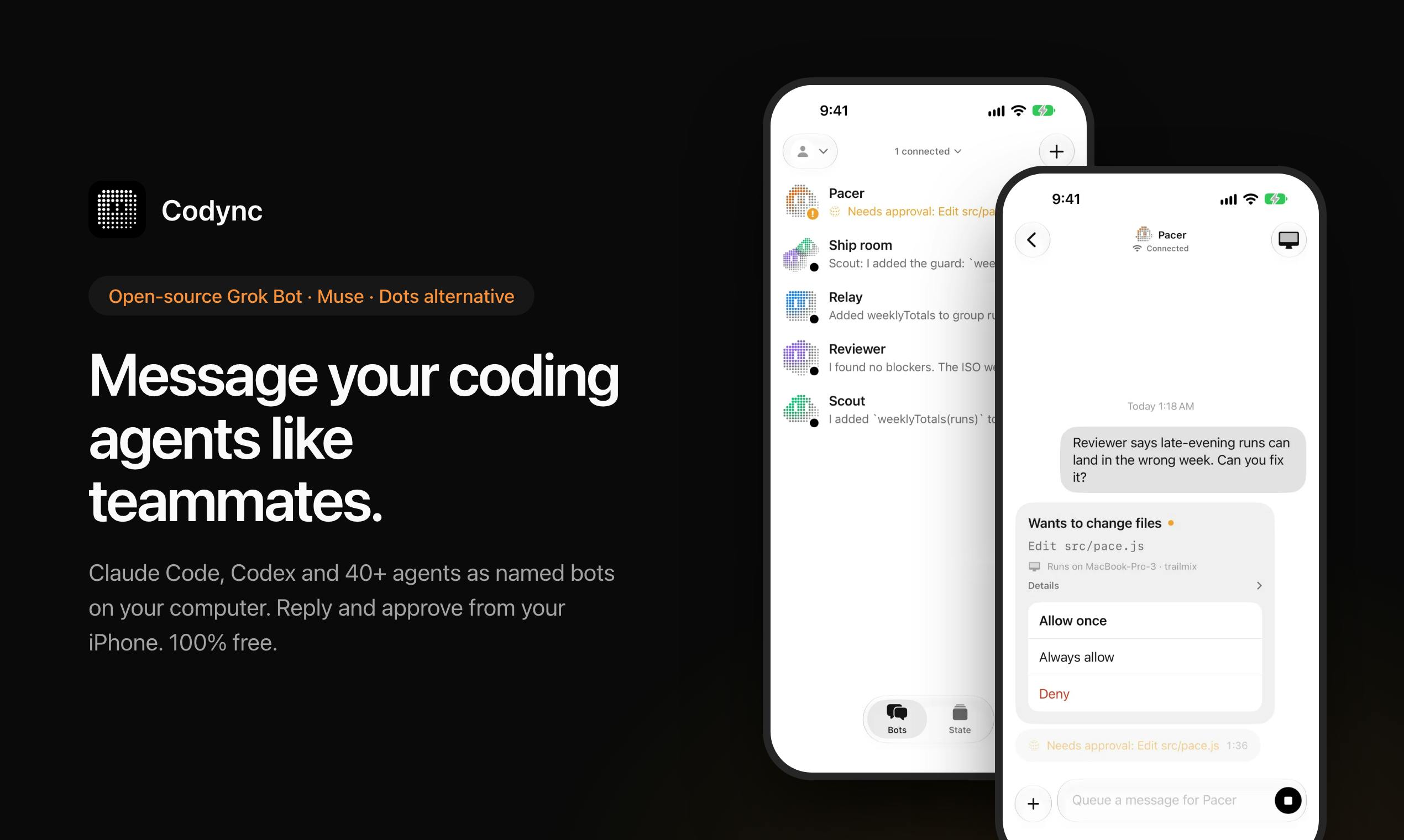
Codync positions itself as "the open-source alternative to Grok Bot, Muse, and Dots." It lets developers run Claude Code, Codex, Cursor, and 40+ other AI agents as "named bots" on their own machines, then reply to and approve actions from an iPhone, Mac, Linux device, or terminal.
In other words, it decouples the "AI agent runtime" from the "human control interface": agents still execute locally on your own machine with full access to the filesystem and development environment, while you can remotely check on their progress, respond to their questions, and approve or reject risky operations from your phone — even when you're away from your desk. This is especially valuable for workflows where AI agents run autonomously for extended periods and require human checkpoints.
Open Source and Free: The Biggest Selling Points
Compared to commercial products like Grok Bot, Muse, and Dots, Codync's differentiation is crystal clear — MIT license, completely free, and end-to-end encrypted.
For developers and teams who care about data sovereignty, this combination is quite persuasive. AI coding agents often need access to entire codebases, environment variables, and even production credentials during execution. Handing that control over to a closed-source third-party service inherently comes with trust costs. Codync's open-source nature means the code is auditable, end-to-end encryption means commands and feedback passed between devices never pass through a readable intermediary, and being free eliminates the paid subscription barrier entirely.
Judging by its Product Hunt performance — 79 upvotes, 10 comments, ranked #14, listed under Open Source, Developer Tools, Artificial Intelligence, and GitHub — the "open-source alternative" narrative clearly resonates with a segment of the developer community.
A note on end-to-end encryption (E2EE): E2EE means data is encrypted on the sender's side and can only be decrypted by the recipient who holds the key — intermediate nodes, including the service provider's servers, can never read the plaintext. In the context of remotely controlling AI agents, the data in transit may include code snippets, terminal output, environment variables, and file paths accessed by the agent — all of which, if leaked, could directly expose a project's core assets. Commercial products using traditional transport-layer encryption (TLS) leave the service provider technically capable of accessing plaintext data; E2EE eliminates this possibility at the architectural level. That said, the security of E2EE depends heavily on the quality of key management implementation — including device pairing methods, key derivation algorithms, and whether forward secrecy is supported. Codync does not yet have a public third-party security audit, which is a critical area for teams with high security requirements to examine before adoption.
The Practical Value of Unified Multi-Agent Control
Codync emphasizes support for 40+ agents, managed as named bots. This design has several practical implications.
First, a unified entry point. Developers today might simultaneously use Claude Code for refactoring, Codex for scripting, and Cursor for day-to-day editing — switching between disparate tools is costly. Registering them all as named bots lets you schedule and monitor them from a single interface.
Second, a complete mobile approval loop. The biggest risk with AI agents is autonomous execution — an agent might run a command you never intended. Codync lets you approve actions from an iPhone, meaning agents can keep making progress while you commute or sit in meetings, pushing a notification to you only when a decision is needed. A single tap approves it. This makes the human-in-the-loop supervision model lighter and more portable.
Third, cross-platform coverage. Support for iPhone, Mac, Linux, and terminal accommodates developers with different preferences — even terminal power users get a consistent experience.
A note on Human-in-the-Loop (HITL): HITL is a supervision paradigm in AI system design where human review is mandated at critical decision points in an automated workflow, rather than letting the system run fully autonomously. In AI coding agent scenarios, this is especially important: agents may execute high-risk operations like deleting files, pushing code, calling external APIs, or modifying databases — and the cost of an unchecked wrong decision can be irreversible. Traditional HITL implementations often require developers to sit at their computers waiting for the agent to ask a question, severely disrupting workflow. Codync moves the approval action to mobile, freeing HITL supervision from physical location constraints. Agents can continue running in the background and only interrupt the user via push notification when a decision is required — minimizing the friction of human intervention while preserving control over critical operations.
Issues and Limitations Worth Noting
To be objective, publicly available information about Codync is currently limited to its Product Hunt listing, and independent in-depth reviews and real-world user feedback are still scarce. Several key questions remain to be verified:
- Setup and configuration complexity: Is onboarding 40+ agents and configuring remote control user-friendly for less experienced developers?
- E2EE implementation details: Has the encryption scheme been audited? How are device pairing and key management handled?
- Stability and latency: Remote approval depends on network connectivity — how reliable is mobile control of long-running local tasks?
- Feature gap vs. commercial products: Are there advanced features in Grok Bot, Muse, or Dots that Codync has yet to cover?
These questions can only be answered through real-world deployment.
Summary
Codync represents a clear trend in the AI tooling ecosystem: when a popular commercial product emerges, the community quickly incubates open-source, free, privacy-focused alternatives. For developers who value data sovereignty, want to keep AI agents firmly on their own machines, and still want the convenience of remote mobile approvals, Codync deserves a spot on your watchlist. Given that it's MIT-licensed and free, the cost of trying it is minimal — pulling the code from GitHub and running it yourself is probably the fastest way to determine whether it fits your workflow.
Related articles

Random Pruning of the DPO Computation Graph: 1.4x Training Speedup and Lower Peak Memory
DPO training too slow and memory-hungry? This paper proposes a random pruning framework for the DPO computation graph, sampling independently across position, sequence, and branch dimensions; branch pruning achieves a 1.426x step-time speedup and cuts training time by about 30%, with in-depth attribution of memory and time gains.

Why Does JEPA Underperform MLM in Longitudinal EHR Representation Learning?
New study compares JEPA and MLM for longitudinal EHR representation learning on MIMIC-IV: three JEPA variants train stably without collapse but underperform MLM; target size, not heterogeneity, drives prediction error.

Transfer Learning + Visible Light Communication: A New Approach to Energy-Efficient Indoor Positioning
A study proposes a transfer learning-based visible light communication indoor positioning method, achieving 47% accuracy improvement on the BOSCH factory dataset, 67.5% model efficiency under high noise, and introducing the ME composite metric for energy-efficient positioning in energy-constrained industrial IoT scenarios.