Cohere's Open-Source Critique and Anthropic's IPO on the Same Day: Coincidence or Strategy?
Cohere's open-source critique and Anthropic's IPO filing happened on the same day, raising community doubts about closed-source vendors' motives.
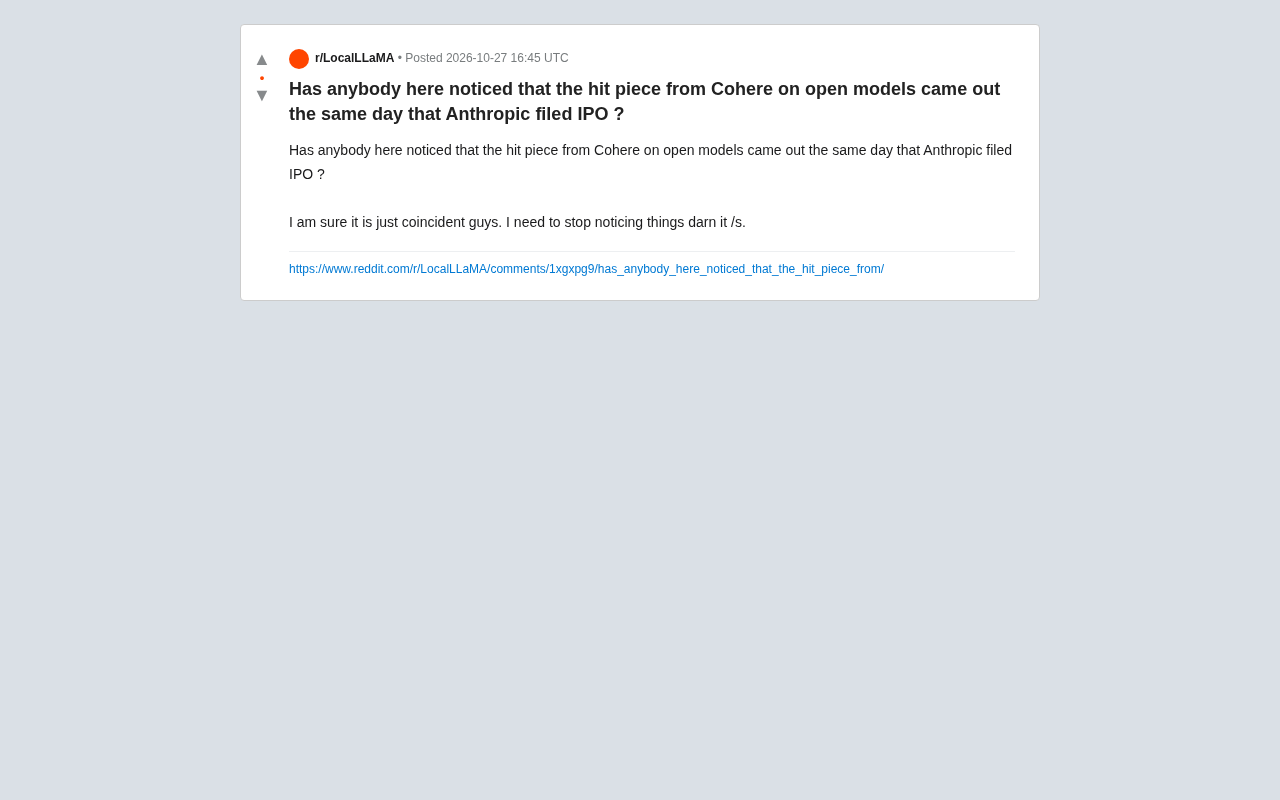
A Reddit user noticed that Cohere published an article criticizing open-source models on the same day Anthropic filed for an IPO, and the poster sarcastically implied possible coordination. The article notes that the original discussion provided no article content or IPO filing details, so causation cannot be proven; corporate opinion publishing and IPO filing are handled by different teams whose schedules may have been set long in advance, making same-day occurrence more likely a coincidence. Yet the community reaction reveals a deeper issue: when closed-source vendors criticize open source, their credibility is naturally discounted by their commercial stance, and the public's real demand is more transparent disclosure. The article argues that open-source vs. closed-source competition will continue, and developers should focus on model evaluations and total cost of ownership rather than vendors' public opinion battles.
Event Recap: Two Things Collide on the Same Day
A Reddit user noticed that Cohere published a critical article about open-source models, and on that very same day, Anthropic was reported to have filed for an IPO. The poster wrote with a hint of sarcasm: "I'm sure this is just a coincidence—I really need to kick my habit of noticing details."
This timeline overlap sparked community discussion. It should be noted that the original discussion did not provide the specific content of Cohere's article or the detailed filing documents for Anthropic's IPO, so this article focuses only on analyzing the phenomenon of the "timing coincidence" and does not make factual assertions about the actual motives of the two companies.
Background: The Open-Source vs. Closed-Source Debate
Cohere and Anthropic are both in the first tier of large-model commercialization, but they have chosen different paths. Cohere has long centered on enterprise-grade API services, while Anthropic is built on the Claude series of models and a safety narrative. The rise of open-source models (such as the Llama series, Mistral, etc.) has directly compressed the pricing room and customer stickiness of closed-source API vendors.
Against this backdrop, any closed-source vendor publicly questioning the capabilities or sustainability of open-source models will be interpreted as part of a business strategy. What made the Reddit user sensitive to this is: if criticism of open source happens to appear at a critical moment in a closed-source company's capital operations, the public has reason to question the underlying conflicts of interest.
Cohere is a Toronto-based AI company founded by former Google Brain researcher Aidan Gomez and others. It started out providing enterprise NLP APIs and later pivoted to large-model services, mainly offering text generation, retrieval augmentation, and other capabilities to enterprise customers. Anthropic was founded by former OpenAI VP of Research Dario Amodei and his sister, and is known for the Claude series of models and its "Constitutional AI" safety framework, emphasizing controllable and interpretable model behavior. IPO (Initial Public Offering) refers to a company issuing shares to the public and listing them for trading for the first time; it is a key milestone for corporate fundraising and for early investors to exit. Filing for an IPO means the company must undergo stricter financial disclosure and regulatory scrutiny, and any negative publicity could affect its valuation and offering window. Open-source models such as Meta's Llama series and France's Mistral allow enterprises and developers to deploy them on their own through public weights, significantly reducing inference costs and thus putting direct pressure on the usage-based billing model of closed-source APIs.
Does Same-Day Occurrence Equal Causal Connection?
Logically speaking, two events happening on the same day cannot directly lead to a causal conclusion. A company publishing an opinion article and filing IPO documents are handled by different teams, and the schedules may have been set weeks or even months in advance. Coincidences are not uncommon in the business world.
But the community's reaction reveals another layer of the problem: when closed-source vendors criticize open source, their credibility is naturally discounted by their commercial stance. This is not a problem faced by Cohere alone—any party with commercial interests participating in public technical discussion needs greater transparency to maintain credibility. The core demand expressed through the Reddit post's irony is actually a desire to see clearer information disclosure, not mere conspiracy theorizing.
A basic principle of causal inference is that temporal precedence or simultaneous occurrence does not equal causation; common causes, coincidence, and selection bias must also be ruled out. In business communication, corporate opinion articles are usually planned by marketing or public policy teams, while IPO documents are advanced by finance and legal teams; the two schedules are often locked in months in advance, so same-day appearance is more likely a scheduling coincidence. However, public sensitivity to conflicts of interest is reasonable: when a company's commercial stance aligns with the direction of its public statements, listeners will naturally question its objectivity. The credibility theory in communication studies points out that the credibility of an information source depends on expertise and neutrality of motive, and the existence of commercial interests weakens the latter. Therefore, when closed-source vendors participate in open-source discussions, proactively disclosing interest relationships and distinguishing factual statements from position statements are common practices for maintaining credibility.
Impact on the Open-Source Ecosystem
Regardless of Cohere's motives for the article, the tension between open-source models and closed-source commercial models will persist. The advantage of the open-source community lies in transparency and reproducibility, while the advantage of closed-source vendors lies in engineered services and compliance support. Competition between the two benefits users overall, but only on the premise that public discussion is not dominated by a single commercial stance.
For developers, a more pragmatic approach is to focus on capability evaluations and total cost of ownership of the models themselves, rather than being led by the public opinion battles between vendors. The reason this Reddit post gained attention is precisely that it shows the community remains vigilant against "narrative-pushing" content—and that vigilance itself is a sign of a healthy open-source ecosystem.
Total Cost of Ownership (TCO) is a key metric when evaluating model selection. In addition to API call fees, it also includes hidden costs such as compute, deployment and operations, data compliance, and model fine-tuning and iteration. The advantage of closed-source APIs lies in out-of-the-box usability and compliance support, but at large scale over the long term, costs may be higher than self-hosted open-source models; the advantage of open-source models lies in auditability, customizability, and keeping data within one's own domain, but they require the team to have engineering capabilities. Reproducibility is another core value of the open-source ecosystem: public weights and training details enable researchers to verify evaluation results and reproduce experiments, reducing the information asymmetry caused by vendors' unilateral performance claims. For developers, establishing an evaluation process based on public benchmarks and their own business scenarios is more conducive to rational decision-making than following vendor narratives.
Conclusion
Cohere's criticism of open-source models and Anthropic's IPO filing occurred on the same day, and there is currently no public evidence that the two were coordinated. But this coincidence was quickly amplified, reflecting the community's widespread distrust of the commercial motives behind closed-source vendors' public statements. For those following the AI industry, a more valuable question than asking "is it a conspiracy" is: how can we build a more transparent environment for technical discussion, so that the relationship between opinions and interests no longer needs to be revealed by netizens "noticing details"?
One-line Summary
Cohere's criticism of open source and Anthropic's IPO filing occurred on the same day, raising community doubts about the motives behind closed-source vendors' statements.
Paragraph Summary
A Reddit user noticed that Cohere published an article criticizing open-source models on the same day Anthropic filed for an IPO, and the poster sarcastically implied that the two might be coordinated. The article points out that the original discussion did not provide the article's content or IPO filing details, so causation cannot be confirmed; corporate opinion publishing and IPO filing are handled by different teams, their schedules may have long been fixed, and same-day occurrence is more likely a coincidence. However, the community reaction reveals a deeper issue: when closed-source vendors criticize open source, their credibility is naturally discounted by their commercial stance, and the public's real demand is more transparent information disclosure. The article argues that competition between open source and closed source will continue, and developers should focus on model capability evaluations and total cost of ownership rather than being swayed by vendors' public opinion battles.
Related articles
Open Source Leaders Declare "F**k Open Source": The Ideological Schism in the Free Software Movement
Leaders from GNOME, elementary OS, and the Software Freedom Conservancy endorse a "F**k Open Source" statement advocating anti-capitalist, anti-meritocratic free software. This article examines the statement, endorsers, governance controversies, and profanity rhetoric, analyzing the ideological schism's practical impact on project selection.

Professional Designers Test AI-Cloned CAD: How Far Are Fusion/SolidWorks Alternatives Really?
LTT professional designers test AI-cloned Fusion and SolidWorks alternatives SolidCraft and PuraMetric. Interfaces are similar, but shortcuts fail, constraints are missing, and interactions are inconsistent—how far are they from replacing professional CAD tools?

Why Does Nuclear Fallout Decay So Fast? Explaining the 7-10 Rule
Why does radioactive fallout decay so fast after a nuclear explosion? This article explains the exponential decay of short-lived fission products, the classic 7-10 rule, and why sheltering in the first hours to days can greatly reduce radiation dose, while noting that long-lived contaminants can remain for years.