Open Source Leaders Declare "F**k Open Source": The Ideological Schism in the Free Software Movement
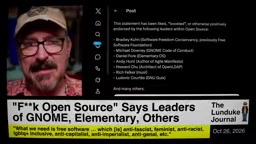
Open source leaders endorse an extreme "F**k Open Source" statement, sparking controversy over ideological governance.
According to Lunduke Journal, leaders from GNOME, elementary OS, the Software Freedom Conservancy, and other organizations have jointly endorsed a statement with extreme wording advocating "F**k open-source," arguing that software should be anti-capitalist, anti-meritocratic, and anti-generative AI, and emphasizing that source-available software under free software licenses is included. The video author notes that endorsers span projects large and small, representing a significant portion of open source leadership, and alleges that relevant organizations ban dissenting contributors via codes of conduct. The author criticizes excessive profanity as weakening the argument but believes doubling down makes it easier for outsiders to identify and distance themselves from projects departing from meritocracy. The incident reflects a deep conflict between the "open source" and "free software" discourse systems and serves as a governance risk screening signal for developers and enterprises.
A Statement That Ignites Controversy
According to the YouTube tech commentary channel Lunduke Journal, leaders from several well-known open source organizations and projects—including GNOME, elementary OS, and the Software Freedom Conservancy—have jointly endorsed a statement with extreme wording. The core claim of the statement is startlingly blunt: "F**k open-source. We don't need open-source. What we need is free software"—they deliberately use profanity and explicitly state that this is the result after self-censorship.
The real impact of this statement lies not in the profanity itself, but in the fact that it places the political positions that have appeared piecemeal in open source community governance discussions over the years onto the table in one go, without embellishment: software should be "anti-hierarchical, anti-fascist, feminist, anti-racist, LGBTQ+ inclusive, anti-capitalist, anti-imperialist, anti-generative AI." The statement also specifically emphasizes that this includes source-available software released under free software licenses.
The Difference Between Free Software and Open Source
The free software movement was initiated by Richard Stallman in 1985, emphasizing the four freedoms of users to use, study, modify, and distribute software, and treating it as an ethical and political issue rather than a mere development methodology. In 1998, Eric Raymond and others proposed the term "open source," intending to weaken the ideological flavor and highlight practical value and commercial friendliness. The two overlap heavily at the license level, but their philosophical foundations differ: the free software movement focuses more on social justice and user rights, while open source focuses more on collaboration efficiency and product quality. The statement's "F**k open-source. We don't need open-source. What we need is free software" is an extreme expression of this divergence—it refuses to regard open source as a goal and instead sees it as a compromise or even betrayal of the free software philosophy.
Who Endorsed It: An Incomplete List
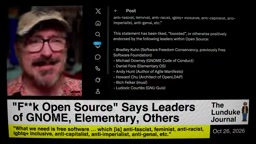
The video author listed a "partial list" and emphasized that this is just the tip of the iceberg. The list includes Bradley Kuhn of the Software Freedom Conservancy (former executive director of the Free Software Foundation), Michael Downey of the GNOME Code of Conduct team, Daniel Foray, founder of elementary OS, Andy Hunt, author of the Agile Manifesto, Howard Chu, architect of OpenLDAP, Richard Felker of musl, Ludovic Courtès of GNU Guix, and others.
These names span small projects and large foundations, and the breadth of coverage led the author to conclude: "A considerable proportion of the leadership in the open source and free software world is buying into this statement." They expressed support by liking, reposting, and commenting "This is exactly what we are fighting for."
Politicized Governance and Community Exclusion
The video author's core argument goes beyond the text of the statement to the actual governance behavior of these organizations. He claims that many organizations will directly ban contributors who disagree with their standards—even high-quality contributors; at the GNOME Foundation, mentioning the author himself in a positive light is grounds for a ban, which is described as official policy.
The author also mentions that more than one person on the list has issued death threats against him. These allegations are intense single-source statements that readers should treat with caution, but the governance conflicts they reflect are real: when codes of conduct evolve from protective tools into ideological censorship mechanisms, contributors' retention no longer depends solely on code quality.
The Evolution and Controversy of Codes of Conduct
Codes of conduct were originally used to clarify the bottom line of community interaction, such as prohibiting personal attacks, harassment, and discriminatory speech, to lower the barrier to participation. However, in recent years, some projects' codes of conduct have introduced broader "inclusivity" clauses, bringing political positions, identity politics, and ideological expression into enforceable scope, and establishing dedicated enforcement teams. Critics argue that this may cause the code to slide from a protective tool to a censorship mechanism: vague enforcement standards, opaque appeal procedures, and overly broad definitions of "offensive" speech, resulting in contributors being punished for their views rather than their behavior. Supporters emphasize that without clear codes, marginalized groups find it difficult to gain a safe environment for participation in technical communities. This tension is the background to the allegation in the video of "banning dissenting contributors."
Profanity as Rhetoric: Weakening Rather Than Strengthening
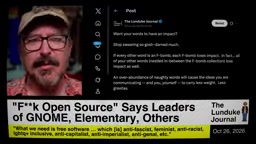
The video spends considerable time criticizing the excessive profanity in the statement. The author shows a screenshot of an OSNews editor calling the United States a "war criminal" with insulting language attached, arguing that this way of expressing oneself is counterproductive.
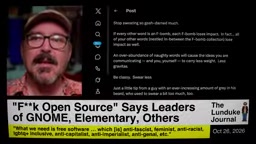
His analogy is quite vivid: in PG or PG-13 movies, characters rarely swear, and an occasional line carries weight and reflects the character's frustration; if every sentence contains an F-bomb, the audience will only think the speaker lacks logic and is using profanity to cover up poverty of thought. "If you want your words to have real influence and want people to take you seriously, don't put swear words in every sentence."
Doubling Down: A Parting of Ways with the "Build Great Software" Path
The timeline the author observes is noteworthy: at a time when a considerable portion of the open source and computer industry publicly says "we've had enough of this extreme left-wing politics, we want to build great software," these "true believers" not only fail to restrain themselves but double or even triple down, writing their positions even more nakedly.
In his view, this is actually a good thing—doubling down makes it easier for outsiders to identify which projects are departing from elite meritocracy, code quality, and productivity, and instead promoting discrimination, censorship, and oppression. "This makes it very easy for me to judge: I don't want this, I want to stay far away from these projects."
You may not have noticed, the author points out that at least one person on the list has served on the board of the Open Source Initiative (OSI)—an organization whose core mission is the definition of "open source," yet now its former senior leader endorses "F**k open source." This mismatch between identity and stance is itself highly ironic.
Why This Deserves Serious Attention
The author's criteria are clear: if it were just ordinary netizens grumbling, it could be ignored; but when these statements are endorsed, promoted, and repeatedly reaffirmed by the helmsmen of large open source projects, they must be taken seriously, because they signal the governance direction and value priorities of these projects.
He also states outright that mainstream tech media will not report such content, and claims that these media "largely agree with statements like F**k open source." This allegation is also a single-source view, but it points to a structural phenomenon: the political shift in the open source community has long lacked contrasting discussion in mainstream narratives.
For developers and enterprises, this statement provides a practical screening signal. When project leadership publicly places "anti-capitalism, anti-meritocracy" above engineering quality, selection decisions are not just technical assessments but also assessments of governance risk. The diversity of the open source ecosystem is inherently an advantage, but when ideology becomes an entry barrier, the code community may degenerate into a political community—this is perhaps the most alarming aspect of this controversy.
Background Supplement
The Open Source Initiative (OSI) and the Definition of "Open Source"
The Open Source Initiative (OSI) was founded in 1998, and its core function is to maintain the "Open Source Definition" and review whether licenses comply with that definition. OSI's stance has long been pragmatic, emphasizing that open source is a development methodology rather than a political movement. Therefore, when someone on the list who once served on the OSI board endorses "F**k open source," the irony lies not only in the wording but also in the departure from identity and institutional mission: OSI is committed to promoting the "open source" brand, while the endorser publicly denies the value of that brand. This mismatch highlights the long-latent tension between free software fundamentalism and open source pragmatism.
Related articles

@ai-sdk/typesafe-ai 3.0.29 Patch Release: Dependency Chain Update Analysis
@ai-sdk/typesafe-ai releases patch 3.0.29 updating @ai-sdk/provider-utils and other deps. This article analyzes the release's nature, typesafe-ai's role in the AI SDK, and practical patch upgrade advice.

@ai-sdk/valibot 3.0.70 Patch Update: Dependency Upgrades and Ecosystem Signals
@ai-sdk/valibot 3.0.70 patch released, updating dependencies and syncing @ai-sdk/provider-utils@5.0.70. This article explains the real impact, upgrade advice, and version alignment strategy in the modular AI SDK ecosystem.

@ai-sdk/voyage 2.0.70 Released: Dependency Update and Version Analysis
@ai-sdk/voyage 2.0.70 patch release updates @ai-sdk/provider-utils to 5.0.70. Analysis of changes, impact on AI SDK developers, and upgrade recommendations.