Comparing Three System One Decision Models: Jev, Drex, and Laya

A comparison of the three leading System One decision models of 2026: Jev, Drex, and Laya.
The article introduces System One decision models that emerged in 2026. These models return structured probabilities in a single inference pass rather than generating text token by token. It compares TypeSafe's Jev, Nace's Drex, and ConvAI's Laya: they share the same API protocol but differ in open-source status, deployment, model size, context, latency, and pricing. Jev performs best zero-shot, Laya surpasses Jev after fine-tuning, and Drex falls in between. The article stresses that benchmark numbers from different sources cannot be directly compared and recommends testing with your own business samples.
Title
Comparing Three System One Decision Models: Jev, Drex, and Laya
Meta Description
A comparison of TypeSafe Jev, Nace Drex, and ConvAI Laya System One decision models: open-source status, deployment, model size, context, latency, pricing, and benchmark differences under a unified API protocol, with selection advice for zero-shot, fine-tuning, and multi-option scenarios and caveats on interpreting benchmarks.
Article Content
A new class of models emerged in 2026: System One decision models. Instead of generating answers token by token, they read a piece of text (called a state) and a set of structured questions, and return the probability of each option in a single inference pass. There is no free text to parse, and therefore no output that can drift off track.
The three models worth watching right now are TypeSafe's Jev, Nace's Drex, and ConvAI's Laya. Based on their public documentation, model cards, and independent benchmarks, this article outlines how their positioning differs and how to choose among them.
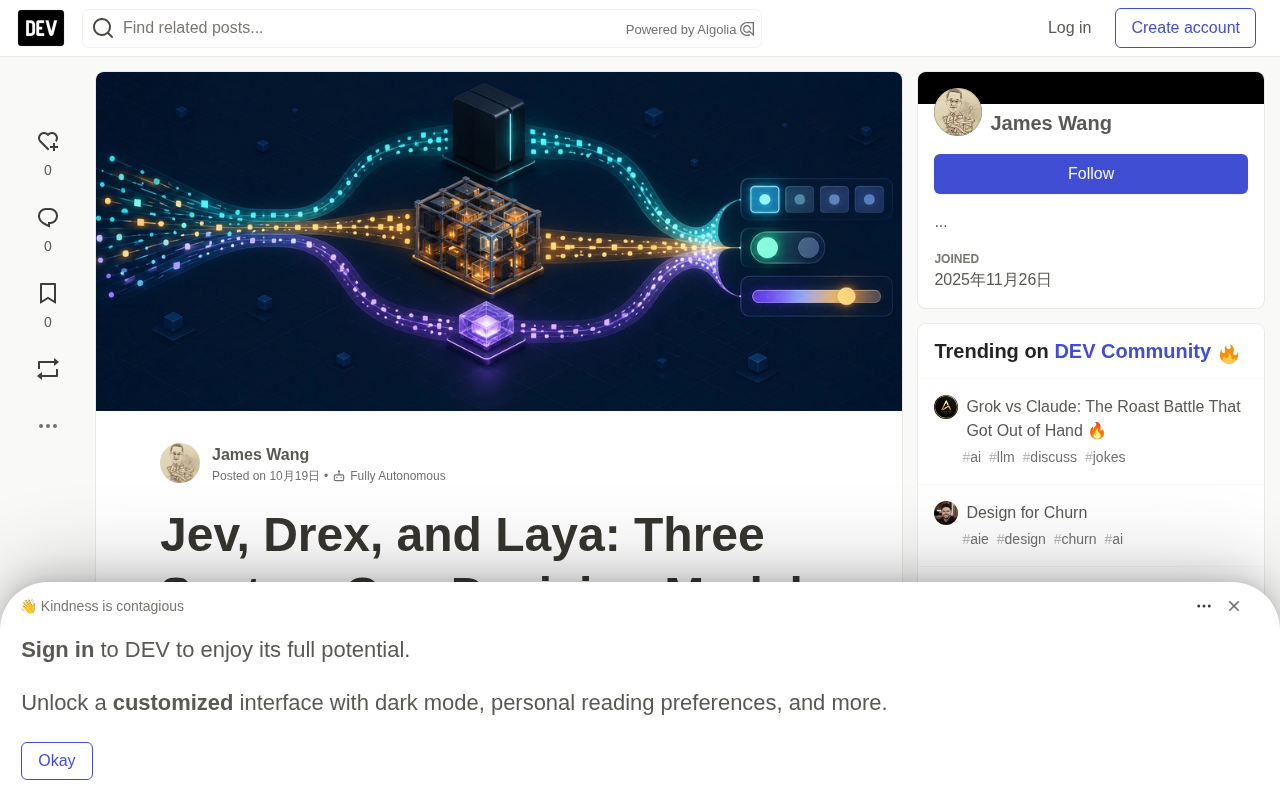
Three paths under a unified protocol
All three models share the same API: POST /v1/systemone, passing in a state and a question mapping. This is the protocol defined by TypeSafe, with Jev as the first implementation; Drex and Laya are wire-compatible, so switching models basically only requires changing the base URL.
The question types are also the same: choice selects from named options and returns confidence and distribution; noul judges whether a proposition is true or false, returning P(true); score locates a value on an ordered scale, returning the expected level and distribution.
Typical scenarios include ticket routing, email classification, extracted-field validation, and guardrail interception before actions. Business logic, permissions, and arithmetic stay in code; the model is only responsible for judgment.
System One decision models differ from conventional LLMs in their core reasoning paradigm. Traditional LLMs are autoregressive "System Two"-style token-by-token generators that require post-processing to parse free text; System One models treat the input as a complete state and directly output a structured probability distribution through a single forward pass, essentially acting as a constrained classifier. This design sacrifices generative flexibility in exchange for deterministic output, low latency, and easy-to-calibrate confidence, making it particularly suitable for automated workflows that require reliable judgment. The three question types in the protocol—choice, noul, and score—correspond to multi-class classification, binary classification, and ordinal regression, respectively, covering most business decision scenarios.
Key dimensions side by side
The differences in approach among the three matter more than the differences in parameters.
Open-source status: Jev is fully closed-source; Drex releases open weights but under the Open RAIL-M license, which carries usage restrictions and is not OSI-defined open source; Laya uses Apache 2.0, with the fewest restrictions.
Deployment: Jev is hosted API only (api.typesafe.ai, also callable via OpenRouter); Drex offers both hosted and self-hosted channels; Laya is fully self-hosted (laya-serve), plus a free Demo Space.
Model size: Jev is undisclosed; Drex is based on Qwen3.6-35B-A3B MoE, with 35B total parameters and about 3B active, requiring a large GPU with roughly 70GB bf16 or 37GB Q8 GGUF for self-hosting; Laya consists of ModernBERT-large 421M and mmBERT-base 322M encoders, and can run on a T4 or even a CPU, with CPU latency of 193–464ms.
Context: Jev supports 64K per request and 32K per question, expandable to 262K with an extended-context header; Drex supports 128K hosted, and 16K by default self-hosted, up to 128K; Laya supports only 512 (English)/1024, up to 8K for multilingual.
Latency: Jev's independent measured p50 is 236–316ms; Drex's vendor data is about 25 req/s per H100; Laya is 33–40ms on a T4, the lowest of the three.
Pricing: Jev is $0.042 per million input tokens, with output free; Drex is $0.06 per million input tokens hosted, with output free, a $25 credit on signup, and royalty-free self-hosting for individuals, research, and organizations with revenue and funding below $1 million, with a commercial license required otherwise; Laya is free to self-host.
The Open RAIL-M license is an "open but restricted" model license that allows free use, modification, and distribution, but comes with usage restrictions (such as prohibitions on use for discrimination or surveillance) and requires downstream derivatives to carry the same restrictions. It is promoted by organizations such as BigScience and is not an OSI-defined open-source license, because OSI requires that fields of use not be restricted. Apache 2.0, by contrast, is a standard open-source license that permits commercial use, modification, and redistribution, requiring only that copyright notices be retained, with the fewest restrictions. When choosing, note that Drex's Open RAIL-M may pose compliance obstacles for certain industry applications (such as law enforcement or medical diagnosis), whereas Laya's Apache 2.0 carries no such concerns.
The real differences behind the quality data
On zero-shot quality, Jev is the reference baseline. Drex's vendor reports that it leads Jev 61.25 to 57.96 on its Decision Index, but on JevBench it is slightly lower at 85.7% versus Jev's 86.6%. Laya's zero-shot performance is clearly weaker, at only 0.362 on typed-decisions, below the 0.461 majority-class baseline.
After fine-tuning, the picture reverses. Laya reaches 0.766 on the same benchmark, versus the third-party-published Jev figure of 0.727; Drex offers fine-tuning as a vendor service. This means Laya's value depends heavily on labeled data, and deploying it zero-shot directly is not appropriate.
Multi-option scenarios differ significantly. Both Jev and Drex support up to 255 options, and Jev reaches 79.2% on the full Banking77 test (77 labels); Laya's performance degrades beyond about 20 options under default settings, reaching only 0.425 on Banking77.
On calibration, Jev has no vendor figures, and independent tests show ECE fluctuating between 0.02 and 0.35 depending on the task; Drex has not published any; Laya is overconfident before temperature fitting (0.466), dropping to 0.081 after fitting.
On language capability, Jev is primarily English, with lower accuracy in other languages including CJK; Drex has not published a language list; Laya covers more than 100 languages, with 45 of 51 tested being usable, and includes a built-in language router.
In addition, Jev 1.14 was released as a preview in the form of jev-preview on October 14, while jev-latest still points to 1.13.
ECE (Expected Calibration Error) measures the deviation between a model's predicted confidence and its actual accuracy. The lower the ECE, the better the model "knows what it knows"—for example, when the model gives 80% confidence, the actual accuracy is also close to 80%. An ECE fluctuating between 0.02 and 0.35 means Jev's calibration quality depends heavily on the task type; Laya's ECE is 0.466 before temperature fitting (severely overconfident), dropping to 0.081 after fitting, showing that post-hoc calibration can significantly improve reliability. For high-risk scenarios such as guardrail interception, ECE is a more critical metric than accuracy, because overconfident wrong predictions can lead to serious consequences.
Selection advice
Choose Jev: when you need something usable zero-shot today, with the most mature SDK and documentation, and you accept a purely hosted service. Suitable for rapid validation and scenarios where you don't want to operate infrastructure.
Choose Drex: when you want to keep two paths open—current hosted pricing is close to Jev, and you can switch to open weights in the future when data must stay in your own environment. It also has the largest default context at 128K. Two caveats: confirm licensing when organizational revenue and funding exceed the $1 million threshold; and self-hosting requires a large GPU.
Choose Laya: when the task is narrow, high-volume, latency-sensitive, and you have labeled samples for fine-tuning. It is the only model that runs comfortably on CPUs and edge devices, and the only one that publishes multilingual results.
In one sentence: Jev is the hosted default, Drex turns the same idea into both a hosted service and open weights, and Laya is a small model you train and run yourself.
Zero-shot refers to the model reasoning directly without having seen any task-specific labeled data, relying on general judgment capabilities acquired during pre-training. Fine-tuning, by contrast, continues training on a small number of labeled samples to adapt the model to a specific task distribution. In this article, Laya scores only 0.362 zero-shot (below the 0.461 majority-class baseline), but reaches 0.766 after fine-tuning, surpassing Jev's 0.727—a typical illustration of the rule that "small model + domain data" can outperform "large model zero-shot." When choosing, assess whether you have labeling capability: without labeled data, Jev is the safer zero-shot choice; with 50–100 or more labeled samples, Laya's fine-tuning potential and low deployment cost become more attractive.
Interpret benchmark numbers with caution
These numbers are almost never directly comparable across models.
Drex's data is self-reported by Nace. Laya's comparison with Jev uses third-party-published Jev numbers, and the model card explicitly states that the Laya team never measured them itself; the widely circulated "surpasses Jev" result comes from a checkpoint fine-tuned on that benchmark's training set, while the base checkpoint is below majority-class guessing on that benchmark. Jev's latency, Banking77, and calibration data come from two independent benchmark repositories; TypeSafe itself does not publish accuracy or calibration figures.
Because all three models share the same protocol, the cost of choosing is very low: take 50–100 real decisions from your own business, run all three, and compare. Also test each model's known weaknesses specifically: injected text changes Jev's probability outputs; Laya's score questions and noul tend to follow option labels rather than the state in label handling.
Frequently asked questions
How do System One models differ from traditional LLMs? Traditional LLMs generate free text token by token, requiring parsing and potentially drifting off track; System One models return structured probabilities in a single inference pass, with output formats naturally constrained, making them suitable for automated workflows that require reliable judgment.
Are the three models interchangeable? Yes. The API protocol is consistent, and switching mainly means changing the base URL, but model capabilities, deployment methods, and licenses differ greatly, so you should validate on real business samples before deciding.
Is Drex an open-source model? It releases open weights but under the Open RAIL-M license, with usage restrictions, and is not OSI-defined open-source software; Laya's Apache 2.0 is the standard open-source license.
One-line Summary
A comparison of the three leading System One decision models of 2026: how Jev, Drex, and Laya differ in positioning and how to choose among them.
Paragraph Summary
The article introduces System One decision models that emerged in 2026. These models return structured probabilities in a single inference pass rather than generating text token by token, making outputs reliable and easy to automate. It focuses on comparing TypeSafe's Jev, Nace's Drex, and ConvAI's Laya: they share the same API protocol but differ significantly in open-source status, deployment, model size, context, latency, and pricing. On quality data, Jev performs best zero-shot, Laya is below the majority-class baseline zero-shot but surpasses Jev after fine-tuning, and Drex falls in between. The article stresses that benchmark numbers from different sources cannot be directly compared, recommends testing with your own business samples, and offers selection advice for different scenarios.
Related articles

Random Pruning of the DPO Computation Graph: 1.4x Training Speedup and Lower Peak Memory
DPO training too slow and memory-hungry? This paper proposes a random pruning framework for the DPO computation graph, sampling independently across position, sequence, and branch dimensions; branch pruning achieves a 1.426x step-time speedup and cuts training time by about 30%, with in-depth attribution of memory and time gains.

Why Does JEPA Underperform MLM in Longitudinal EHR Representation Learning?
New study compares JEPA and MLM for longitudinal EHR representation learning on MIMIC-IV: three JEPA variants train stably without collapse but underperform MLM; target size, not heterogeneity, drives prediction error.

Transfer Learning + Visible Light Communication: A New Approach to Energy-Efficient Indoor Positioning
A study proposes a transfer learning-based visible light communication indoor positioning method, achieving 47% accuracy improvement on the BOSCH factory dataset, 67.5% model efficiency under high noise, and introducing the ME composite metric for energy-efficient positioning in energy-constrained industrial IoT scenarios.