Complete Guide to Connecting Third-Party Models in Cursor: Breaking Free from Vendor Lock-In

A complete guide to integrating third-party AI models in Cursor to break free from vendor lock-in.
This guide explains how developers can break free from vendor lock-in in Cursor by connecting third-party AI model providers like Fireworks.ai and OpenRouter. It covers configuring custom OpenAI-compatible endpoints, leveraging the rise of open-source models, and implementing intelligent routing strategies to balance cost and quality across different task complexities.
Why Developers Are Seeking Model Alternatives for Cursor
As one of the most popular AI coding tools today, Cursor has won over a large number of developers with its deeply integrated code completion, chat, and Agent capabilities. However, as usage deepens, more and more users are focusing on a core issue — vendor lock-in.
Vendor lock-in is a classic problem in the software industry, referring to a situation where users become highly dependent on a particular vendor's products or services, making the cost of migrating to a competitor prohibitively high. In the cloud computing era, this problem is particularly acute — AWS, Azure, and GCP each build differentiated APIs and service ecosystems that are difficult to leave once you're deeply invested. In the AI coding tools space, vendor lock-in manifests as dependency on specific model APIs, prompt engineering optimizations, and feature adaptations. When a platform adjusts its pricing strategy, changes its terms of service, or discontinues support for a particular model, users have almost no bargaining power or alternative options.
Recently on the Reddit community, a developer started a discussion: "Has anyone used third-party model providers in Cursor?" They openly expressed a dislike for being tied to a single vendor and wondered if anyone had tried subscription-based model services like Fireworks.ai or standardcompute.com, or even running high-performing open-source models themselves.
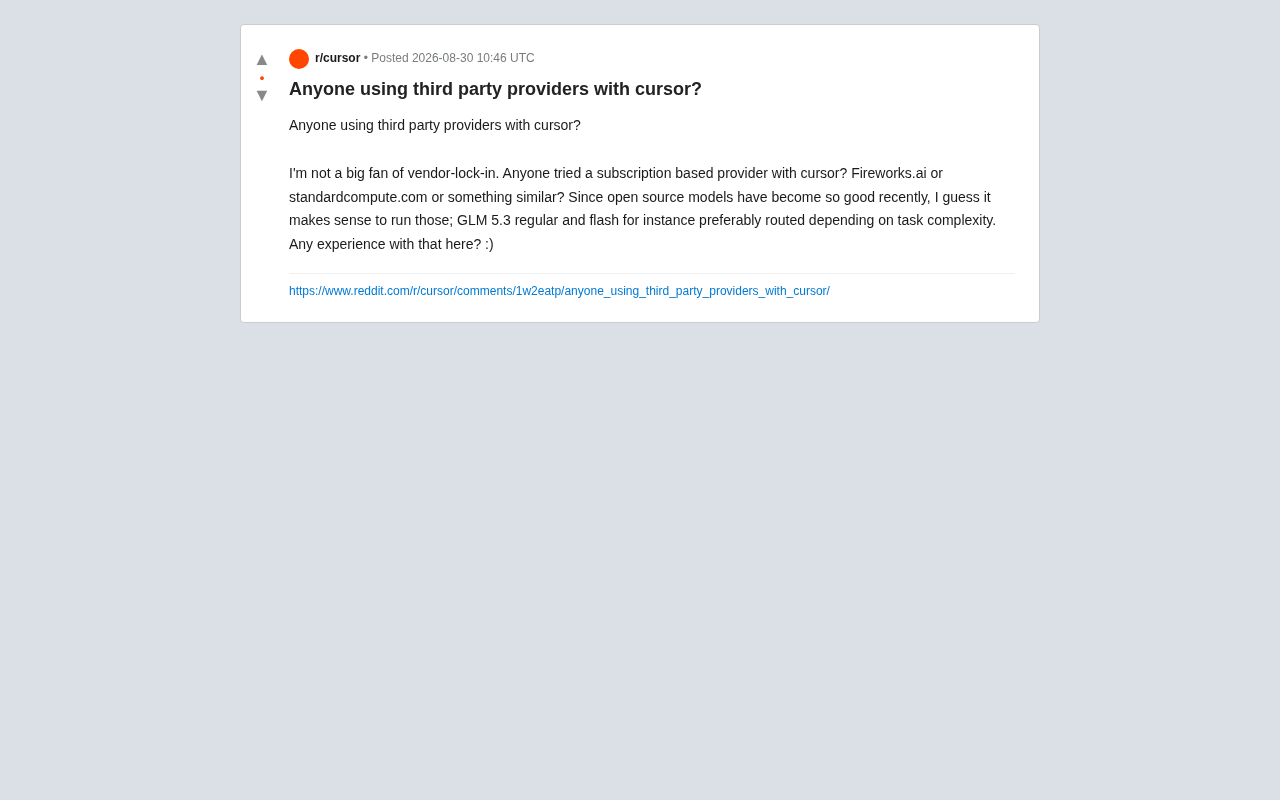
This topic may seem simple, but it touches on an increasingly important trend in the AI coding tool ecosystem: When open-source models become powerful enough, developers are no longer willing to be locked into officially designated models and pricing structures.
The Concerns of Vendor Lock-In and the Rise of Open-Source Models
Limitations of Cursor's Default Model System
Cursor uses closed-source models from top vendors like OpenAI and Anthropic by default. While these models are highly capable, they also bring several practical issues:
- Opaque pricing or rising costs: Price adjustments and quota limits for official plans are often decided unilaterally by the platform, leaving users with no room to negotiate.
- Limited model selection: Users can only choose from models the platform permits, unable to flexibly switch to more cost-effective alternatives.
- Data privacy concerns: Code data processed through third-party closed-source services poses compliance risks for certain enterprises and sensitive projects.
The original poster's sentiment of "not wanting to be locked in" represents the genuine concerns of a significant portion of technical users.
Open-Source Models Have Reached Practical Utility
A key observation in the discussion was: "Since open-source models have recently become so good, it's starting to make sense to run them." This genuinely reflects the industry reality of recent years.
Since 2024, open-source code models have undergone a massive leap forward. Meta's Code Llama series, Mistral's Codestral, DeepSeek Coder V2, and Zhipu AI's GLM-4 series have all demonstrated code generation capabilities approaching or even surpassing GPT-3.5 Turbo levels. Particularly noteworthy is that Qwen2.5-Coder and DeepSeek-Coder-V2 have achieved results very close to top closed-source models like Claude 3.5 Sonnet on code benchmarks such as HumanEval and MBPP. Most of these models use Apache 2.0 or similar permissive licenses, allowing commercial use and local deployment. Advances in model distillation and quantization techniques have also made running high-quality code models on consumer-grade GPUs a reality — for example, GGUF-quantized models can run smoothly on a single RTX 4090.
Taking the GLM series mentioned in the post as an example, Chinese open-source models have gradually approached and even surpassed some closed-source models in specific scenarios for code generation and reasoning tasks.
This means developers can absolutely consider a tiered model usage approach:
- Use standard models for complex tasks (such as architecture design, complex refactoring)
- Use lightweight Flash models for simple, high-frequency completion requests
- Use intelligent routing to dynamically assign models based on task complexity, balancing quality and cost
This "route models by task complexity" approach has become a trending direction in AI application engineering.
Choosing and Connecting Third-Party Model Providers
Major Subscription-Based Model Service Platforms
The original post mentioned several noteworthy third-party platforms:
Fireworks.ai is a model hosting platform focused on fast inference, founded by former members of Meta's AI infrastructure team. Its core technical advantage lies in its proprietary FireAttention inference engine, which achieves extremely low time-to-first-token latency (typically under 100ms) and high throughput through technologies like Speculative Decoding, Continuous Batching, and PagedAttention. Fireworks.ai also supports model fine-tuning and Function Calling, offering ready-to-use services for mainstream open-source models from Llama, Mistral, to Qwen. Its per-token pricing model is typically 3-10x cheaper than calling OpenAI or Anthropic APIs directly, which provides significant cost advantages for high-frequency API call scenarios (such as code completion).
standardcompute.com and similar platforms represent the subscription-based compute service direction, providing developers with more predictable cost structures.
OpenRouter is another frequently mentioned option that aggregates APIs from multiple model providers, supporting unified interface calls to different models.
The common value of these services is: they are typically compatible with the OpenAI API format, which makes integrating them into Cursor entirely feasible from a technical standpoint. The OpenAI API format has become the de facto industry standard interface specification, built around HTTP-based RESTful APIs that interact through endpoints like /chat/completions, using JSON-formatted message arrays to pass conversation context. Since OpenAI was the first company to commercialize LLM APIs at scale, its interface design has been widely imitated and made compatible by subsequent players. While Anthropic's Claude and Google's Gemini each have their native APIs, virtually all third-party inference platforms (such as vLLM, Ollama, LM Studio, etc.) prioritize implementing OpenAI-compatible interfaces. This compatibility means developers only need to swap out the Base URL and API Key — without modifying any calling code — to switch the underlying model provider. This is the technical foundation for breaking vendor lock-in.
How to Configure Custom Model Endpoints in Cursor
Cursor provides the ability to configure custom OpenAI-compatible endpoints (Custom OpenAI Base URL). Here are the specific steps:
- Open Cursor and navigate to the model configuration options in Settings
- Find the custom API endpoint settings area
- Enter the third-party provider's API Base URL and API Key
- Specify the model name you want to use
Through this method, you can connect Cursor's chat and certain features to compatible platforms like Fireworks.ai or OpenRouter, enabling free model switching.
Important notes: Some of Cursor's advanced features (such as Agent mode, Tab smart completion) have deeply customized optimizations for specific models. Third-party models may not deliver an experience fully consistent with official models in these scenarios.
Real-World Trade-offs and Practical Recommendations
Balancing Convenience and Freedom
While connecting third-party models is technically feasible, developers need to clearly understand several trade-offs:
- Experience consistency risk: Cursor's team has done extensive prompt optimization and feature adaptation for specific models. Custom models may underperform in complex scenarios like Agent mode and multi-file editing.
- Configuration and maintenance overhead: You'll need to manage API Keys, monitor usage, handle exceptions and routing logic on your own, significantly increasing operational burden.
- Differences in cost structure: Subscription platforms charge by API calls or compute, and whether you actually save money depends on your personal usage frequency and intensity — not every scenario is cheaper than the official plan.
Intelligent Routing: The Core Strategy for Cutting Costs and Boosting Efficiency
The original poster's suggestion to "route different models based on task complexity" is a strategy well worth adopting. Its essence is using the right model for the right task.
Intelligent routing is a key architectural pattern in AI application engineering. The core idea is to use a lightweight classifier or rule engine to assess task complexity before a user request reaches the LLM, then dispatch the request to models of different capability tiers (and different costs). This architecture borrows from load balancing and traffic governance concepts in microservices. There are typically three implementation approaches: rule-based routing (e.g., based on token length, presence of specific keywords), semantic classification routing based on embedding vectors, and using a small LLM as a router for intent recognition on requests. Startups like Martian and Unify.ai specialize in providing AI routing services. According to industry practice data, a well-designed intelligent routing strategy can reduce API call costs by 50-70% while maintaining over 95% output quality.
| Task Type | Recommended Model Tier | Typical Scenarios |
|---|---|---|
| Simple completion | Lightweight Flash model | Variable naming, formatting, simple syntax completion |
| Medium complexity | Standard model | Function writing, single-file refactoring |
| High complexity | Flagship model | Architecture design, cross-file refactoring, complex debugging |
With middleware tools like LiteLLM and OpenRouter, developers can implement rule-based automatic routing to significantly reduce API call costs without sacrificing too much quality. LiteLLM is an open-source Python library and proxy server designed to provide a unified calling interface for over 100 LLMs. Its core features include: converting all model calls to OpenAI-compatible format, providing load balancing and failover mechanisms, implementing budget and rate-based access control, and detailed call logging and cost tracking. Developers can define model routing rules through simple configuration files — for example, sending simple requests to a locally deployed Llama model while forwarding complex requests to the Claude API. In the Cursor use case, developers can deploy the LiteLLM proxy locally and point Cursor's custom API endpoint to that proxy, achieving transparent multi-model routing.
Conclusion: Multi-Model Routing Is the Evolution Direction for AI Coding Tools
This Reddit discussion reflects the increasingly mature demands of AI coding tool users: they are no longer satisfied with out-of-the-box solutions and want to take control of their model choices.
As open-source model capabilities continue to improve and third-party inference platforms like Fireworks.ai and OpenRouter mature, "using your own chosen models in Cursor" is gradually shifting from a niche practice to a viable mainstream option. For developers tired of vendor lock-in who seek cost control and data sovereignty, this is undoubtedly worth investing time to explore.
Between convenience and freedom, the optimal solution differs for everyone. But one thing is certain — multi-model support, intelligent routing, and breaking free from vendor lock-in are becoming the next evolutionary direction for the AI coding tool ecosystem.
Related articles
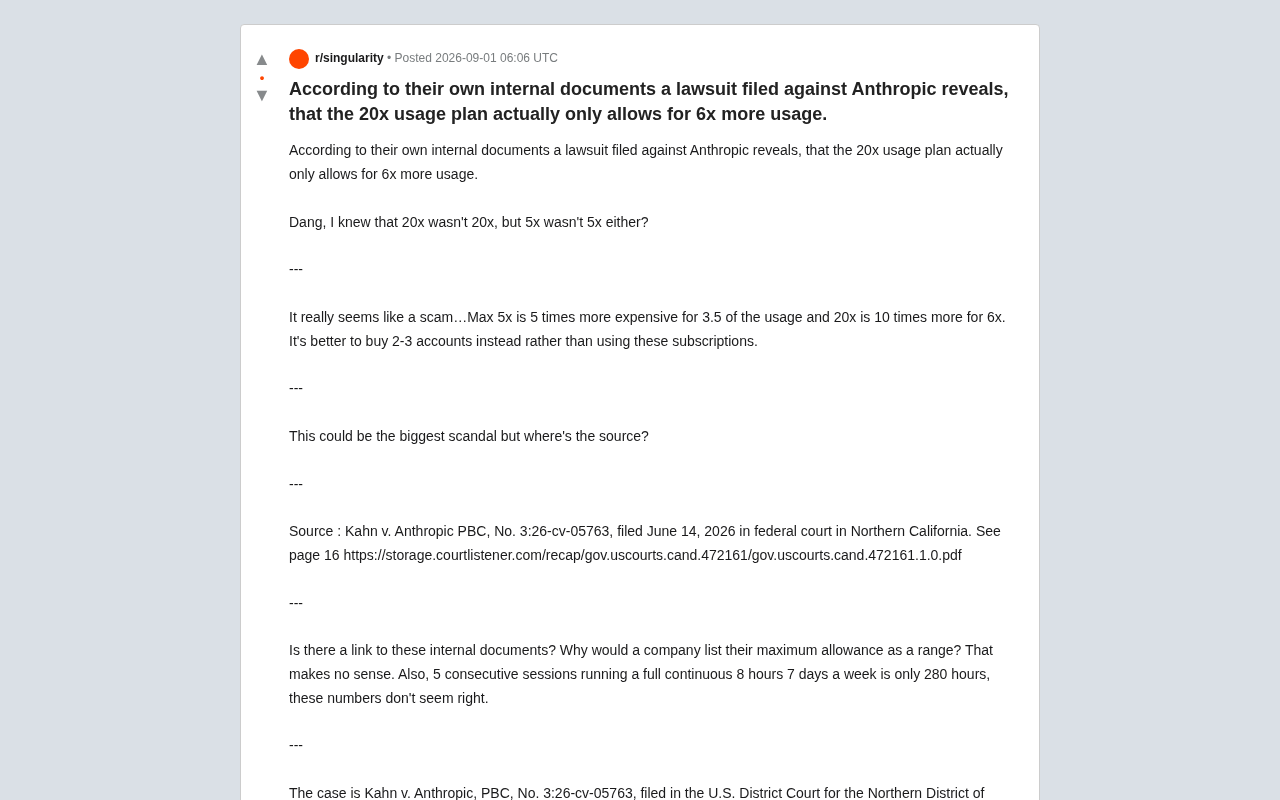
Anthropic Sued: Claude Max 20x Plan Allegedly Delivers Only 6x Usage?
A lawsuit against Anthropic alleges Claude Max's 20x plan delivers only ~6x usage, and the 5x plan just 3.5x. We break down the legal details, community reactions, and the AI subscription transparency crisis.

Cursor Beginner's Guide: A Six-Step Workflow for Managing Changes, Rollbacks, and Validation
New to Cursor and keep breaking things? Learn a six-step dev workflow covering Cursor Rules, Plan mode, Diff review, and Checkpoint rollback to go from guesswork to engineering.
Is Cheap Cursor Reselling Reliable? The Real Risks of Shared Account Pools Exposed
An in-depth analysis of Cursor Pro budget reselling services, exposing the shared account pool model behind so-called legitimate accounts and deep discounts from technical, compliance, and data security perspectives.