Complete Kali Linux Cybersecurity Learning Path from Zero to Practitioner: A Full Guide from Beginner to Hands-On

A structured three-stage guide taking cybersecurity beginners from fundamentals through Kali Linux to real-world practice.
This comprehensive guide presents a three-stage cybersecurity learning path designed for absolute beginners: foundational knowledge (Linux, web dev, databases, and legal awareness), advanced attack and defense with Kali Linux penetration testing tools, and hands-on practice including CVE vulnerability reproduction, incident response, SRC bug bounty hunting, and CTF competitions. It emphasizes legal compliance throughout and aims to build a complete, actionable skill set.
Why You Need a Systematic Cybersecurity Curriculum
Cybersecurity is one of the hottest fields in tech education today, but the barrier to entry remains daunting for absolute beginners. The creator of this newly developed systematic cybersecurity course shared that during the preparation phase, he spent an entire month reviewing virtually every cybersecurity tutorial available online. His conclusion was concerning: some tutorials were stuck on content from four or five years ago, completely out of step with the evolution of tools and attack-defense techniques; others were cobbled together from miscellaneous sources, incomplete, and highly fragmented.
This "mixed bag" reality directly drives up the learning cost for newcomers. A beginner who genuinely wants to get started often has to sift through countless low-quality, outdated materials repeatedly, wasting enormous amounts of time. Motivated by this pain point, the author decided to build a complete tutorial from scratch—one that absolute beginners could understand while still providing ample hands-on projects.
Interestingly, this course was far from developed in isolation. According to the creator, before officially recording, he communicated extensively with over forty zero-experience followers to iteratively refine the content structure. The entire course took five months to complete. This approach of "reverse-designing the curriculum from the learner's perspective" is precisely what many technical tutorials lack.
Breaking Down the Three-Stage Learning Path
The course's core architecture is clearly divided into three progressive sections: Fundamentals, Attack & Defense Advanced, and Hands-On Practice. This layered design aligns with the natural progression of skill acquisition—build the foundation first, then learn offense and defense, and finally consolidate through real-world practice.
Stage 1: Fundamentals — Building a Knowledge Foundation from Zero
The introductory stage covers an impressively broad range of topics, including cybersecurity laws and regulations, the Linux operating system, HTML, PHP, and database fundamentals. There's an easily overlooked detail worth noting: the author placed "cybersecurity laws and regulations" at the very beginning of the course. This is critically important—as the tongue-in-cheek phrase "from getting started to getting arrested" suggests, cybersecurity skills are a double-edged sword. Studying these technologies without awareness of legal boundaries can easily lead to crossing the line.
China's cybersecurity legal framework is built on three core laws: the Cybersecurity Law enacted in 2017, the Data Security Law enacted in 2021, and the Personal Information Protection Law. Article 27 of the Cybersecurity Law explicitly states that no individual or organization shall engage in activities that endanger cybersecurity, such as illegally intruding into others' networks, interfering with normal network functions, or stealing network data. Articles 285 and 286 of the Criminal Law—covering "Illegal Intrusion into Computer Information Systems" and "Destruction of Computer Information Systems" respectively—draw even stricter criminal red lines: unauthorized access to or destruction of computer systems can carry sentences of up to seven years or more in prison. In recent years, cases of security testers being convicted for overstepping boundaries have become increasingly common, making "authorization boundaries" the lifeline of security practitioners: all penetration testing must have written authorization, and all vulnerability research must be conducted within legitimate platform frameworks. Legal compliance is the first lesson in this field—not an optional one.
Beyond theoretical instruction, the author also guides students step-by-step through setting up cybersecurity lab environments (known as "ranges" or "labs"). These practice environments are the core infrastructure of security learning—they provide a legal, isolated space where learners can practice attack and defense techniques without touching real systems. Popular open-source lab platforms include DVWA (Damn Vulnerable Web Application), Metasploitable, Hack The Box, and VulnHub. These platforms offer virtual machines or web applications pre-loaded with known vulnerabilities, providing learners with safely isolated experimental spaces. Labs typically run in virtualized environments (such as VMware or VirtualBox), completely isolated from the host machine and external networks, ensuring that no attack activity affects real systems. The process of setting up a lab is itself an important learning experience—it involves virtual network configuration, operating system installation, service deployment, and other foundational operations skills that security practitioners must master.
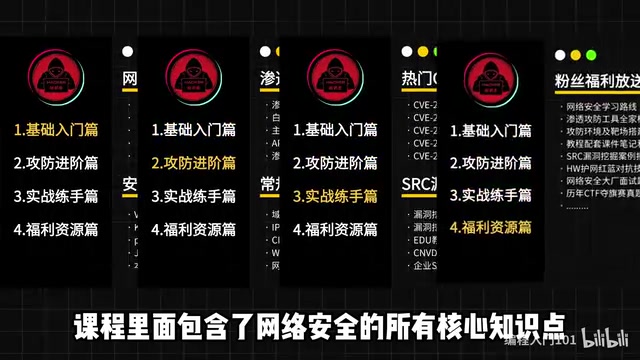
Stage 2: Attack & Defense Advanced — Kali Linux Penetration Testing and Tool Practice
After solidifying the fundamentals, the course moves into the advanced attack and defense stage. This section first walks through the complete penetration testing workflow and common tools (with the Kali Linux ecosystem serving as the core platform), then dives deep into common attack methods, defense strategies, and vulnerability discovery.
Kali Linux is a Debian-based Linux distribution maintained by the Offensive Security team, designed specifically for penetration testing and digital forensics. It comes pre-installed with over 600 security testing tools covering the entire attack chain: information gathering (e.g., Nmap, Recon-ng), vulnerability analysis (e.g., Nikto, OpenVAS), password attacks (e.g., John the Ripper, Hashcat), wireless attacks (e.g., Aircrack-ng), web application testing (e.g., Burp Suite, SQLmap), and post-exploitation (e.g., Metasploit Framework). Kali Linux has become the de facto standard platform in the security industry because it integrates fragmented security tools into a unified operating system environment, lowering the barrier of tool installation and configuration so learners can focus on attack and defense techniques rather than environment setup.
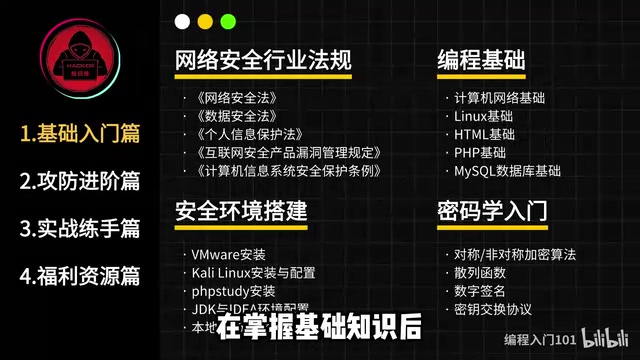
In a learner-friendly touch, the author provides accompanying mind maps and study documents. For technical learning, structured notes and knowledge graphs can significantly reduce cognitive load, helping students build connections between different areas of attack and defense knowledge rather than memorizing isolated tool commands.
Stage 3: Hands-On Practice — Turning Knowledge into Real-World Skills
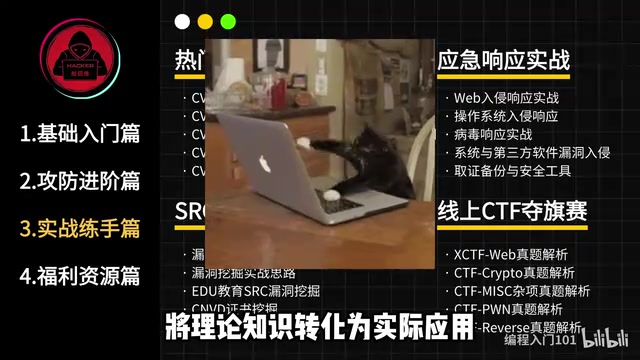
The third stage is the most valuable part of the entire course, focusing on real-world scenario exercises including:
- Reproducing Popular CVE Vulnerabilities: CVE (Common Vulnerabilities and Exposures) is a public vulnerability identification system maintained by the U.S.-based MITRE Corporation. Every discovered and confirmed security vulnerability is assigned a unique CVE identifier (e.g., CVE-2021-44228, the infamous Log4Shell vulnerability). CVE reproduction means recreating the trigger conditions and exploitation process of a vulnerability in a controlled environment, understanding its root cause and exploitation principles by reconstructing known vulnerabilities. Learners gain not only specific technical details (such as input validation flaws, memory overflows, permission misconfigurations, etc.) but also develop a complete methodology from discovery to analysis to exploitation. The related CVSS (Common Vulnerability Scoring System) provides quantitative severity ratings for vulnerabilities, helping security teams prioritize remediation;
- Incident Response Practice: Incident Response refers to the systematic process of detection, containment, eradication, recovery, and post-incident review following a security event. NIST (National Institute of Standards and Technology) divides incident response into four phases: Preparation, Detection & Analysis, Containment-Eradication-Recovery, and Post-Incident Activity. In practice, incident response personnel need multidimensional skills including log analysis, malware analysis, traffic forensics, and intrusion trace investigation. Common incident scenarios include Webshell implantation on web servers, ransomware infections, data breaches, and DDoS attacks. Incident response capability represents security thinking from a defensive perspective, complementing the offensive perspective of penetration testing—only together do they form a complete security skill set;
- SRC Vulnerability Hunting Practice: SRC (Security Response Center) is an official platform established by enterprises to collect product vulnerabilities discovered by external security researchers. Nearly all major Chinese internet companies operate SRCs, such as Tencent TSRC, Alibaba ASRC, and ByteDance BSRC. Third-party aggregation platforms like Butian and Vulbox also exist. White hat hackers conduct security testing on target systems within authorized scope, submit vulnerability reports through SRC platforms, and receive rewards such as cash bounties, points, or certificates of honor after vendor confirmation. Bug bounties vary dramatically based on severity—low-risk vulnerabilities might earn only a few hundred yuan, while critical remote code execution vulnerabilities can command tens of thousands or even hundreds of thousands of yuan;
- Online CTF Competitions: CTF (Capture The Flag) is the most mainstream competitive format in the cybersecurity field. Participants solve a series of security challenges to obtain hidden "flag" strings and submit them for points. CTFs typically follow two formats: Jeopardy (challenge-based) and Attack-Defense. Challenge categories span Web security, reverse engineering, cryptography, binary exploitation (Pwn), digital forensics, and miscellaneous (Misc). Internationally renowned CTF events include DEF CON CTF, HITCON, and PlaidCTF, while prominent competitions in China include the Qiangwang Cup, XCTF League, and CISCN. CTF competitions are not only a litmus test for comprehensive security abilities but also an important reference for security companies when recruiting talent.
The value of this hands-on design lies in transforming theoretical knowledge into actionable, verifiable skills, rather than leaving learners at the "I understood the concept" stage.
Monetizing Your Learning: A Positive Feedback Loop Between Skills and Income
One particularly appealing design element of this course is the integration of "learning monetization" into the learning path. The author notes that hands-on exercises like SRC vulnerability hunting aren't just practice—they can also generate bug bounty rewards within legal and compliant frameworks, allowing students to earn real income during the learning process.
The significance of this design lies in establishing a positive incentive loop—when learning can generate tangible returns, learners' sustained motivation increases significantly. Of course, legal boundaries must be emphasized once again: SRC vulnerability submissions and CTF competitions are officially recognized legitimate channels, fundamentally different from unauthorized penetration testing. Unauthorized penetration—even if it uncovers real vulnerabilities—not only won't earn rewards but may result in criminal prosecution. There are precedents both domestically and internationally of security researchers facing legal consequences for overstepping testing boundaries.
Supporting Resources and Study Recommendations
The author has also prepared a complete resource package for students, covering cybersecurity learning roadmaps, lab environment setup materials, penetration testing tools, SRC vulnerability hunting case studies, and red team vs. blue team technical documentation. These resources provide practical help for beginners in setting up their learning environment and avoiding detours.
Key Reminders for Zero-Experience Learners
- Legal Awareness First: All technical practice must be conducted in authorized environments or on legitimate platforms. Never perform unauthorized testing on real systems;
- Prioritize Fundamentals: Linux, web development, and databases form the foundation of cybersecurity. Skipping fundamentals to jump straight into tools typically yields diminishing returns. Specifically, Linux command-line operations (file management, process management, network configuration, permission control, etc.) form the underlying environment for virtually all security tools; HTML/CSS/JavaScript and PHP web technologies are prerequisites for understanding web vulnerabilities (such as XSS, SQL injection, and file upload vulnerabilities); MySQL and other database knowledge is essential for understanding SQL injection attack principles—without understanding normal SQL query logic, you cannot comprehend how injection attacks manipulate query intent;
- Get Hands-On: Security is a field that relies heavily on practical experience. Lab setup and CTF practice are non-negotiable;
- Stay Current: Attack and defense techniques evolve rapidly, and learners must maintain a habit of following industry developments. Consider regularly monitoring CVE vulnerability advisories, security research blogs (such as Google Project Zero and major security vendor lab blogs), and active security research communities on Twitter/X to stay attuned to the latest attack methods and defensive technologies.
Conclusion
The value of this tutorial lies not in how many exclusive tricks it teaches, but in how its clear three-stage path solves the core pain point for zero-experience learners: "Where do I even start?" From foundational knowledge to advanced Kali Linux attack and defense techniques, through to hands-on exercises including CVE reproduction, SRC vulnerability hunting, and CTF competitions, it forms a complete learning loop. For newcomers looking to break into cybersecurity, a carefully designed learning path that emphasizes legal boundaries is far more valuable than scattered, fragmented tutorials.
Related articles

The White House Arcade Game Controversy: A Full Analysis of Racism Allegations and Copyright Disputes
The White House's policy-themed arcade games sparked dual controversies: the Build the Wall game drew racism accusations, and Tetris's copyright holder pushed back. A deep dive into ethics and law.

MiniMax H3 in Practice: Building a Combined REF2VA and FL2VA Workflow
Compare MiniMax H3's REF2VA and FL2VA modes across visual quality, motion, and audio, plus a ComfyUI fusion workflow combining both for optimal results.
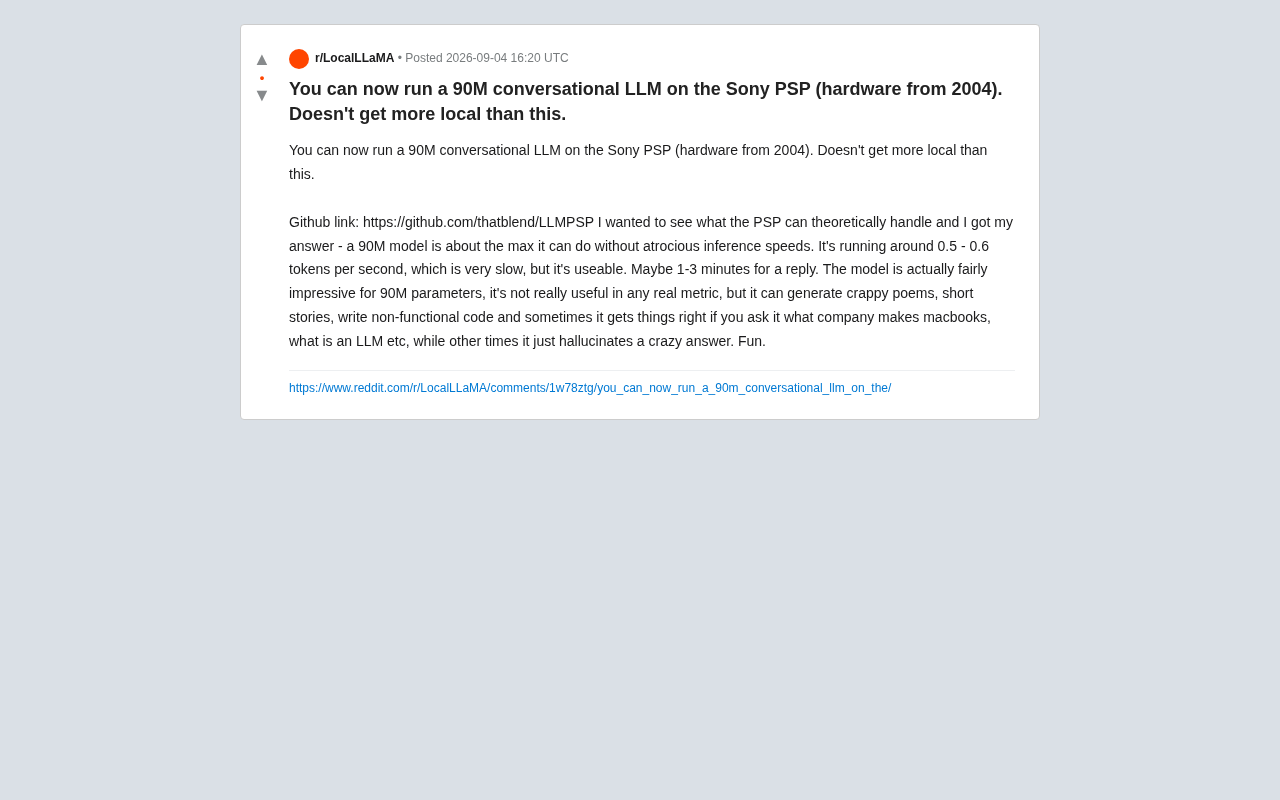
Running a 90M-Parameter LLM on a Sony PSP: Where Are the Limits of Edge Inference?
A developer ran a 90M-parameter LLM on a 2004 Sony PSP at ~0.5 tok/s. This article analyzes the LLMPSP project's technical approach, quantization strategy, and what it reveals about the limits of edge AI inference.