compound-engineering-plugin: A Unified Plugin Layer for Cross-AI Coding Tool Collaboration

A unified plugin layer enabling cross-tool collaboration between Claude Code, Codex, Cursor and more.
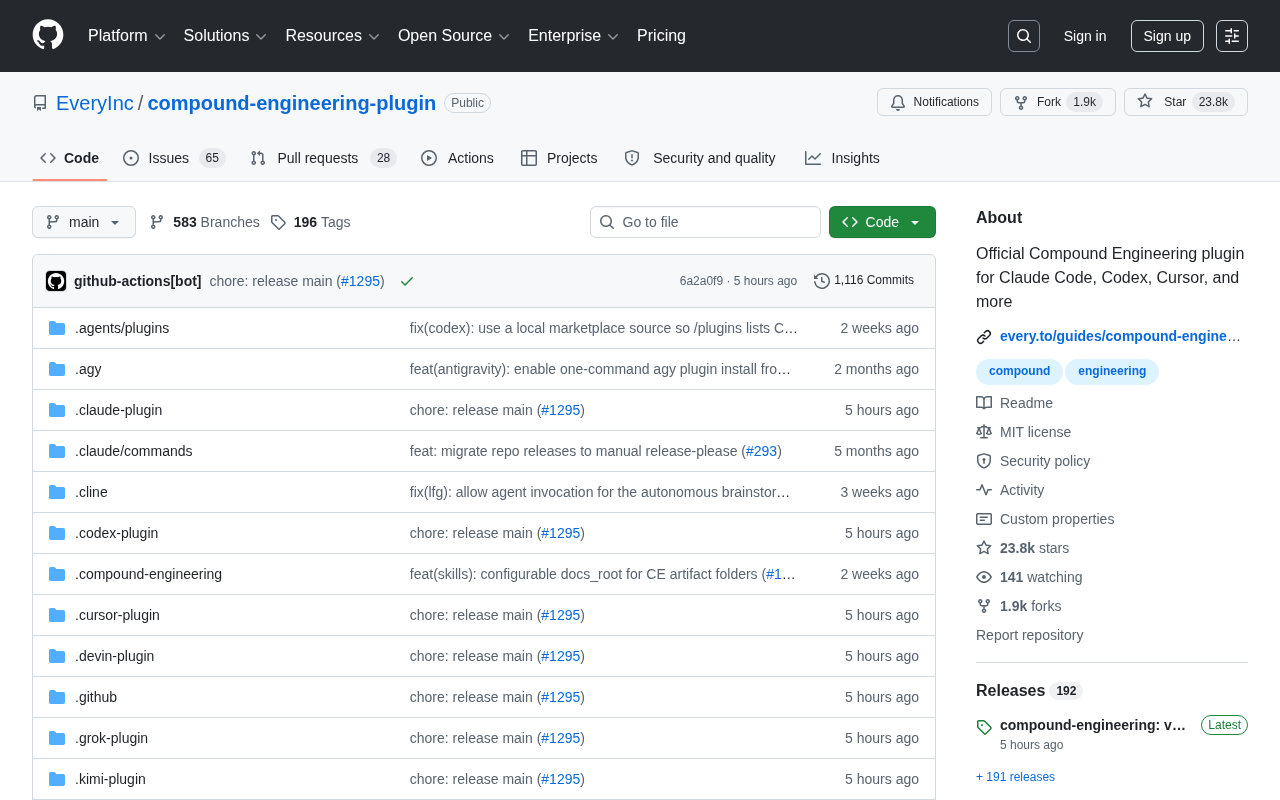
compound-engineering-plugin is an open-source TypeScript project (23K+ GitHub stars) that provides a unified abstraction layer for multiple AI coding tools including Claude Code, Codex, and Cursor. It solves the standards fragmentation problem in multi-tool environments by structuring engineering knowledge into machine-readable formats, enabling compound value accumulation across all AI-assisted operations.
What Is Compound Engineering?
In an era of explosive growth in AI-assisted programming tools, developers face a new challenge: how do you get Claude Code, Codex, Cursor, and other AI coding assistants to collaborate efficiently under a single set of engineering standards and knowledge systems? The compound-engineering-plugin from EveryInc is a solution designed precisely for this pain point.
The project has already garnered over 23,756 stars and 1,944 forks on GitHub, with 33 new stars in a single day, making it one of the most closely watched open-source projects in the current AI engineering tool ecosystem. Written in TypeScript, it positions itself as an official, cross-tool plugin layer.
The core philosophy behind "Compound Engineering" is this: a single AI tool's capability is linear, but when multiple AI tools are stacked under a unified knowledge and standards framework, engineering efficiency can grow at a compound rate. This is fundamentally different from the traditional model of "using an AI completion tool once" — it emphasizes the accumulation and reuse of experience, conventions, and context.
One Plugin Covering Multiple AI Coding Tools
A Unified Abstraction Layer Across Platforms
The plugin's greatest value lies in its "cross-tool" nature. It officially supports Claude Code, Codex, Cursor, and other mainstream AI coding environments, with room for expansion ("and more"). This means developers don't need to maintain separate configurations, prompts, or workflow standards for each AI tool.
In software engineering, an "abstraction layer" is a classic architectural pattern — inserting a unified interface between underlying implementations and upper-level calls to mask differences between implementations. ORMs in the database domain and cross-platform frameworks in frontend development employ similar approaches. In the AI coding tool ecosystem, fragmentation is particularly pronounced today: Claude Code uses CLAUDE.md files to store project instructions, Cursor relies on .cursorrules configuration files, and Codex has its own context management approach. Each tool differs in prompt format requirements, context window management strategies, and how it reads engineering standards. The compound engineering plugin's abstraction layer encapsulates these differences and provides a unified standard definition interface above them.
For teams, this point is especially critical. When team members use different AI coding assistants, code style, architectural conventions, and review standards are often difficult to unify. The compound engineering plugin provides an abstraction layer that crystallizes engineering standards, ensuring different tools follow the same set of rules when invoked.
TypeScript as the Technology Choice
The project uses TypeScript as its primary language, which ensures type safety and facilitates integration with modern frontend and Node.js toolchains. For teams primarily working with JavaScript/TypeScript, the plugin can be more naturally embedded into existing development workflows.
TypeScript's popularity in developer tools and plugin systems is no accident. Compared to plain JavaScript, TypeScript's static type system provides a natural "contract layer" for plugin architectures — when a plugin needs to define data structures for engineering standards (such as code review rules, naming conventions, architectural boundaries, etc.), the type definitions themselves become a form of executable documentation. Furthermore, TypeScript shares the same tech stack with VS Code (the foundation of Cursor) and Node.js CLI tools (Claude Code's runtime environment), significantly reducing the cost of adapting the plugin across different host environments. This technology choice also means that plugin configuration files and rule definitions can benefit from IDE intellisense and type checking, reducing configuration errors.
Why Compound Engineering Is Becoming a Trend
From Code Completion to Engineering Collaboration
The development of AI coding tools has gone through several stages: first came code completion (like early Copilot), then conversational generation (like ChatGPT-assisted coding), and now we've entered the "Agent" stage — where AI can autonomously execute multi-step engineering tasks.
Specifically, the code completion stage (2021-2022) limited AI to predicting the next few lines at the cursor position, essentially a local auto-complete function. The conversational generation stage (2023) introduced multi-turn dialogue capabilities, allowing developers to describe requirements in natural language and have AI generate entire code blocks, though each conversation was relatively independent. The Agent stage (2024 to present) represents a qualitative leap — tools like Claude Code and Codex can autonomously read files, execute commands, run tests, fix errors, and even refactor across multiple files, forming complete "plan-execute-verify" loops. This means AI is no longer a tool that passively responds to commands, but an engineering collaborator with a degree of autonomous decision-making ability. When multiple such Agents act on a project simultaneously, the lack of a unified coordination mechanism leads to decision conflicts and style drift.
In this context, relying solely on any tool's native capabilities is no longer sufficient. The real challenge is how to make AI understand a project's historical decisions, follow team conventions, and maintain consistency across multiple iterations. The compound engineering plugin makes this "engineering knowledge" explicit and structured, enabling AI to "understand" project context regardless of which tool is being used.
The Compound Interest Effect of Engineering Knowledge
The word "Compound" itself implies compound interest. Every time engineering standards are crystallized, every time a workflow is optimized, it continues to generate value in all subsequent AI interactions. This aligns with EveryInc's long-standing philosophy — they have previously explored the idea of "making AI an accumulating asset rather than a disposable tool" on their content platform.
This compound interest effect actually has precedents in traditional software engineering. Code style guides (like Google's Style Guide), Architecture Decision Records (ADRs), and technical conventions in team wikis are all forms of engineering knowledge preservation. But these traditional formats have a fundamental problem: they're written for humans, and AI tools can't directly understand or execute them. Developers need to manually "translate" standards into prompts, and this translation must be repeated with every AI interaction. The compound engineering plugin's breakthrough is that it structures engineering knowledge into machine-readable formats, allowing every new standard added to automatically and continuously influence all subsequent AI-assisted operations. This echoes the DevOps philosophy of "Infrastructure as Code" — making implicit knowledge explicit and manual operations automatic.
Practical Implications for Developers and Teams
For individual developers, this plugin reduces the cognitive cost of switching between multiple AI tools. For teams, it provides a method to standardize "engineering best practices" and implement them across tools.
From a cognitive science perspective, the core challenge developers face in multi-tool environments is "context switching cost." Every time you switch AI tools, you need to readapt to that tool's prompting style, remember its configuration method, and ensure output conforms to project standards. Research shows that frequent context switching can reduce productivity by 20%-40%. In AI coding scenarios, this problem is further amplified — developers must manage not only their own context but also the AI's context. For example, code style preferences carefully tuned in Cursor need to be reconfigured when switching to Claude Code. The compound engineering plugin minimizes this repetitive cognitive overhead by providing a Single Source of Truth, allowing developers to focus on actual engineering decisions rather than tool configuration.
Interestingly, the accumulation of over 23,000 stars in a short period demonstrates that the community strongly resonates with the need for "cross-AI tool collaboration." As AI coding tools continue to diversify, the pain point of lacking a unified standards layer will become increasingly acute, and the value of plugins like this will amplify accordingly.
However, as a rapidly evolving open-source project, users should pay attention to its documentation completeness, the stability of its adaptation to various tools, and the sustainability of community maintenance. Developers are advised to pilot and validate it in small-scale projects before formally introducing it into production environments.
Summary
compound-engineering-plugin represents an important direction in the evolution of AI coding tools: moving from point-based intelligence to collaborative engineering. It attempts to use a unified plugin layer to solve the problem of standards fragmentation in multi-AI tool environments, enabling engineering knowledge to accumulate value at a compound rate. For teams currently using multiple AI coding assistants simultaneously, this is an open-source solution worth watching and trying.
Related articles

Gaussian Process Bandit Optimization: Exploration Strategies and Inference Regret Guarantees
Cumulative regret guarantees in Bayesian optimization fail to reflect final recommendation quality. This article examines a new study that provides inference regret guarantees for Gaussian process bandit optimization through exploration query strategies and fill distance analysis, validated on hyperparameter optimization and control tasks.

The Most Detailed Codex Guide on Bilibili: From Installation to Real-World Practice
The most detailed Codex guide on Bilibili: from app store installation to daily work mode configuration, with a real coffee shop project demonstrating file organization, data extraction, dashboard creation, and other practical tasks. Learn to use Plan Mode and desktop pets to leverage Codex efficiently.

Appearance Compensation in Volume Rendering: Why RGB Accuracy Cannot Guarantee Density Correctness
Volume rendering research reveals that volumetric data perfectly reproducing external RGB views may still contain density errors: appearance compensation can double central density and keep external rays unchanged even when L2 error exceeds 14.52%. Density recovery depends on appearance capacity, spatial resolution, and measurement design.