Compute Architecture for Long-Running AI Agents: State Management and Fault Tolerance Challenges
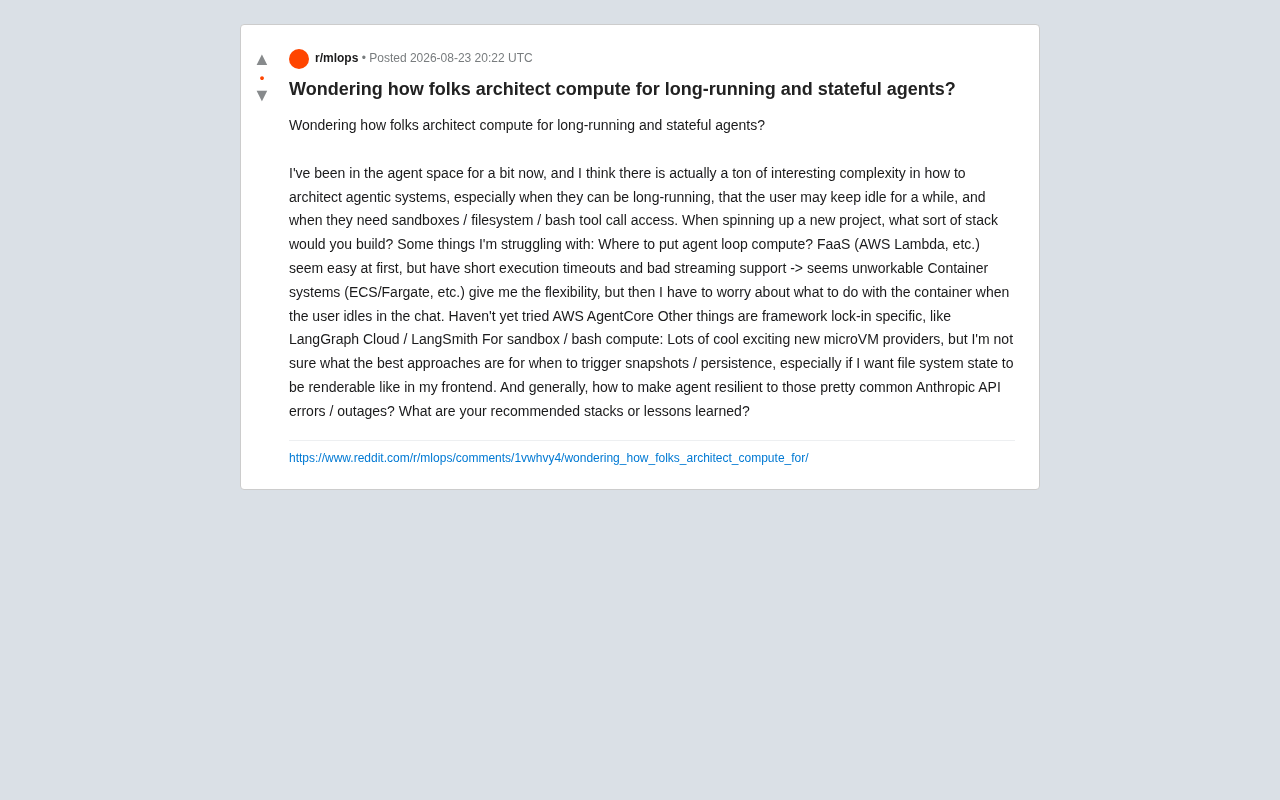
Long-running stateful AI agents face four core compute architecture challenges with no industry standard solution yet.
This article synthesizes a technical Reddit discussion focused on the compute architecture challenges of building long-running, stateful AI agents. FaaS solutions fall short due to 15-minute execution limits and poor streaming support; containers offer flexibility but create a cost-vs-state dilemma during user idle periods; and managed frameworks introduce lock-in risk. At the sandbox layer, triggering microVM snapshots at the right time is difficult, and two fundamentally different persistence needs must be handled simultaneously: conversation state and file system state. On fault tolerance, long-running agents are highly sensitive to LLM API interruptions and require built-in exponential backoff, checkpointing, and resume capabilities. Four architectural principles are distilled: match compute to task lifecycle, fully decouple state from compute, carefully balance snapshot strategies, and always assume upstream failure.
Introduction: The Hidden Complexity of Agent Architecture
As AI Agents have evolved from simple Q&A bots into complex systems capable of running for extended periods, maintaining state, and accessing file systems and terminal tools, a previously underestimated problem has come to the forefront: how do you design the underlying compute architecture for long-running, stateful agents?
A developer with years of experience in the Agent space recently sparked a technically rich discussion on Reddit. They pointed out that once an agent is no longer a one-off invocation — but instead needs to run for extended periods, tolerate long user idle times within a session, and access sandboxes, file systems, and bash tools — nearly every traditional compute solution starts showing its weaknesses. This article unpacks those core pain points and explores architectural approaches worth considering.

Where Should the Agent Loop Run?
At the heart of any agent is a continuously running "reason-act" loop (the agent loop), and the choice of compute substrate for this loop directly determines the system's availability and cost profile. Here's a breakdown of the major options and their trade-offs.
The Fatal Flaw of FaaS
FaaS (Function-as-a-Service) solutions like AWS Lambda initially seem very appealing — pay-per-use, no server management, elastic scaling. But a closer look reveals two critical issues: execution timeout limits that are too short (Lambda caps at 15 minutes) and poor support for streaming output.
For agents that need to engage in multi-turn, long-form conversations with LLMs and stream tokens back in real time, these two limitations are nearly fatal. A complex reasoning chain can run for tens of minutes or longer, making FaaS's short lifecycle essentially unworkable for long-running Agent scenarios.
The Idle Cost Problem with Containers
Shifting to container orchestration systems like ECS/Fargate does provide flexibility in runtime duration and resource configuration. But a new problem emerges: what do you do with a running container when a user goes idle in the chat interface for an extended period?
Keeping it alive continuously incurs costs; tearing it down loses state. This is fundamentally a conflict between stateful services and on-demand billing. Newer services like AWS AgentCore attempt to address this, but mature solutions for this specific scenario are still being explored across the industry.
Vendor Lock-In Risk with Managed Frameworks
Managed solutions like LangGraph Cloud / LangSmith can handle some state management concerns out of the box, but the trade-off is framework lock-in. Once you're deeply tied to a managed service built around a specific framework, future migration costs and flexibility both suffer — a decision that teams prioritizing long-term control need to weigh carefully.
Sandbox Environments and State Persistence Strategies
If choosing compute for the agent loop is already thorny, sandbox and file system persistence introduces an entirely different layer of challenge.
Timing Snapshots in microVMs
A wave of microVM (micro virtual machine) providers has emerged — these technologies give agents isolated, secure sandbox environments where they can safely execute bash commands. The real difficulty, however, isn't whether the sandbox can run, but when to trigger snapshots and persistence.
This is especially tricky because many Agent products want file system state to be rendered in real time on the frontend. This means the sandbox's file system must not only be persistable, but also exposed to the frontend interface in some way, so users can see the agent's activity on its "workbench" as it happens. Finding the right snapshot strategy that balances performance, cost, and real-time visibility remains an open problem with no standard answer.
The Dual-State Management Challenge
Interestingly, "state" here actually spans two distinct dimensions:
- Conversation / memory state: the context and interaction history within the agent's reasoning loop
- File system state: files, directories, installed dependencies, and other artifacts in the sandbox environment
These two types of state have completely different persistence mechanisms, recovery speeds, and cost models. An elegant architecture must handle both gracefully, decoupling them from the compute instance so they can be managed independently.
Fault Tolerance and Resilience: Handling Upstream Outages
Another pain point that comes up repeatedly is how to make agents resilient to LLM API errors and service interruptions.
Systems that depend on third-party LLM APIs are inherently exposed to upstream instability. For short, one-off requests, a simple retry is usually sufficient. But for a long-running agent that may have been executing for a significant time and accumulated substantial context, a poorly handled API error can cause the entire task chain to collapse and state to be lost.
This demands that the architecture include the following mechanisms by default:
- Graceful exponential backoff retries: prevent transient failures from aborting the entire workflow
- Resume-from-checkpoint capability: restart execution from the last successful step
- State checkpointing: periodically save intermediate state to reduce the cost of rollbacks
The reliability of a truly production-grade Agent system often has less to do with how powerful the model is, and more to do with whether the system can survive when its dependencies fail.
Core Architectural Principles
Drawing from this discussion, a few key principles emerge for designing compute architectures for long-running, stateful agents:
- Match the compute substrate to the task lifecycle: long-running tasks should avoid FaaS timeout traps; containers or dedicated Agent runtimes are more appropriate, but must be paired with a strategy for reclaiming idle resources
- Fully decouple state from compute: conversation state, memory, and file system state should be externalized and persisted independently from the running instance, so compute resources can be torn down and rebuilt at any time
- Snapshot strategies require careful cost-vs-latency trade-offs: if real-time file system visualization is required, snapshot frequency and overhead need to be carefully balanced
- Assume upstream will fail: build in retries, checkpoints, and resume capabilities — treat API interruptions as the norm, not the exception
Conclusion
The real value of this discussion is in surfacing the deep waters between "getting a demo to work" and "production-grade reliability" in Agent engineering. Agents that run for extended periods, maintain state, and require sandbox access carry far greater architectural complexity than typical LLM applications. There is currently no widely accepted "standard stack" for this — teams are still iterating across FaaS, containers, microVMs, and managed frameworks.
For teams actively building Agent products, understanding these architectural trade-offs may matter more than blindly adopting whatever solution happens to be trending.
Related articles
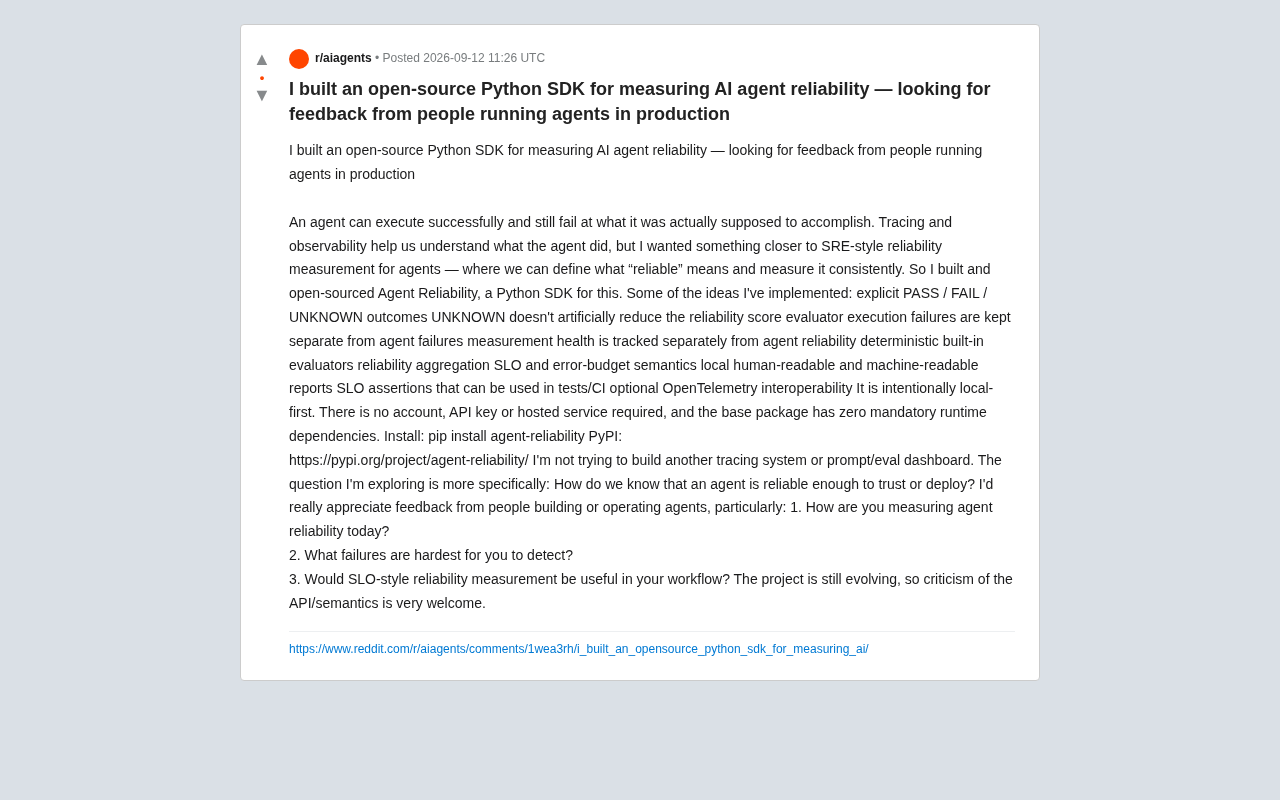
Open-Source Python SDK: Measuring AI Agent Reliability with SRE Principles
Agent Reliability is an open-source Python SDK that applies SRE's SLO and error budget concepts to AI Agent evaluation, with PASS/FAIL/UNKNOWN states, CI assertions, and zero forced dependencies.
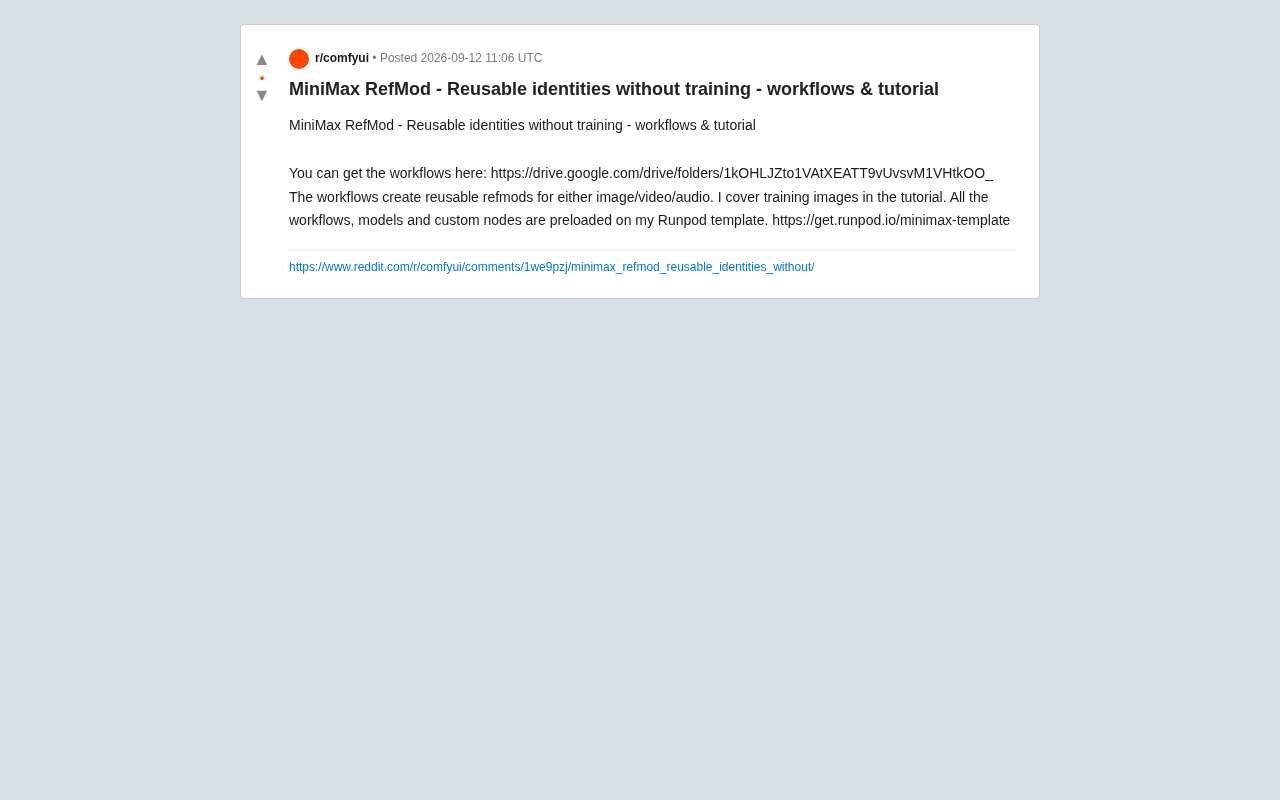
MiniMax RefMod: A Complete Guide to Training-Free Reusable Identity Workflows
MiniMax RefMod offers training-free reusable identity workflows for image, video, and audio generation. Includes Runpod template and tutorial for quick setup.

Invalid Source Material Notice
The source material provided lacks substantive information and is unrelated to AI/tech topics, making it impossible to produce a complete professional article.