Compute:Arena: A Community-Crowdsourced Local AI Performance Benchmarking Platform
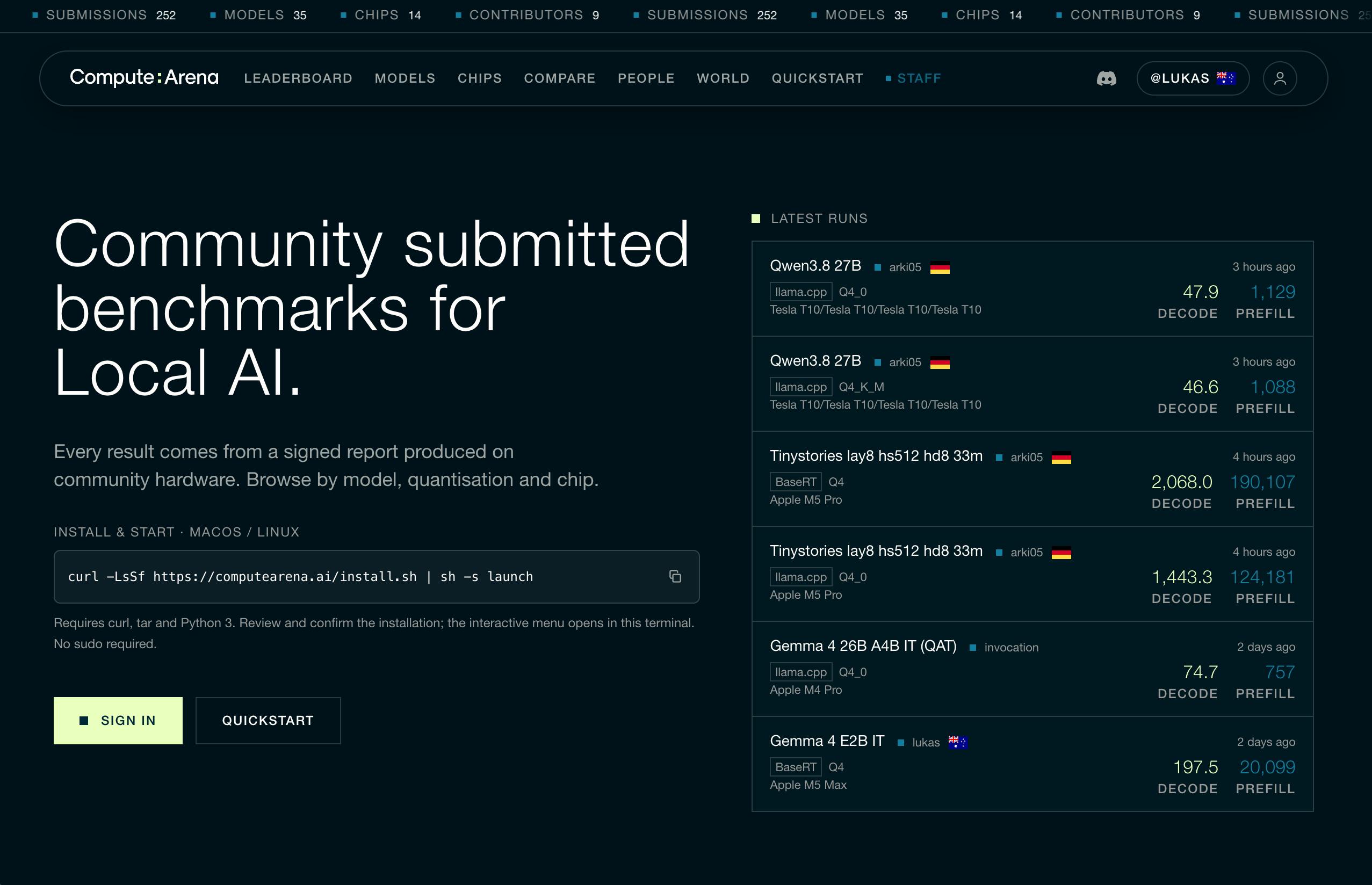
Compute:Arena crowdsources local AI model performance data across diverse hardware and quantization configurations.
Local AI model performance varies widely depending on hardware, runtime, and quantization scheme, yet community benchmark data has long been scattered and hard to compare. Compute:Arena addresses this gap with an open-source, crowdsourced approach — building a searchable, comparable benchmark database covering consumer GPUs, Apple Silicon, and popular runtimes like llama.cpp, Ollama, and MLX. Its open-source nature ensures transparent and reproducible methodology, while its Apple tag signals dedicated focus on M-series local inference. Currently at 74 Product Hunt votes and still in early stages, its long-term value hinges on establishing rigorous submission standards and a sustainable contributor community.
Running AI models locally is becoming an increasingly popular choice among developers and enthusiasts — but one question never goes away: for the same model, just how fast can it run across different hardware, runtimes, and quantization schemes? Compute:Arena aims to answer that question through community crowdsourcing.
A Community-Driven Local AI Benchmark Library
Compute:Arena has a clear positioning: a community-submitted performance benchmark platform for local AI models, covering any hardware, any runtime, and any quantization scheme. It recently launched on Product Hunt, earning 74 upvotes and landing at #17 on the daily leaderboard, categorized under tags including Open Source, Artificial Intelligence, GitHub, and Apple.
This positioning addresses a very real pain point. When you want to run a large language model on your own machine, community performance data is typically scattered and incomparable — one person tests on an M2 Max, another on an RTX 4090; one runs Q4 quantization, another Q8; the runtime might be llama.cpp, Ollama, or MLX. Without a unified standard for data collection, it's nearly impossible to get reliable references before buying hardware or choosing a configuration. What Compute:Arena sets out to do is aggregate these real-world measurements from across the community into a single searchable, comparable public database.
Why "Crowdsourcing" Is the Key
The sheer diversity of the local AI hardware ecosystem makes it impossible for any single team to cover every test combination. Consumer GPUs, multiple generations of Apple Silicon, CPUs of varying vintages — multiply those by dozens of models and multiple quantization precisions, and the number of permutations becomes enormous.
This is exactly where the crowdsourcing model shines: let users who actually own the hardware upload their own benchmark results, and harness the collective power of the community to fill in the gaps. This approach closely mirrors the established hardware benchmarking communities in the gaming world — no single-point test can match the breadth of data from a large pool of real users. For anyone planning to set up a local inference environment, a sufficiently rich crowdsourced benchmark library can directly inform decisions around hardware purchases and quantization strategy.
What Open Source Brings to the Table
Based on Compute:Arena's Product Hunt category tags, the platform has a clear open-source and GitHub identity. Open source means that benchmark methodology, data standards, and submission processes are likely transparent to the public — something especially important for benchmarking tools. Only when test methods are reproducible and auditable can community-submitted data be meaningfully compared across the board.
Worth noting is the Apple tag, which signals that the platform pays special attention to local inference on Apple Silicon. As M-series chips demonstrate increasingly capable local LLM performance thanks to their Unified Memory Architecture, demand for benchmark data in this specific niche is growing rapidly.
Apple Silicon's Unified Memory Architecture (UMA) is the key reason it stands out for local LLM inference. In traditional PC architectures, the CPU and GPU each have their own separate memory pools, creating bandwidth bottlenecks when transferring data between them. M-series chips, by contrast, have the CPU, GPU, and Neural Engine all sharing a single high-bandwidth memory pool — model weights can be accessed directly by the GPU without copying across a bus. This means that even a consumer-grade M2/M3 MacBook can run quantized models with up to 70B parameters locally with relatively low latency. MLX is Apple's officially optimized machine learning framework for this architecture, and together with llama.cpp's Metal backend, it forms the primary technical path for local inference on Apple Silicon. Performance data for this specific scenario is currently scarce in the community, which explains why Compute:Arena gives the Apple platform dedicated attention.
What We Know — and What Remains to Be Seen
Given the current publicly available information, Compute:Arena presents more of a clear product vision and positioning than a proven track record. Key metrics such as database scale, degree of test standardization, and community activity level still need further validation. The product page currently has only 1 comment, indicating it is still in early stages.
For community-driven tools like this, success or failure typically comes down to two things: whether the platform can establish submission standards that are rigorous enough to ensure data quality yet easy enough to actually follow, and whether it can create a positive flywheel that keeps contributors uploading results for new hardware and new models. If both of those click into place, Compute:Arena has a real shot at becoming a practical piece of infrastructure for the local AI community.
Summary
Compute:Arena targets a genuine and specific need in the local AI wave — solving the "just how fast can my hardware run this?" question through a unified, open, crowdsourced approach. Its open-source and community-oriented nature gives reason to be optimistic about both its transparency and its coverage breadth. For developers and enthusiasts evaluating local inference setups, this is a project worth bookmarking and keeping an eye on.
Background: Key Concepts
Quantization is one of the core variables affecting performance in local inference scenarios. It refers to the process of compressing model weights from high-precision floating-point formats (such as FP32 or FP16) into lower-precision integers (such as INT8 or INT4), trading a degree of accuracy for smaller memory footprints and faster inference speeds. Common quantization schemes like Q4_K_M and Q8_0 come from the GGUF format's naming system, and throughput differences between schemes on the same hardware can be several times over. Meanwhile, runtimes like llama.cpp, Ollama, and MLX each support different quantization formats and take different low-level optimization paths, making cross-runtime comparisons on "the same model, same hardware" equally complex. This is precisely why a benchmark library that can accurately record the four-dimensional combination of model × quantization scheme × runtime × hardware offers real, practical value for users facing decision paralysis.
Related articles
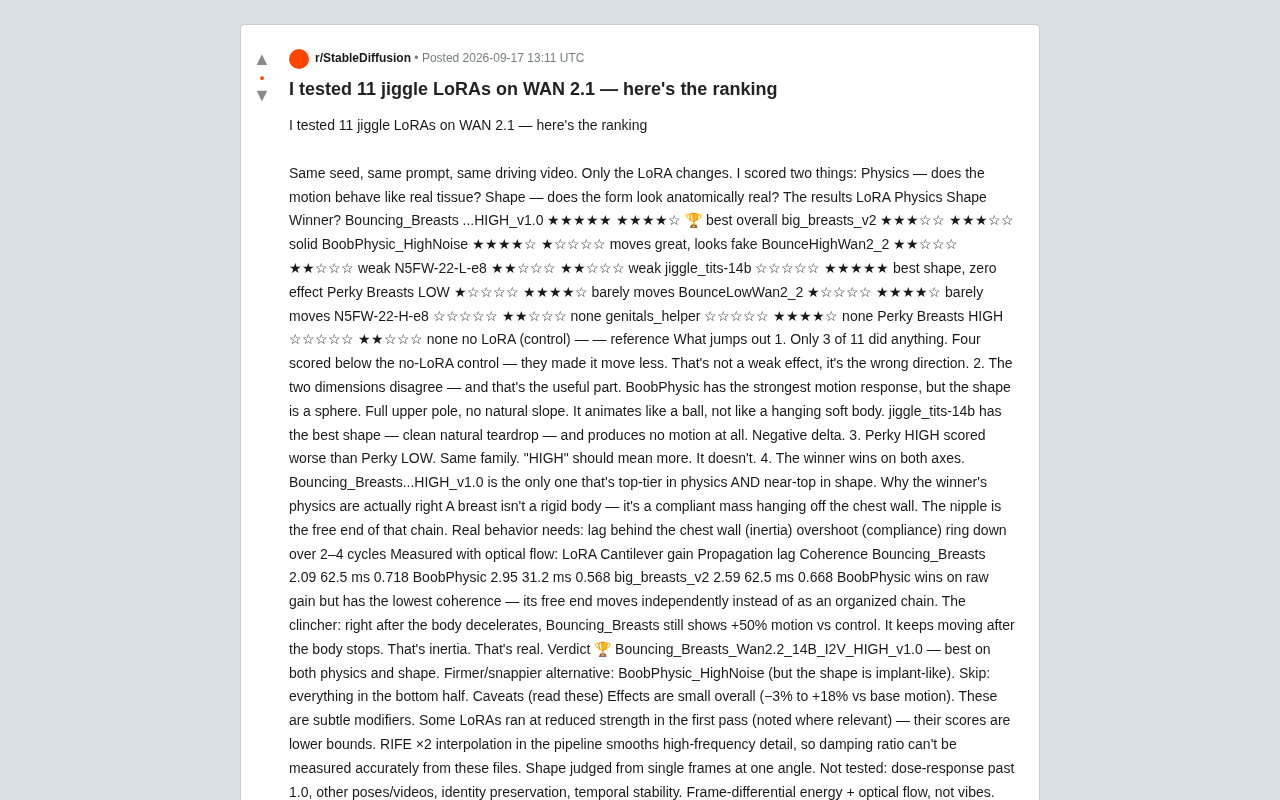
WAN 2.1 Physics Motion LoRA Benchmark: Rankings and Methodology for 11 Models Tested
A Reddit user benchmarked 11 physics-motion LoRAs on WAN 2.1 using optical flow analysis. Only 3 worked meaningfully; 4 scored below the no-LoRA baseline. Full rankings and methodology inside.

Lucid Partners with Bolt to Target European Robotaxi Market
Lucid Motors has signed a letter of intent with European mobility platform Bolt to explore Robotaxi services in Europe, though no vehicle orders have been placed yet.
AI Assistants Enter the "Phone Call" Era: Instinct and Meta Muse Add Voice Task Execution
AI assistants Instinct and Meta Muse now make phone calls on your behalf — booking restaurants, canceling subscriptions — marking a leap from chat tools to real-world agents.