Conditional Diffusion Models Learn Transition Kernels of Jump-Diffusion Processes: New Theoretical and Empirical Advances

Conditional diffusion models non-parametrically learn jump-diffusion transition kernels with rigorous non-asymptotic error guarantees.
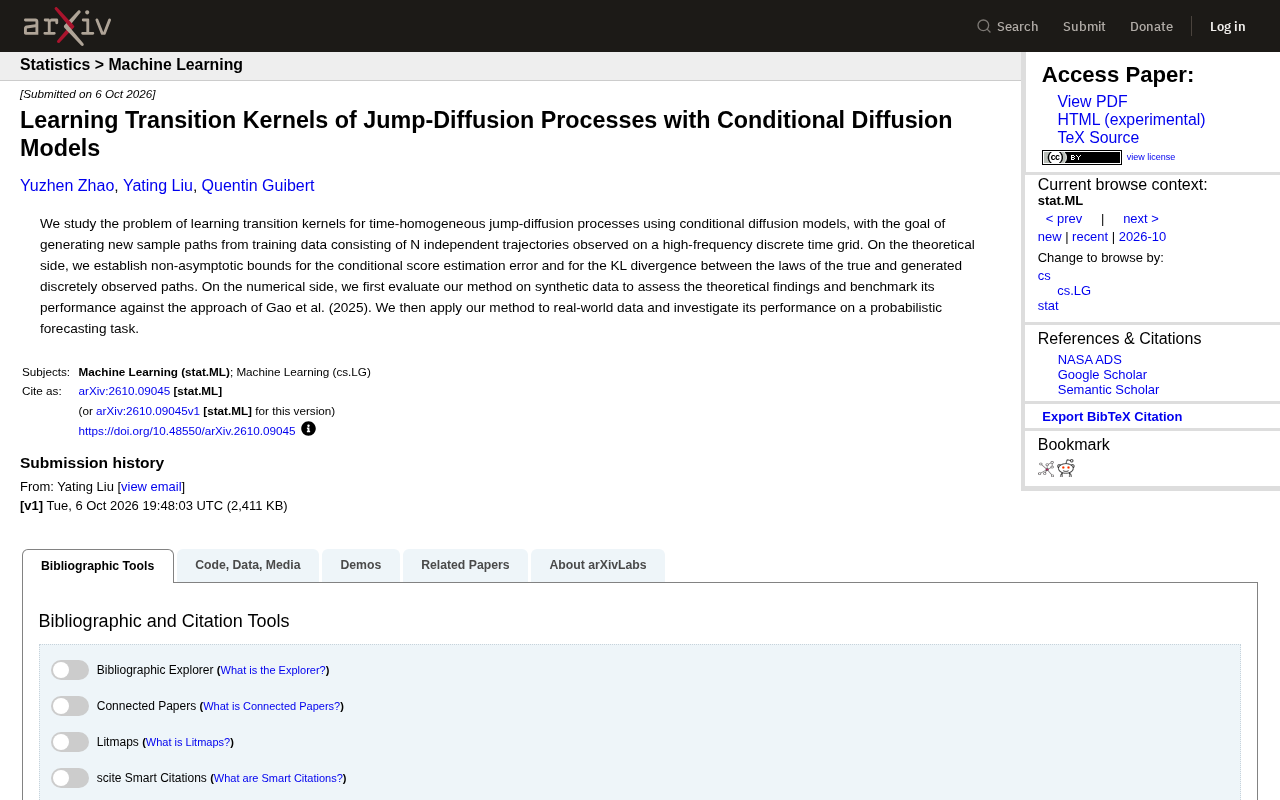
This arXiv preprint proposes learning the transition kernels of time-homogeneous jump-diffusion processes in a data-driven way using conditional diffusion models, generating new sample paths from finite observed trajectories without pre-specifying jump distributions or diffusion coefficients. The study establishes non-asymptotic bounds on conditional score estimation error and KL divergence convergence guarantees between generated and true path distributions. Experiments on both synthetic benchmarks and real-world probabilistic forecasting validate the theoretical and practical consistency of the approach.
Background: Why Jump-Diffusion Processes Are Hard to Model
Jump-diffusion processes are essential tools for modeling the stochastic evolution of systems in finance, physics, and biology. By layering discrete jump components on top of continuous Brownian motion, they can capture real-world phenomena such as sudden asset price spikes or crashes, and neural spike firing. Yet a central challenge has long persisted: how to accurately learn the transition kernel — the probabilistic law governing how a system evolves from one state to the next — from a limited set of observed trajectories.
Traditional methods typically rely on strong parametric assumptions about the process. When real data deviates from those assumptions, model performance degrades significantly. A new study posted on arXiv (arXiv:2610.09045v1) proposes a fresh approach: leveraging conditional diffusion models, which have recently achieved remarkable success in generative AI, to learn the transition kernels of time-homogeneous jump-diffusion processes in a data-driven manner — and to use those learned kernels to generate new sample paths.
The most iconic classical model for jump-diffusion processes is the jump-diffusion option pricing model proposed by Merton (1976), in which asset prices are driven by geometric Brownian motion superimposed with compound Poisson jumps. Learning the transition kernel is difficult for two main reasons. First, the randomness of jump events means that within a single time step, the system may undergo vastly different state transitions, resulting in conditional distributions with multi-modal, heavy-tailed shapes that are hard to capture with finite-parameter families. Second, in a discrete observation setting, neither the number of jumps nor their timing along the continuous-time path is directly observable — the so-called "latent jump" problem — making likelihood-based estimation analytically intractable in most cases and forcing reliance on computationally expensive numerical integration or MCMC methods. The time-homogeneous assumption, while restricting time-varying dynamics, allows observations from different time periods to be treated as independent samples from the same transition kernel, substantially reducing statistical complexity and providing the necessary foundation for theoretical analysis.
Method Overview: Generating Stochastic Paths with a Generative Model
The research objective is clearly defined: given N independent trajectories observed on a high-frequency discrete time grid as training data, the model must learn to generate new paths that follow the same distributional laws. The key word here is "conditional" — the diffusion model does not generate samples unconditionally, but rather uses the current state as a condition to predict the distribution of the next state, iteratively chaining these steps to produce complete time series.
This approach cleverly reframes sequential generation as a problem of learning transition kernels. By modeling complex conditional probability distributions through iterative denoising, diffusion models require no pre-specified form for the jump distribution or diffusion coefficients, making them far more expressive than traditional parametric methods. This non-parametric flexibility is especially valuable for the hybrid dynamics combining continuous diffusion and discrete jumps.
Conditional diffusion models are an extension of denoising diffusion probabilistic models (DDPMs). Standard DDPMs progressively corrupt data into Gaussian noise through a forward noising process, then train a neural network to reverse this process and recover the data distribution. The conditional variant additionally injects conditioning information — here, the current system state — into the denoising network's input, enabling the model to produce samples for a specific condition. In the context of transition kernel learning, the model generates samples of $X_{t+\Delta t}$ conditioned on $X_t$. By training repeatedly on large numbers of observed pairs $(X_t, X_{t+\Delta t})$, the neural network implicitly learns the full shape of the conditional distribution $p(X_{t+\Delta t} \mid X_t)$ without any parametric assumptions about its functional form. The key distinction from classical Kalman filtering or particle filtering is that those methods require an explicitly specified state transition equation, whereas the diffusion model shifts that prior knowledge requirement onto data volume and model capacity.
Theoretical Contributions: Rigorous Error Bounds
The study delivers two important theoretical results, which form the core value distinguishing this work from purely engineering-driven practice.
Non-Asymptotic Bounds on Conditional Score Estimation
Training a diffusion model is fundamentally about learning the "score function" of the data distribution — the gradient of the log density. The study establishes non-asymptotic bounds on conditional score estimation error. "Non-asymptotic" means these bounds hold for finite sample sizes, not merely in the limit as sample size approaches infinity. This is more practically meaningful, since real data is always finite.
The score function $\nabla_x \log p(x)$ is the cornerstone of score-based generative models, systematically introduced by Hyvärinen (2005) within the score matching framework. Intuitively, it points in the direction of steepest ascent of the data density, allowing particles sampled via Langevin dynamics to migrate toward high-density regions. In conditional diffusion models, the network actually learns the conditional score of the intermediate noised variable, $\nabla_{x_\tau} \log p_\tau(x_\tau \mid x_0)$, where $\tau$ is the diffusion timestep. Establishing non-asymptotic bounds typically requires specific assumptions about the function class of the score network (e.g., Sobolev or Besov classes), the regularity of the training data distribution, and the network approximation error. Quantitative relationships between sample complexity and estimation error are then derived using tools from statistical learning theory such as covering numbers or Rademacher complexity. This line of results has advanced rapidly in recent years — notably in Chen et al. (2023) — and the present paper extends it to the conditional setting for jump-diffusions. The technical challenge lies in handling the distributional discontinuities introduced by jumps.
Convergence Guarantees in KL Divergence
Going further, the study quantifies the KL divergence (Kullback-Leibler divergence) between the distribution of real discretely-observed paths and the distribution of model-generated paths. KL divergence measures the discrepancy between two distributions. This result theoretically guarantees that, as long as the score is estimated accurately enough, the statistical properties of generated paths will closely approximate those of the true process. This provides a rigorous mathematical foundation for "simulating jump-diffusion processes with diffusion models," rather than resting only on the empirical observation that they "look similar."
The KL divergence $D_{\mathrm{KL}}(P | Q) = \mathbb{E}_P[\log(P/Q)]$ is the standard information-theoretic tool for measuring discrepancy between probability distributions. Its non-negativity and sensitivity to tail distributions make it widely used in evaluating generative models. The key tools for propagating score estimation error into path-distribution KL divergence are Girsanov's theorem and the Fokker-Planck equation from stochastic calculus: score estimation error essentially introduces bias in the drift term of the reverse SDE, which accumulates over time and causes the generated path distribution to deviate from the true distribution. This KL divergence can then be upper-bounded by integrating the $L^2$ norm of the bias. For processes with jumps, the change of measure on path space requires more refined tools such as the compensated Poisson random measure, making the theoretical derivation significantly more involved than in the pure-diffusion case — and this is where the paper's theoretical contribution is most challenging.
Empirical Evaluation: Synthetic and Real-World Data
The numerical experiments proceed in two stages with a clear logical progression.
The first stage is conducted on synthetic data, with the goal of validating theoretical findings in a controlled setting where the true distribution is known. The proposed method is benchmarked against the existing method of Gao et al., examining whether actual performance aligns with the predictions of the error bounds. The advantage of synthetic data is that ground truth is available, enabling clear assessment of convergence behavior and the tightness of the theoretical bounds.
The second stage applies the method to real-world data, focusing on a probabilistic forecasting task. Unlike point forecasting, which outputs a single value, probabilistic forecasting requires the model to produce the full distribution of future states, thereby characterizing uncertainty. This is precisely where jump-diffusion process modeling excels — applications in financial risk management, extreme event early warning, and similar domains critically depend on accurate characterization of tail distributions and sudden jumps.
Significance and Outlook
The value of this work lies in bridging generative AI and stochastic process theory. On one hand, it extends diffusion models from their popular applications in image and text generation to the rigorous modeling of structured stochastic dynamics. On the other hand, it goes beyond an engineering demonstration that "works," filling in the theoretical analysis — a piece that is often overlooked.
For researchers and practitioners in quantitative finance and time series forecasting, this represents a new modeling paradigm: rather than manually designing parametric models for each type of process, diffusion models can autonomously capture complex transition dynamics from data, while still providing theoretically controlled error guarantees. As diffusion models are further explored for continuous-time stochastic processes, similar methods may find broader application in high-frequency financial data, physical simulation, climate modeling, and beyond.
Of course, as a preprint, the method still awaits validation and extension in high-dimensional state spaces, non-time-homogeneous processes, and with respect to computational efficiency. But the research framework it demonstrates — theoretical bounds, empirical benchmarking, and real-world application in one unified effort — sets a commendable standard for future work.
Related articles

Gaussian Process Bandit Optimization: Exploration Strategies and Inference Regret Guarantees
Cumulative regret guarantees in Bayesian optimization fail to reflect final recommendation quality. This article examines a new study that provides inference regret guarantees for Gaussian process bandit optimization through exploration query strategies and fill distance analysis, validated on hyperparameter optimization and control tasks.

The Most Detailed Codex Guide on Bilibili: From Installation to Real-World Practice
The most detailed Codex guide on Bilibili: from app store installation to daily work mode configuration, with a real coffee shop project demonstrating file organization, data extraction, dashboard creation, and other practical tasks. Learn to use Plan Mode and desktop pets to leverage Codex efficiently.

Appearance Compensation in Volume Rendering: Why RGB Accuracy Cannot Guarantee Density Correctness
Volume rendering research reveals that volumetric data perfectly reproducing external RGB views may still contain density errors: appearance compensation can double central density and keep external rays unchanged even when L2 error exceeds 14.52%. Density recovery depends on appearance capacity, spatial resolution, and measurement design.