ConferenceGrid: A Deep Dive into the B2B Conference Intelligence Database

ConferenceGrid turns scattered B2B conference data into a queryable relationship graph for sales and competitive intelligence.
ConferenceGrid is a B2B conference intelligence database covering 6,000+ conferences, 62,000 speakers, and 55,000 sponsor slots. Using graph database architecture, it connects companies, events, and people into a queryable relationship network, enabling multi-hop queries for sales prospecting, competitive analysis, and partnership discovery. It positions conference participation as a high-confidence intent signal for ABM strategies.
An Overlooked B2B Lead Goldmine
In B2B marketing, conferences have always been a core channel for customer acquisition and brand exposure. Companies sponsor trade shows, send speakers, and set up booths—all behaviors that contain rich business intelligence. Yet for years, this data has been scattered across individual conference websites, agenda pages, and sponsor lists, making it nearly impossible to leverage systematically.
According to research from Bizzabo, Forrester, and other institutions, B2B companies allocate an average of 20%-30% of their marketing budgets to offline events (conferences, trade shows, roadshows, etc.), making it the second-largest budget category after digital advertising. Sponsorship fees for a mid-tier industry summit typically range from tens of thousands to hundreds of thousands of dollars, while top-tier events (such as CES, AWS re:Invent, and Dreamforce) can command booth and sponsorship fees in the millions. Because the investment threshold is so high, a company's conference choices inherently carry strong strategic signals—reflecting its current business priorities, target customer segments, and market expansion direction.
ConferenceGrid recently launched on Product Hunt (ranking #13 on the day with 83 votes), targeting precisely this pain point. It positions itself as a "conference database for B2B teams," aiming to consolidate fragmented conference data into a queryable relationship network.
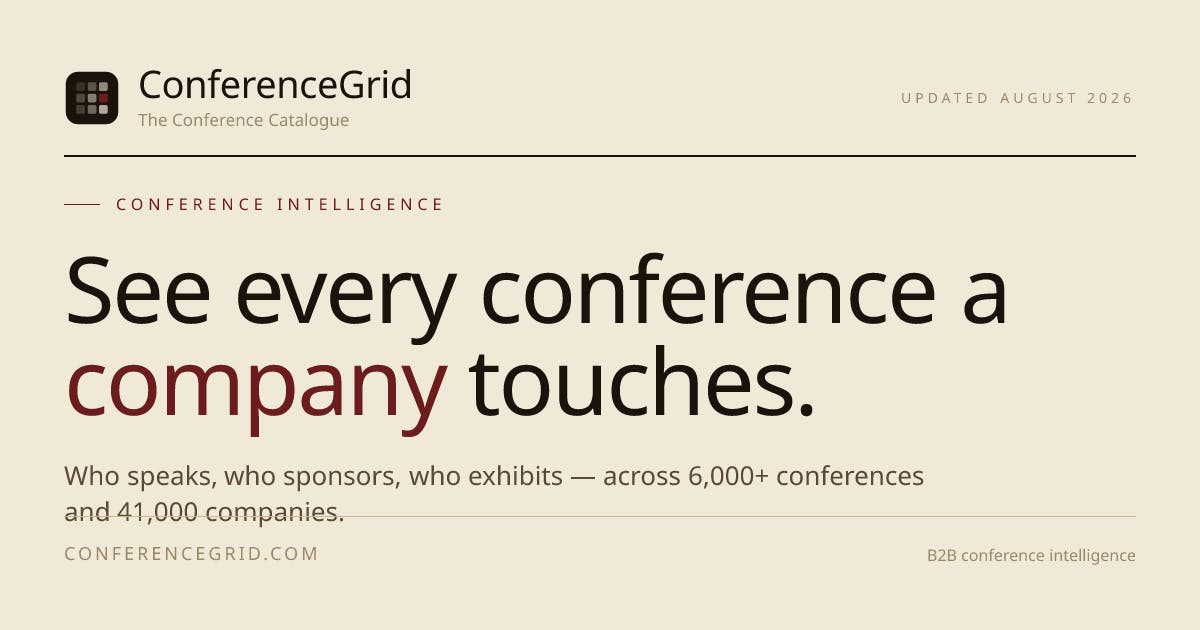
ConferenceGrid's Core Capabilities: Turning Conference Data into a Relationship Graph
Data Scale
According to official information, ConferenceGrid currently covers:
- 6,000+ conferences
- 62,000 speakers
- 55,000 sponsor slots
This data is organized as a "graph" rather than simple tabular listings. This design philosophy is crucial—it means users can start from any node (company, person, or conference) and trace its relationships.
From a technical perspective, ConferenceGrid's graph structure is rooted in the design principles of graph databases. Unlike traditional relational databases (such as MySQL) that store data in rows and columns, graph databases use nodes and edges as their fundamental units, making them naturally suited for expressing complex relationships between entities. Common graph databases include Neo4j and Amazon Neptune. In B2B intelligence scenarios, the advantage of graph structures lies in supporting "multi-hop queries"—starting from one node and tracing multiple layers of connections along relationship paths. In traditional databases, this would require extensive JOIN operations with extremely poor performance. Knowledge graph technology has rapidly gained adoption in enterprise applications in recent years, with Google's Knowledge Graph and LinkedIn's Economic Graph serving as prime examples of large-scale commercial implementations.
Typical Use Cases
The product's core promise is: Query any company and instantly see every conference it has sponsored, exhibited at, or spoken at.
This delivers practical value for different roles:
- Sales teams: Assess a target account's marketing budget direction and priorities through the conferences they attend, and identify opportunities for face-to-face interaction;
- Marketing teams: Analyze competitors' conference strategies and evaluate which events are worth investing in;
- BD and partnership teams: Identify potential partners active at the same set of conferences;
- Recruiting and talent teams: Locate industry speakers who frequently present in specific domains.
Why Graph Structure Is Key to B2B Intelligence Analysis
Traditional conference information services can typically only answer one-directional questions like "who participated in a given conference." The graph structure that ConferenceGrid emphasizes essentially connects three types of entities—companies, conferences, and people—enabling bidirectional and even multi-hop queries.
For example, you can not only find which conferences a company has sponsored but also discover in reverse "which companies appear simultaneously at these three industry summits," or "what other conferences has a high-frequency speaker appeared at, and which companies do they represent." This relational mining capability is the most valuable aspect of B2B intelligence analysis.
Product Positioning and Market Opportunity
ConferenceGrid is categorized under Marketing and was built by independent developer Natwar Maheshwari. From a product perspective, it targets a relatively vertical but genuinely needed niche market—B2B intent data based on offline events.
As ABM (Account-Based Marketing) and intent data receive increasing attention, conference participation behavior is actually a strong signal. ABM is a B2B marketing strategy whose core approach is concentrating marketing resources on pre-selected high-value target accounts (companies) rather than casting a wide net. ABM requires tight alignment between sales and marketing teams to develop personalized outreach strategies for each target account. According to industry reports from platforms like Demandbase, companies implementing ABM see significantly higher average deal sizes and win rates compared to traditional marketing approaches. The core challenge of ABM lies in accurately identifying target accounts' purchasing intent—which is precisely where intent data proves its value.
Intent data is typically divided into three categories: first-party intent data (visitor behavior on your own website), second-party intent data (interaction data shared by partners), and third-party intent data (browsing, search, and content consumption behavior aggregated through external platforms). Representative vendors include Bombora, 6sense, and TechTarget. However, purely online intent data suffers from a "high noise, weak signal" problem—a user browsing an article doesn't necessarily indicate purchasing intent. By contrast, when a company is willing to spend money sponsoring a conference on a specific topic, it usually indicates a clear strategic investment or procurement need in that area. This type of "voting with real dollars" signal has far higher credibility than weak signals like web browsing, qualifying as a "high-confidence intent signal."
Questions Worth Examining
As an early-stage product, ConferenceGrid still has several aspects worth watching:
Data Timeliness and Coverage
Conference data changes frequently—agenda adjustments, sponsor additions and removals, and speaker substitutions are all routine. A scale of 6,000 conferences isn't particularly massive on a global level, and any bias in industry or geographic coverage (such as a lean toward tech or North America) will directly impact usability for different users. How data update frequency is maintained is also key to long-term value.
Data Sources and Compliance
Speaker information and sponsor lists mostly come from publicly available conference websites, but how personal information is handled and whether it complies with various data regulations (such as the EU's GDPR and California's CCPA) are issues that this type of data product must address.
Differentiation Moat
Conference information itself is public. The real moat lies in data completeness, structuring quality, and ongoing maintenance capability. In the Data-as-a-Service space, competitive moats typically don't come from exclusive access to a single data source but from accumulation across three dimensions: coverage (data completeness), structuring quality (whether data has been cleaned, standardized, and entity-disambiguated), and timeliness (whether update frequency can keep pace with real-world changes).
A typical success story is ZoomInfo—its core data (business contact information) mostly comes from public sources, but through continuous automated collection, manual verification, and machine learning deduplication, it built a data quality moat that's nearly impossible to replicate, ultimately going public with a market cap exceeding $10 billion. ConferenceGrid faces a similar strategic choice: graph-based relational mining is its current highlight, but whether it can build a sufficiently deep moat remains to be seen based on subsequent feature evolution and data accumulation speed.
Conclusion
ConferenceGrid represents a precise wedge in B2B marketing tools: transforming long-overlooked offline conference data into queryable, analyzable business intelligence. For teams that rely on event marketing and precision customer acquisition, tools like this can significantly reduce the labor costs of intelligence gathering.
It's still in its early stages, and how far it can go ultimately depends on data scalability, timeliness, and whether the value of its "relationship graph" can truly translate into decision-making efficiency for users. But at minimum, it validates a direction—in the era of data-driven marketing, the more vertical and structured a data asset is, the more likely it is to become a source of differentiated competitive advantage.
Related articles

Why Does Gemini Keep Getting Things Wrong? A Deep Dive into AI Hallucinations and How to Deal with Them
Deep analysis of why Google Gemini and other LLMs frequently produce errors, explaining the technical mechanisms behind AI hallucinations and offering practical prompting tips for better AI usage.

DNS Sale Record Proposal: Declaring Domain For-Sale Status via TXT Records
A new proposal suggests declaring domain for-sale status via DNS TXT records, enabling machine-readable domain trade information. This article analyzes its technical implementation, market impact, and risks.

Legendary OSINT: The Viral Open-Source Intelligence Tool Collection on GitHub
Legendary OSINT is a fast-growing GitHub resource library with 1600+ Stars, aggregating OSINT tools for anti-fraud, threat intelligence, and KYC/AML compliance.