DNS Sale Record Proposal: Declaring Domain For-Sale Status via TXT Records

A proposal to use DNS TXT records for declaring domains as for-sale, enabling automated domain trade discovery.
A new proposal suggests using DNS TXT records to declare domain for-sale status in a machine-readable format, bypassing limitations of WHOIS privacy restrictions and centralized trading platforms. By leveraging existing DNS infrastructure with a standardized TXT record format like `_for-sale.example.com`, buyers and tools could automatically discover available domains without relying on intermediaries. While technically simple, the proposal faces adoption challenges and potential abuse risks.
An Overlooked Pain Point in Domain Trading
In the world of the internet, domain trading is a massive yet highly fragmented market. Of the approximately 350 million registered domains globally, more than half may be idle or available for sale, with countless domains changing hands every day. Yet a long-standing problem has never been elegantly solved: How can an interested buyer quickly and reliably find out whether a domain is for sale, and who to contact about it?
Current approaches rely on several less-than-ideal methods: posting sale information on domain landing pages, attempting to reach owners through WHOIS contact details, or using listing systems on third-party domain trading platforms. These approaches either depend on the existence of an HTTP service, are limited by WHOIS privacy protection policies, or are trapped within the closed ecosystems of specific platforms.
Notably, the WHOIS pathway has become increasingly difficult in recent years. The WHOIS protocol (RFC 3912) is one of the internet's earliest directory services, once allowing anyone to query a domain registrant's name, address, phone number, and email. However, the implementation of the EU's General Data Protection Regulation (GDPR) in 2018 fundamentally changed this landscape. ICANN was forced to require registrars to hide personal registration information, resulting in the contact details in most domain WHOIS records being replaced with privacy protection service proxy information. ICANN subsequently introduced RDAP (Registration Data Access Protocol) as a modern replacement for WHOIS, but accessing complete registration data still requires a strict authentication process. While this privacy protection shields domain holders from harassment, it has also objectively severed the communication channel between potential buyers and domain owners, exacerbating information asymmetry in domain trading.
Mainstream domain trading platforms—such as Sedo, Afternic, Dan.com, GoDaddy Auctions, and others—typically charge 10%-20% commission. Although they provide escrow services to protect both buyers and sellers, the market's core pain point remains that "price discovery" is extremely difficult. A large number of domains exist in a "dark market" state where owners are willing to sell but haven't listed on any platform; meanwhile, buyers looking for specific domains often need to go through domain brokers, cold emails, or even legal channels to establish contact.
A recent discussion on Hacker News pointed to a new approach: having domains declare themselves "for sale" directly in DNS records. While this idea may seem simple, it addresses a real gap in domain infrastructure.
Why Choose DNS as the Carrier for Domain Sale Information
The Natural Advantages of DNS
DNS (Domain Name System) is one of the internet's most fundamental and ubiquitous infrastructure layers. Born in 1983 and designed by Paul Mockapetris, it was originally defined in RFC 882 and RFC 883 (later superseded by RFC 1034 and RFC 1035). DNS is a hierarchical distributed database system that translates human-readable domain names into machine-readable IP addresses. Its global resolution infrastructure consists of 13 root server clusters, hundreds of top-level domain servers, and countless recursive resolvers, processing trillions of queries daily.
Any registered domain, regardless of whether it has a website or email service configured, necessarily has DNS records. This means DNS is an ideal carrier for "domain for sale" information—it doesn't depend on the existence of any application-layer service. It's precisely this ubiquitous coverage that makes DNS an ideal base layer for carrying metadata.
By comparison, declaring sale status through a web landing page has obvious drawbacks: domain owners must actively set up and maintain a web server, yet many domains for sale are precisely those sitting idle with no website configured at all. In such cases, a potential buyer has virtually nowhere to start.
The Market Transformation Enabled by Machine Readability
Another key value of encoding sale information into DNS records (such as TXT records) is machine readability. This means domain trading platforms, crawlers, investment tools, and even browser extensions can automatically scan and index this information without needing to parse human-readable web content or bypass anti-scraping mechanisms.
This provides the technical foundation for building a more transparent, open secondary domain market. In theory, anyone could build a domain trade information aggregation service based on DNS records, without requiring permission from any centralized platform.
Technical Implementation Path for DNS Domain Sale Records
Implementation Based on TXT Records
The most straightforward implementation uses DNS TXT record types. TXT records were originally defined in RFC 1035, designed to store arbitrary text information associated with a domain. Over time, TXT records have been assigned increasingly standardized uses: SPF (Sender Policy Framework, RFC 7208) uses TXT records to declare which mail servers are authorized to send email on behalf of a domain; DKIM (DomainKeys Identified Mail, RFC 6376) publishes public keys for verifying email signatures via TXT records; DMARC (RFC 7489) likewise relies on TXT records to declare email authentication policies. Additionally, Google, Microsoft, and other service providers widely use TXT records for domain ownership verification.
This pattern of "convention-based" extension demonstrates the flexibility of TXT records as a general-purpose metadata carrier—no modification to the DNS protocol itself is needed, only the agreement on new text format specifications. Defining a standardized TXT record format for domain sale status is the path of least resistance.
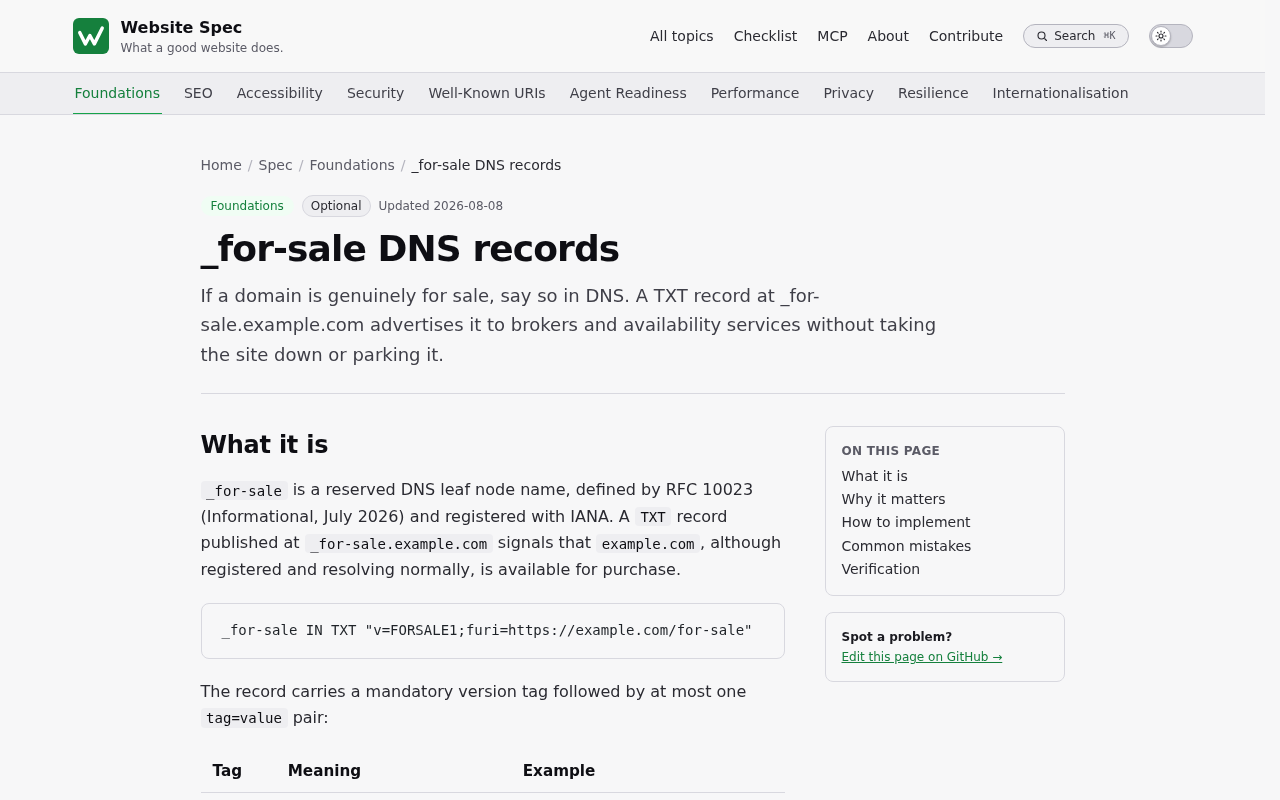
One can imagine a record format like the following:
_for-sale.example.com. IN TXT "v=sale1; price=5000; currency=USD; contact=mailto:[email protected]"
By agreeing on a unified prefix (such as _for-sale) and field structure, tools can reliably extract key information like price, currency, and contact details. The advantage of this approach is that no DNS software or protocol modifications are required—any domain owner can add such a record today.
Challenges of Standardization and Adoption
However, the true prerequisite for this idea to deliver value is broad standardization consensus. If everyone uses their own format to declare sale information, the benefits of machine readability will be significantly diminished. Forming a de facto standard requires joint support from major domain registrars, trading platforms, and related toolchains.
This is the classic dilemma faced by many similar infrastructure proposals: technically straightforward, but extremely difficult to overcome the "chicken-and-egg" adoption threshold. Without enough domains using it, tools have no incentive to support it; without tool support, domain owners have no incentive to set it up.
Value and Risks of the DNS Domain Sale Proposal
Positive Implications for the Domain Trading Ecosystem
If this approach were widely adopted, it could make the domain trading market significantly more transparent and efficient. Buyers could more easily discover domains for sale and contact sellers directly, reducing information monopolies and commission extraction by intermediary platforms. For independent developers and small businesses, this means lower domain acquisition costs and a smoother transaction experience.
It also aligns with a "decentralized" internet philosophy—placing metadata directly on the open infrastructure layer rather than within closed commercial platforms.
Security and Abuse Risks to Watch For
On the other hand, directly exposing contact information in public DNS records could also lead to spam and abuse issues. Just as publicly available WHOIS information once became a breeding ground for spam and scams, publicly available sale contact details could similarly be exploited by automated tools.
Additionally, there are challenges around information authenticity and timeliness. DNS's caching mechanism is central to its efficient operation but introduces information timeliness issues. Every DNS record carries a TTL (Time To Live) value specifying how many seconds a recursive resolver may cache that record. Common TTL settings range from 300 seconds (5 minutes) to 86400 seconds (24 hours). After a domain owner modifies a DNS record, the old record may still be returned by resolvers worldwide until the TTL expires. For domain sale status information that may change frequently, TTL settings need to balance query efficiency against information freshness—too short a TTL increases load on authoritative DNS servers, while too long may cause already-sold domains to still appear as available.
As for the risk of malicious parties setting fake sale information for domains they don't own, this is technically constrained by DNS control rights—only a domain's actual administrator can modify its DNS records, providing a basic layer of authenticity assurance.
Conclusion: Domain Trading Innovation That Returns to Infrastructure
The idea of "letting domains declare themselves for sale in DNS" is not earth-shattering in itself—technically, it could even be called quite modest. But it embodies an approach worth appreciating: using existing, ubiquitous infrastructure to solve a long-overlooked practical problem.
From SPF to DKIM to DMARC, TXT records have repeatedly proven their value as the internet's "universal metadata layer." Domain sale information is simply another natural extension of this pattern.
Currently, this proposal is still in the early stages of conceptual discussion. Whether it can develop into a widely adopted domain trading standard depends on community consensus formation, toolchain support, and effective responses to abuse risks. But regardless of the final outcome, this kind of thinking that returns to the essence of infrastructure is often precisely where internet innovation originates.
Related articles

CSS Anchor Positioning: A New UI Positioning Approach Without JavaScript
A deep dive into CSS Anchor Positioning: from anchor-name and position-anchor to the anchor() function, position-area shorthand, position-try-fallbacks, anchor-size, and upcoming anchor queries.

New AI Chart Interaction: Continuous Follow-up Questions and Visualization in Conversation
Explore a new AI interaction method for continuously generating charts in conversation. Use the /visualize command to ask follow-up questions and visualize answers in the same chat window, improving data analysis efficiency.

Cursor Merges Into X Subscription: Paid Plans Share Unified Usage Pool, Grok Model Coding Usage Doubled
Cursor joins The X Subscription with a unified usage pool and doubled Grok coding quota. Third-party models shift to API pricing. Existing users can keep or migrate plans.