Congress Summons Jensen Huang: Nvidia CEO Faces Questions Over China Espionage Allegations

House Republicans demand Jensen Huang give a closed-door briefing on China espionage allegations, plunging Nvidia back into geopolitical turmoil.
Republicans in the U.S. House of Representatives have demanded that Nvidia CEO Jensen Huang give a closed-door briefing by the end of Wednesday regarding an "affair" with a person accused of being a Chinese spy. The report comes from a single source, with no details on the allegations, the person involved, or the nature of the relationship disclosed, and neither Nvidia nor Huang has publicly responded. The article argues that Nvidia's dominant position in the AI chip market and its sensitive role in U.S.-China tech rivalry have quickly drawn congressional attention. The closed-door briefing is both a chance to clarify and a high-stakes gamble, and the fallout could affect the regulatory environment across the entire AI chip supply chain.
A Sudden Demand for a Closed-Door Briefing
According to an RSS source, Republicans in the U.S. House of Representatives have demanded that Nvidia CEO Jensen Huang give a closed-door briefing by the end of this Wednesday regarding an "affair" (which could mean a business dealing or a personal relationship) with an individual accused of being a Chinese spy. The demand pushes the head of the world's most valuable semiconductor company into the center of Washington's political maelstrom.
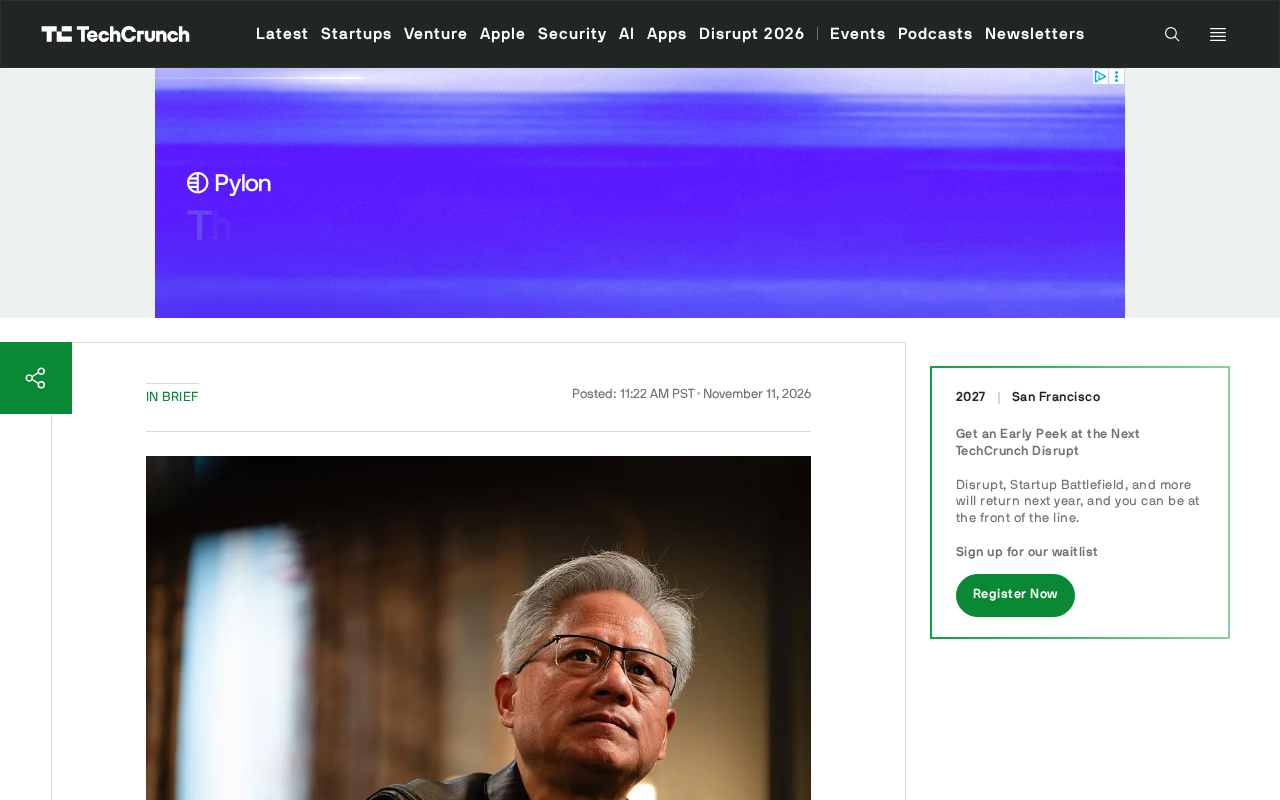
The news itself is extremely brief, yet it contains several key points: the requesting party is House Republicans, the format is a closed-door briefing, the deadline is the end of the business day on Wednesday, and the core controversy is the relationship between Jensen Huang and a person accused of being a Chinese spy. Nvidia has not yet responded publicly, and Huang himself has not confirmed whether he will attend.
Why Nvidia Is Always in the Crosshairs
Nvidia's dominant position in the global AI chip market makes any of its China-related business dealings easy to scrutinize under a magnifying glass. From export controls to supply chain security, Nvidia has long stood at the crossroads of U.S. technology policy toward China. The reason this rumor has drawn congressional attention is precisely that Huang's personal interactions could be interpreted as a potential security vulnerability.
It should be made clear that the currently public information comes from only a single news source, and the specific content of the allegations, the identity of the person involved, and the nature of the so-called "affair" have not been disclosed. Before more facts come to light, it is premature to characterize this as a "spy incident." The fact that Congress is requesting a closed-door briefing itself suggests that the relevant discussions may involve sensitive information and are not suitable for public proceedings.
U.S. semiconductor export controls toward China are the key backdrop for understanding Nvidia's situation. Since October 2022, the U.S. Department of Commerce's Bureau of Industry and Security (BIS) has repeatedly tightened restrictions on exports of advanced AI chips to China, and Nvidia has specifically launched "downgraded" chips (such as the H20) that meet the control thresholds. The balance these products strike between performance and compliance has kept them at the center of policy controversy. Members of both parties in Congress have questioned whether existing controls have loopholes, and any China-related connection involving Nvidia—whether commercial cooperation or personal interaction—could be examined within this regulatory narrative.
What a Closed-Door Briefing Means
When Congress requests a closed-door briefing from a corporate executive, it usually arises on sensitive issues involving national security or trade secrets. For Huang, this is both an opportunity to explain and a high-stakes gamble—attending means cooperating with the inquiry and clarifying the facts, while absence could be interpreted as evasion and invite even greater political pressure.
From Nvidia's perspective, the company is in a critical window of exploding AI computing demand, and any negative narrative related to national security could affect its government relations, export licenses, and even investor confidence. That is also why the deadline is so tight—Congress clearly wants first-hand information as soon as possible.
A closed-door briefing is a non-public information communication mechanism commonly used by the U.S. Congress, usually held in a Sensitive Compartmented Information Facility (SCIF). Participants must sign confidentiality agreements, and the content must not be disclosed externally. Unlike public hearings, closed-door briefings leave no public record, and lawmakers can question witnesses without exposing intelligence sources. For corporate executives, attending a closed-door briefing is not legally compulsory (unless accompanied by a subpoena), but refusing to cooperate often prompts Congress to escalate pressure through contempt of Congress proceedings or subpoenas. Historically, tech executives such as Meta's Zuckerberg and Google's Pichai have given closed-door briefings on issues such as election interference and data security.
Potential Impact on the AI Chip Industry
The impact of this incident will not be limited to Nvidia alone. The current U.S. Congress remains highly vigilant about Chinese technological infiltration, and any China-related rumor involving chip company executives could become a catalyst for further tightening of regulation. If new legislative proposals or hearing arrangements emerge after the closed-door briefing, companies across the entire AI chip supply chain will feel the pressure.
For readers following the AI industry, there are three milestones worth tracking: whether Huang responds before the deadline, whether the closed-door briefing actually takes place, and whether Congress makes public statements after the briefing. These three milestones will determine whether the incident remains at the rumor level or escalates into substantive policy action.
Principles for Judgment During an Information Vacuum
The available source material consists only of a one-sentence news summary, lacking details of the allegations, responses from the parties involved, and Congress's specific demands. In such an information vacuum, the most reasonable attitude is to stay attentive without rushing to conclusions. Historically, congressional summonses of tech executives have not been uncommon, and the outcome could be either a clarification of misunderstanding or an evolution into a long-term investigation. For Nvidia, how to respond to congressional concerns without disclosing trade secrets will test the capabilities of its legal and government affairs teams.
One-line Summary
Republicans in the U.S. House of Representatives have demanded that Jensen Huang give a closed-door briefing over China espionage allegations, plunging Nvidia back into geopolitical turmoil.
Paragraph Summary
Republicans in the U.S. House of Representatives have demanded that Nvidia CEO Jensen Huang give a closed-door briefing by the end of this Wednesday regarding an "affair" with an individual accused of being a Chinese spy. The report comes from a single source only; details of the allegations, the identity of the person involved, and the nature of the relationship have not been disclosed, and neither Nvidia nor Huang has publicly responded. The article argues that Nvidia's dominant position in the AI chip market and its sensitive place in the U.S.-China technology rivalry have quickly drawn congressional attention to the rumor. A closed-door briefing is both an opportunity to clarify and a high-stakes gamble; how the incident unfolds will depend on whether Huang responds, whether the briefing takes place, and whether Congress makes public statements, and its impact could extend to the regulatory environment across the entire AI chip supply chain.
Related articles

MiniMax H3 Image Open-Source Hands-On: 16 Reference Images, Poster Typography, and Agent-Based Image Generation Explained
Hands-on review of MiniMax's open-source H3 Image model: compared with GPT, Gemini, and Doubao on Chinese poster typography, 16 reference images, exploded views with Chinese labels, plus API integration with DeepSeek Harness for Agent-driven generation and recoloring.

DeepSeek Open-Sources Harness: A Plugin-Based Dev Tool with 270K Stars
DeepSeek's official open-source Harness hits 270K GitHub stars, written in TypeScript under MIT. We break down its plugin architecture, multi-model comparison, four use cases, and a three-step start.

New Claude Code Workflow: 9 Open-Source Skill Packs Take Over the Entire PR Lifecycle
Theo open-sources 9 AI agent skill packs for Claude Code and Codex, covering test verification, multi-model code review, PR submission, CI fixes, and auto-merge, with the main skill proving the problem first and humans retaining final merge authority.