Consus: An LLM Gateway for Enterprises Handling Sensitive Data
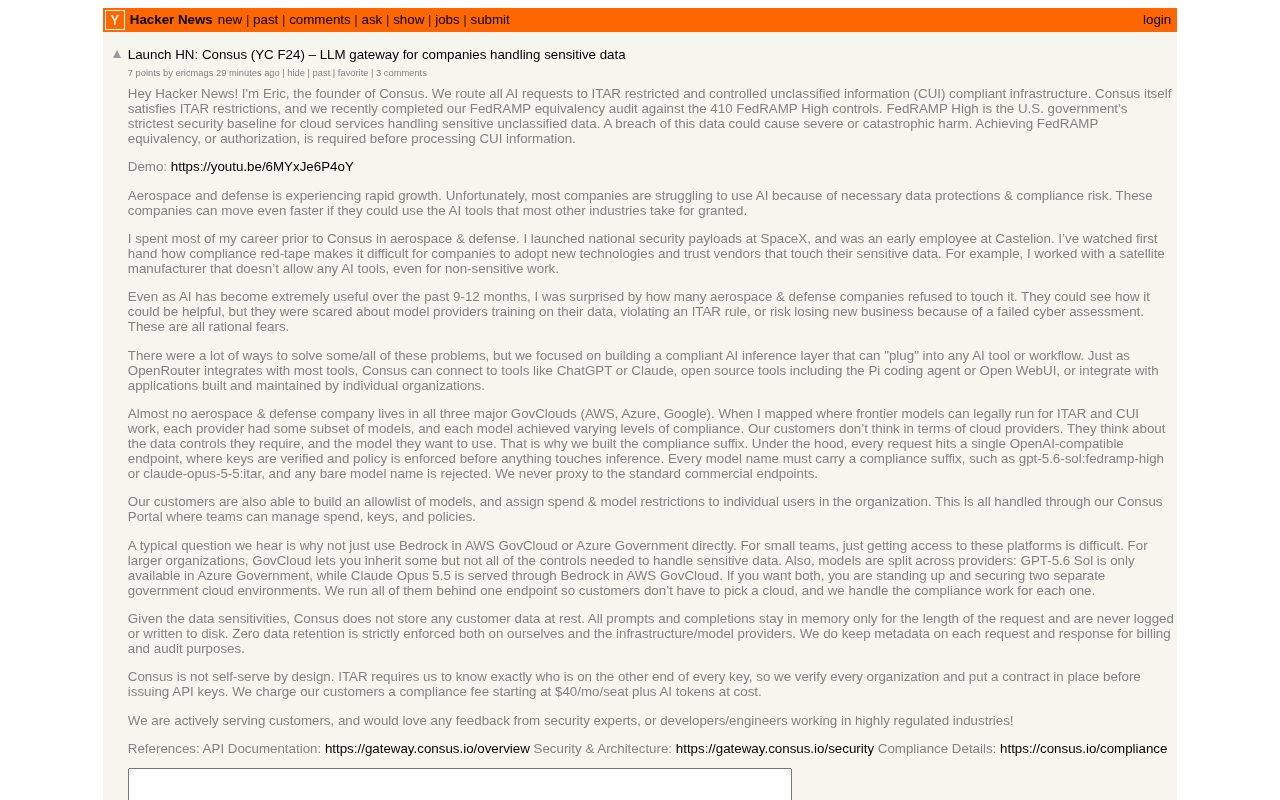
YC F24's Consus offers an LLM gateway for sensitive-data enterprises that redacts, routes, and audits requests between apps and models.
Consus is a YC F24-incubated LLM gateway targeting the tension between business units eager to use AI and security teams worried about data leakage. It inserts a unified gateway between enterprises and model providers like OpenAI and Anthropic, with all requests passing through a policy engine that decides whether to allow, redact, or route to private models. Core capabilities span three layers: detecting and redacting PII, keys, and other sensitive content in prompts; providing a unified API endpoint and multi-model routing by sensitivity level; and logging each call's initiator, data, route, and token usage for compliance auditing. Unlike a plain API proxy, the gateway handles policy enforcement, redaction, auditing, and cost control. Competition comes from Cloudflare, Kong, Portkey, and LiteLLM, with Consus differentiating through sensitive-data-first design.
As enterprises accelerate the adoption of large language models (LLMs), a core tension is becoming increasingly prominent: business units are eager to leverage AI to boost efficiency, while security and compliance teams are highly vigilant about the risk of data leakage. Consus, incubated by YC F24, is targeting exactly this pain point with an LLM gateway designed specifically for enterprises that handle sensitive data.
Why Sensitive-Data Enterprises Need a Dedicated LLM Gateway
In the traditional API calling model, enterprise data is sent directly to model providers like OpenAI and Anthropic, with no controllable audit or filtering layer in between. For industries under strict regulation—finance, healthcare, legal—this means every call could constitute a compliance risk. Consus's approach is to insert a unified gateway between the enterprise and the models, so that all requests first pass through a policy engine, which then decides whether to allow, redact, or route the request to a private model.
This is fundamentally different from a simple API proxy: a proxy only forwards, whereas a gateway takes on multiple responsibilities including policy enforcement, data redaction, log auditing, and cost control.
Breaking Down Consus's Core Capabilities
Based on the positioning in its Launch HN post, Consus primarily addresses problems at three levels.
Sensitive Information Detection and Redaction
Before a request is sent out, the gateway scans the prompt and identifies sensitive content such as PII (personally identifiable information), keys, and internal codenames. Enterprises can configure rules: whether to block outright, replace with placeholders, or allow the send but log it for auditing. This fine-grained control means security teams don't have to impose a blanket ban on AI usage.
PII (Personally Identifiable Information) is a core concept in data compliance, typically encompassing names, ID numbers, phone numbers, email addresses, biometric features, and other information that can identify a specific natural person either alone or in combination. Its definition varies slightly across jurisdictions: GDPR classifies it under "personal data" and grants data subjects a range of rights; the United States relies mainly on sector-specific legislation (e.g., HIPAA covering medical information, GLBA covering financial information); and China's Personal Information Protection Law uses the term "personal information" and requires separate consent when processing sensitive personal information. For an enterprise LLM gateway, the challenge of PII detection lies in covering both structured fields (such as regex matching for ID numbers) and implicit leaks in unstructured text (such as "our CFO whose surname is Zhang"). Common technical approaches combine regular expressions, named entity recognition (NER) models, and contextual judgment, then apply masking, substitution, or pseudonymization after detection—reducing compliance risk while preserving semantic usability.
Multi-Model Routing and a Unified Interface
Consus provides a unified API endpoint, so enterprises don't need to maintain different SDKs and authentication logic for each model vendor. More importantly, it supports routing by data sensitivity level: low-sensitivity requests go to public cloud models, while high-sensitivity requests are automatically directed to privately deployed models. This reduces the integration cost of using multiple models simultaneously.
Privately deployed models typically refer to LLMs running on an enterprise's own infrastructure or in a dedicated cloud environment—for example, inference services deployed after fine-tuning open-weight models such as Llama, Qwen, or DeepSeekAd. Compared with calling public APIs like OpenAI or Anthropic, the core advantage of private deployment is that data never leaves the enterprise boundary, satisfying the hard data-sovereignty requirements of industries such as finance, healthcare, and government. The trade-offs include GPU procurement and operational costs, model capabilities that are usually weaker than leading closed-source models, and the need to handle inference optimization and safety alignment in-house. As a result, real-world architectures often adopt a "hybrid routing" strategy: general, low-sensitivity tasks call public cloud models to get the best results, while requests involving customer data, contract terms, or internal code are downgraded to private models—trading some capability for compliance certainty. In this architecture, the LLM gateway acts as the dispatch hub, automatically making routing decisions based on policy tags so that the application layer doesn't need to be aware of the physical location of backend models.
Auditing and Observability
Every LLM call is logged: who initiated it, what data was involved, which route it took, and how many tokens were consumed. For enterprises that need to demonstrate compliance to regulators, this audit trail is a must-have.
Market Competition and Room for Differentiation
The LLM gateway is not an entirely new concept. Traditional API gateway vendors such as Cloudflare and Kong are extending into AI traffic, while open-source projects like Portkey and LiteLLM offer similar routing and observability capabilities. Consus's differentiation lies in treating "sensitive data handling" as a first-principles design goal rather than a bolt-on feature.
However, this space is rapidly becoming crowded. Consus will need to build moats in the depth of its policy engine, the completeness of its compliance certifications, and its partnerships with major model vendors. As an early-stage YC project, its focus at this stage is undoubtedly on refining its core gateway capabilities and accumulating flagship customers.
An API gateway is a middleware layer sitting between clients and backend services, traditionally responsible for authentication and authorization, rate limiting and circuit breaking, load balancing, and protocol translation—with representative products including Kong, Apigee, and AWS API Gateway. Building on these capabilities, LLM gateways extend them for the particularities of large-model traffic. First, the billing dimension shifts from "number of requests" to "number of input and output tokens," requiring precise metering and quota management. Second, the response mode shifts from one-shot returns to SSE streaming output, imposing new requirements on proxy timeout and buffering strategies. Third, policy checkpoints are introduced at the prompt level, including content filtering, sensitive-information scanning, and injection-attack protection. Open-source projects like Portkey and LiteLLM entered this market precisely through "a unified multi-model calling interface plus observability," while Cloudflare AI Gateway leverages its global edge network to provide nearby proxying and caching. What Consus emphasizes—"sensitive data as a first-principles design"—is essentially an attempt to differentiate on the depth of its policy engine and the completeness of its compliance auditing, rather than competing head-on with the giants on general-purpose proxy capabilities.
What It Actually Means for Enterprises
For mid-to-large enterprises pushing forward with AI adoption, Consus represents a pragmatic approach: rather than choosing between an outright ban and letting things run wild, use technical means to achieve tiered control. The LLM gateway is becoming a key component of enterprise AI infrastructure, alongside vector databases and orchestration frameworks.
The project received 5 points and 1 comment on Hacker News—not a high level of discussion, indicating that market education still needs time. But the compliance pain point it targets is real, and its subsequent product iterations and customer case studies are worth watching.
One-line Summary
YC F24 project Consus launches an LLM gateway for sensitive-data enterprises, performing redaction, routing, and auditing between requests and models.
Paragraph Summary
Consus is an LLM gateway product incubated by YC F24, targeting the core tension between business units eager to use AI and security teams worried about data leakage. It inserts a unified gateway between enterprises and model providers like OpenAI and Anthropic, so that all requests first pass through a policy engine, which then decides whether to allow, redact, or route to a private model. Its core capabilities span three layers: detecting and redacting sensitive information such as PII and keys in prompts; providing a unified API endpoint and routing across multiple models by sensitivity level; and logging each call's initiator, data, route, and token consumption to support compliance auditing. Unlike an ordinary API proxy, the gateway takes on multiple responsibilities including policy enforcement, redaction, auditing, and cost control. Competition comes from traditional gateway vendors like Cloudflare and Kong, as well as open-source projects like Portkey and LiteLLM, and Consus seeks differentiation by making sensitive data handling a first-principles design goal.
Related articles

CSS Anchor Positioning: A New UI Positioning Approach Without JavaScript
A deep dive into CSS Anchor Positioning: from anchor-name and position-anchor to the anchor() function, position-area shorthand, position-try-fallbacks, anchor-size, and upcoming anchor queries.

New AI Chart Interaction: Continuous Follow-up Questions and Visualization in Conversation
Explore a new AI interaction method for continuously generating charts in conversation. Use the /visualize command to ask follow-up questions and visualize answers in the same chat window, improving data analysis efficiency.

Cursor Merges Into X Subscription: Paid Plans Share Unified Usage Pool, Grok Model Coding Usage Doubled
Cursor joins The X Subscription with a unified usage pool and doubled Grok coding quota. Third-party models shift to API pricing. Existing users can keep or migrate plans.