Context Engine: Building a Unified Memory Store for AI Agents and Human Teams

Context Engine provides a unified memory store for AI agents and human teams, attempting to break AI context fragmentation.
Context Engine is a memory management tool on Product Hunt that provides shared memory storage for AI tools like Claude, ChatGPT, Cursor, and Claude Code and human team members. AI automatically saves context while working, and humans can read, ask questions, and add files, enabling a human-machine co-built knowledge base. The product covers conversational AI and coding assistants and uses a free-to-start model to lower the trial barrier, but integration implementation, pricing strategy, and data security details are undisclosed. The memory layer track already has competitors like Mem0 and Zep; Context Engine's differentiation is targeting both AI and humans, and its success depends on integration stability and enterprise-grade security.
In today's world where AI tools are increasingly widespread, a thorny problem is gradually surfacing: AI assistants like Claude, ChatGPT, and Cursor each operate independently, the context and memory they generate during work cannot be shared, and team members find it difficult to track these AIs' "thinking" processes. A product called Context Engine that quietly appeared on Product Hunt attempts to solve this fragmentation problem with "one memory store."
Unified Memory Store: Letting AI and Humans Share Context
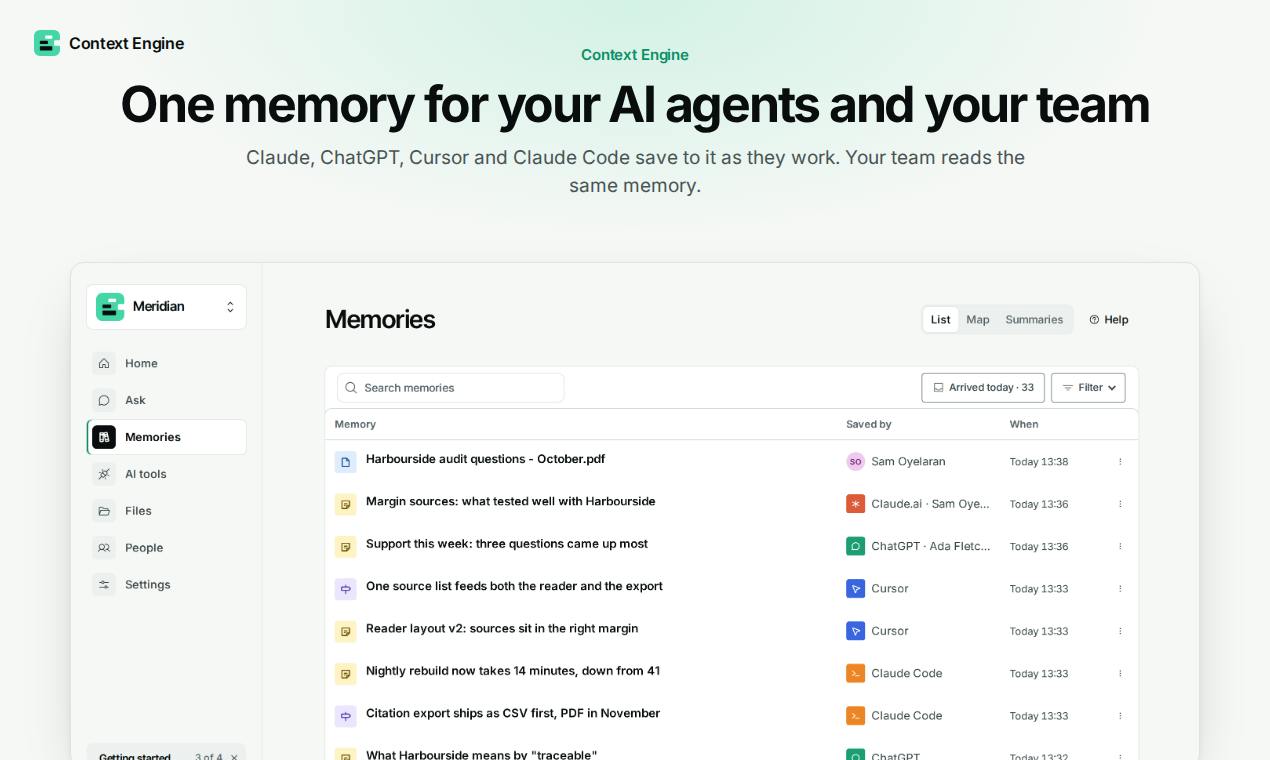
Context Engine's core positioning is very straightforward—providing a shared memory storage for AI agents and human team members. According to its Product Hunt page description, Claude, ChatGPT, Cursor, and Claude Code automatically save context to Context Engine while working, and team members can read these memories, ask questions to the memory store, and even add their own files.
This sounds like a combination of an "AI work log" and a "team knowledge base." Traditional team collaboration tools (such as Notion and Confluence) mainly serve humans, while AI tools' memories are often confined to their respective conversation windows. Context Engine attempts to break down this barrier, making AI's work processes visible, queryable, and supplementable to humans.
In terms of product categorization, Context Engine is classified under productivity, developer tools, and artificial intelligence, indicating that its target users include both developers who need to manage multiple AI agents and ordinary knowledge workers who want to use AI to improve team efficiency.
Multi-AI Tool Integration: Covering Mainstream Agents and Coding Assistants
Currently, Context Engine claims to support AI tools including Claude, ChatGPT, Cursor, and Claude Code. This combination covers conversational AI (Claude, ChatGPT) and AI coding assistants (Cursor, Claude Code), basically covering the AI entry points most commonly used by current knowledge workers.
For developers, the integration of Cursor and Claude Code is particularly noteworthy. In AI-assisted coding scenarios, the context of code generation (such as project structure, requirement descriptions, debugging history) is often scattered across multiple sessions and difficult to trace. If Context Engine can automatically capture this context and form searchable memories, then when teams hand over projects or troubleshoot problems, they can quickly understand what the AI has done and why it did so.
However, the product page does not detail the specific implementation of the integration (whether it is a plugin, API, or browser extension), and the degree of automation and reliability in actual experience remains to be verified.
Claude Code is a command-line AI coding tool launched by Anthropic. It runs in the terminal, can read project files, execute commands, and iteratively modify code based on feedback, so its work context naturally contains a large amount of project-level information. Cursor is an AI code editor based on VS Code, integrating conversation, completion, and codebase indexing capabilities. Although both are AI coding assistants, they have different forms (terminal vs. editor) and different context structures. Context Engine claims to support both simultaneously, which means it needs to handle context data from different sources and in different formats, placing higher demands on standardization and retrieval design.
Redefining the Human Role: From User to Co-Builder of Memory
Another highlight of Context Engine is its emphasis on the active role of humans in the AI memory loop. Team members can not only passively read memories saved by AI, but also ask questions to the memory store and add files. This means humans are no longer passive recipients of AI output, but co-builders of the memory store.
This design approach responds to a real pain point: the information generated by AI agents during work is often a "black box," making it difficult for humans to intervene or correct. By providing a shared memory layer, Context Engine allows humans to supplement background knowledge and correct erroneous information on top of AI's work, thereby improving the quality of subsequent AI output.
Judging from Product Hunt's 87 votes and 3 comments, this product has already attracted the interest of some early users, but the discussion heat is not yet high. As the 8th-ranked product, it will also face no shortage of competition and skepticism.
Free to Start and Commercialization Uncertainty
Context Engine adopts a "Free to start" model, which helps lower the barrier to trying it out and attract individual developers and small-to-medium teams to give it a try. However, the product page does not disclose the specific pricing and feature limitations of paid tiers, and the commercialization path remains unclear.
For this type of memory management tool, data security and privacy are among the issues users care about most. AI work context may contain sensitive content such as code, business logic, and customer information. How Context Engine ensures the security of storage and transmission will be key to determining whether it can be accepted by enterprise-level users. Unfortunately, current public information does not cover this aspect.
Competition in the Memory Layer: Opportunities and Challenges for Context Engine
"AI memory" is not a new concept. Previously, open-source or commercial solutions such as Mem0 and Zep have focused on providing long-term memory for AI agents, while knowledge management tools like Notion and Obsidian are also exploring deep integration with AI. Context Engine's differentiation lies in being aimed at both AI agents and human teams, emphasizing bidirectional read-write and shared context.
This positioning has potential, but also faces challenges: on the one hand, it needs to maintain deep integration with various AI tools, while the API and plugin ecosystems of AI tools change frequently; on the other hand, team memory management involves a series of complex issues such as permissions, versions, and retrieval, and product maturity will take time to verify.
According to information on the Product Hunt page, Context Engine was built by four developers including David Henzel, and the official website link points to a Product Hunt redirect page. For teams wanting to try it out, free to start lowers the cost of trial and error, but it is recommended to focus on data security settings and integration stability during trials.
With AI agents increasingly participating in actual work, how to manage their "memory" is becoming a necessity. Context Engine provides a noteworthy approach: instead of letting each AI fight alone, let them share the same memory foundation with humans. Whether this direction is correct will ultimately be tested by users' actual workflows.
Mem0 and Zep are two frequently mentioned solutions in the current AI memory layer field. Mem0 focuses on providing a hosted long-term memory API for LLM applications, allowing developers to make AI agents remember user preferences and historical interactions with a small amount of code; Zep focuses more on the storage and retrieval of conversation memory, emphasizing low latency and summarization capabilities. Both are aimed at developers and require some integration work. Unlike them, Context Engine also includes human team members in the read-write loop of memory, positioning itself closer to the team collaboration layer rather than pure infrastructure. Understanding this difference helps to judge its competitive position: what Mem0 and Zep solve is "how AI remembers," while what Context Engine wants to solve is "how humans and AI remember together and see each other."
One-line Summary
Context Engine provides a unified memory store for AI agents and human teams, attempting to break AI context fragmentation.
Paragraph Summary
Context Engine is a memory management tool that appeared on Product Hunt. Its core is to provide shared memory storage for AI tools such as Claude, ChatGPT, Cursor, and Claude Code and human team members. AI automatically saves context while working, and humans can read, ask questions, and add files, realizing a knowledge base co-built by humans and machines. The product covers conversational AI and coding assistants and adopts a free-to-start model to lower the trial barrier, but the integration implementation, pricing strategy, and data security details are all undisclosed. The memory layer track already has competitors such as Mem0 and Zep, and Context Engine's differentiation lies in being aimed at both AI and humans; its success will depend on integration stability and enterprise-level security capabilities.
Related articles

Giving Coding Agents Hearing: How AirShot Closes the Audio Feedback Loop
AirShot gives coding agents audio perception: pure CPU offline operation, CLI and MCP invocation modes, with MCP avoiding 20-40s model reload delays. Critic scores against 7 professional launch videos with timestamped suggestions, registers into Cloud Code without a GPU.

MCP Protocol Explained: Giving AI Agents Tools and Memory
MCP lets AI agents securely connect to Gmail, Slack, and other tools with persistent memory. This article explains the three-step loop—connect tools, add memory, define goals—and how it eliminates repetitive work, turning AI from a chat tool into a practical productivity system.

Don't Trust AI Agent Installs? RepoGates' Five-Gate Test in Practice
RepoGates uses five gates to guard AI agents' repo clones, package installs, and MCP server additions, covering browser, Clawed Code, MCP clients, checkup, and deep scan—each with its own blind spots.