MCP Protocol Explained: Giving AI Agents Tools and Memory

MCP uses a three-step loop—connect tools, add memory, define goals—to free AI agents from amnesia and repetitive manual transfer.
The article centers on MCP (Model Context Protocol), noting that large models are trapped in chat windows, cannot directly access email, calendars, or cloud drives, and lack persistent memory, forcing users to repeatedly move data and re-explain context. MCP is an open standard, likened to "USB-C for the AI world," letting agents connect to Gmail, Drive, and Slack in a unified way with persistent context. Its core is a three-step loop: connect tools for read/write access, inject memory from documents to avoid repeated questions, and define goals for autonomous action and optimization. Compared with plugins and function calling, MCP abstracts authentication and context passing into the protocol layer, greatly reducing integration costs. The article stresses that MCP does not promise full automation; final results still need human confirmation. Its value is as a capability foundation.
Your AI loses its memory with every conversation—because it has no persistent memory. You copy and paste between Gmail and Sheets every day, doing repetitive work, and tools can't be called directly by AI. MCP (Model Context Protocol) was created to solve these two pain points: it lets any AI agent securely use your tools and remember context.
According to a demo by YouTube creator Aria Verma, MCP's core logic can be broken down into a three-step loop: "connect tools, add memory, define goals." She emphasizes that she only tests AI workflows that can be implemented in practice, enabling founders to deliver systems rather than hype. This article is based on that video content, combined with the protocol's own design philosophy, to explain why MCP is regarded as a key piece of agent infrastructure.
Why your AI needs MCP
The capability boundaries of current large models are clear: they can reason and generate, but they are isolated within the chat window. Your email, calendar, cloud drive, and project management tools are all invisible islands to the model. Every time a task begins, you have to manually move data around—paste a lead list into the chat box, then copy the model's output back into a spreadsheet.
In this mode, AI is not an "agent"; it is just an advanced input method. Even more troublesome is the lack of memory: the model does not remember the filtering criteria you set last week, does not remember customer preferences, and you have to re-explain the background every time. MCP is designed to solve exactly these two things—tool access and context persistence.

What exactly is MCP: an open standard
MCP is an open protocol that defines how AI applications establish secure connections with external tools and data sources. You can think of it as "USB-C for the AI world": whether the backend is Gmail, Drive, or Slack, as long as interfaces are exposed according to the MCP specification, agents can read data and perform actions in a unified way.
This is different from traditional plugins or function calling. Plugins are often tied to a single platform, and function calling requires developers to handle authentication and context passing themselves. MCP abstracts these into a standard layer: connect once, reuse in many places; permissions are managed by the protocol layer rather than scattered across every integration. For developers, the integration cost drops from "writing a separate adapter for each tool" to "implementing the protocol once."
Function Calling is a capability provided by large model platforms: developers use JSON Schema to describe available functions, the model decides during a conversation when to call them and what parameters to pass, and the platform then returns the call results to the model. It solves "how the model triggers external actions," but authentication, connection management, and multi-tool orchestration still need to be implemented by developers themselves, and interfaces differ across platforms. MCP, on top of this, defines a standardized way of exposing server-side tools and client-side connections, incorporating tool discovery, invocation, and permission declarations into the protocol, so the same set of tool implementations can be reused across models and applications.
Step 1: Connect tools so agents can read and write
The first step of MCP is to bring tools in. The video describes it plainly: connect tools such as Gmail, Drive, and Slack once through MCP, and the agent can instantly read and take action.
The key word here is "action." It is not just reading email content, but also drafting replies, creating documents, and updating spreadsheet status. Take a typical scenario: input "filter 50 leads," and the MCP agent will automatically enrich information, score them, draft follow-up emails, and finally leave you with an updated spreadsheet. The whole process is completed in the background; what you see the next day is the result, not a pile of to-dos.
The value of this capability lies in eliminating the "human middleware." In the past, you had to switch between multiple interfaces, make judgments, and move things around; now the agent completes tool orchestration at the protocol layer, and people are only responsible for defining goals and reviewing results.

Step 2: Add memory so AI stops asking again
The second step of MCP is memory. The protocol lets agents obtain persistent context from documents, so they remember existing information instead of repeatedly asking.
This point is often underestimated. Tool access solves "whether it can do it"; memory solves "whether it does it correctly and quickly." Without memory, the agent has to re-learn your business rules, customer profiles, and historical decisions every time; with memory, it can maintain consistency across consecutive tasks and reduce repeated communication costs.
From an engineering perspective, MCP's memory is not memory at the model parameter level, but a context supply mechanism: relevant documents, historical records, and structured data are injected as needed, giving the model "working memory" on each call. This is more controllable than simply stuffing in long context, and closer to real workflows.
Context Window refers to the maximum number of tokens a model can process in a single call, including system prompts, conversation history, retrieved documents, and tool return results. The "long context" approach of cramming all materials directly into the window is costly and noisy, and information is truncated once it exceeds the window. MCP's memory mechanism is closer to the idea of Retrieval-Augmented Generation (RAG) : the protocol layer selects relevant documents and records to inject into the context according to task needs, rather than stacking them indiscriminately. This controls token overhead and avoids irrelevant information interfering with the model's judgment.
Step 3: Define goals so agents can loop autonomously
Once tools and memory are in place, the final step is to define goals. The loop given in the video is: connect tools, add memory, define goals, then let the agent act, observe, and optimize.
This loop is essentially the basic operating paradigm of an agent. You give a goal (for example, "sort this week's leads by priority and draft follow-ups"), and the agent calls tools to obtain data, processes it according to the rules in memory, produces results, and then adjusts based on feedback. People shift from executors to goal setters and result reviewers.
One detail: MCP does not promise full automation. In the scenario demonstrated in the video, the final spreadsheet still requires human confirmation. The protocol provides the capability foundation; the reliability of the workflow depends on whether goals are clearly defined and whether permission boundaries are reasonable.

The "act, observe, optimize" loop described in the article corresponds to the ReAct paradigm (Reasoning + Acting) in the agent field: the model first reasons about what to do next, then calls tools to execute actions, then observes the returned results and revises the plan, iterating until the goal is achieved. In this loop, MCP plays the role of the tool and context supply layer, while loop control itself is handled by the agent application. This also explains why goal definition and permission boundaries are so important—the more autonomous the loop, the more obvious the amplification effect of erroneous actions.
Who should pay attention to MCP
For developers, MCP means integration work converges from adapting to N platforms to implementing one protocol, enabling faster construction of reusable agent capabilities. For entrepreneurs and business leaders, it means AI shifts from a "chat toy" to a productivity tool that can connect to existing systems—without rebuilding the entire tech stack, but gradually integrating through standard interfaces.
At the end of the video, Aria Verma emphasizes that she tests practical workflows that can be implemented, with the goal of enabling founders to deliver systems rather than chase concepts. This positioning precisely illustrates the current value stage of MCP: it is not the endgame, but the infrastructure layer that allows agents to truly enter daily work. If your AI is still "losing its memory" every day, the problem may not be the model, but the lack of such a protocol layer.
One-line Summary
MCP uses a three-step loop—connect tools, add memory, define goals—to free AI agents from amnesia and repetitive manual transfer.
Paragraph Summary
The article centers on MCP (Model Context Protocol), pointing out that current large models are trapped within the chat window, cannot directly access tools such as email, calendars, and cloud drives, and lack persistent memory, causing users to repeatedly move data and re-explain background. As an open standard, MCP is compared to "USB-C for the AI world," allowing agents to connect to external tools such as Gmail, Drive, and Slack in a unified way and obtain persistent context. Its core process is a three-step loop: connect tools to enable reading and writing, inject memory from documents to avoid repeated questions, and define goals so the agent can act and optimize. Compared with traditional plugins and function calling, MCP abstracts authentication and context passing into the protocol layer, greatly reducing integration costs. The article also emphasizes that MCP does not promise full automation and that final results still require human confirmation; its value lies in providing the capability foundation.
Related articles

Amazon CEO: $220 Billion Bet on AI Infrastructure, AWS AI Revenue Tops $25 Billion in Three Years
Amazon CEO Andy Jassy explains the logic behind $220B in AI infrastructure investment: sold-out capacity through 2028, in-house Trainium chips, a 6-person team rewriting the inference engine in 76 days, and his views on data center controversies and AI security risks.
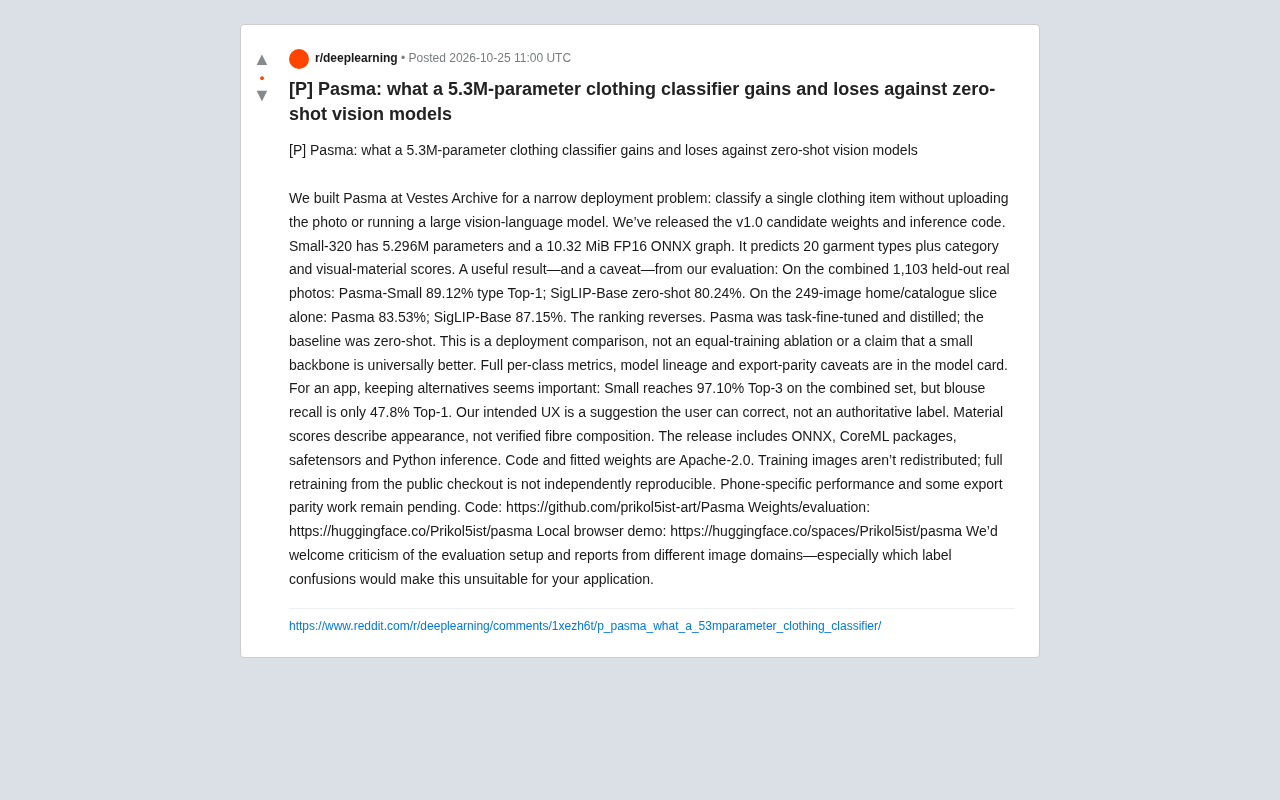
5.3M-Parameter Clothing Classifier Pasma: Small-Model Upset or Scenario-Limited?
Vestes Archive open-sources Pasma, a 5.3M-parameter clothing classifier whose 89.12% combined-set Top-1 beats zero-shot SigLIP-Base, though rankings reverse on the home/catalog subset. We analyze deployment trade-offs, category recall gaps, and reproducibility limits.

Model Suddenly Got Worse? Reddit Discusses the Truth Behind Troubleshooting and How Long It Takes
A Reddit discussion on troubleshooting sudden model performance drops, summarizing common causes like schema changes and feature pipeline failures, with time estimates and practical tips to speed up diagnosis.