Context Engineering: The Key to Building Stronger AI Agents

The Context Engineering course teaches you to keep long-running agents reliable by managing context.
The article introduces the Context Engineering course from DeepLearning.AI and Chroma, which addresses the "context rot" problem AI agents face when running autonomously for long periods. The course advocates designing systems that deliver the right information at the right time in the right format, rather than piling on complex frameworks. Its hands-on approach has students implement tools and hooks from scratch without any framework to understand the underlying mechanisms. Covering diverse example agents in customer service, coding, research, and email management, the course emphasizes that simple interventions can significantly improve performance. It's suitable for developers building agents or struggling with stability issues, and notes that context quality will directly determine agent reliability.
When AI agents start running autonomously for hours or even days, tackling increasingly complex tasks, a thorny problem surfaces: how do you keep an agent's context useful and relevant, avoiding "context rot"? The Context Engineering course, launched in collaboration between DeepLearning.AI and Chroma, was created precisely to solve this pain point.
Why Context Management Becomes the Agent Bottleneck
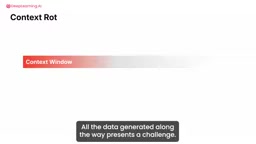
Agent capabilities are evolving rapidly—they can execute more complex, longer-running tasks, working independently for hours or even days. But the accompanying problem is that the massive amounts of data generated along the way keep piling up in the context, diluting key information and causing agent performance to decline.
According to the course, the core work of Context Engineering is designing and building systems that deliver the right information to the agent at the right time in the right format. This isn't esoteric theory—it's pragmatic engineering practice: from giving agents multiple search tools to trimming redundant or irrelevant text from the context, these simple interventions can significantly improve agent performance.
If you've been struggling with agents going off track or performing poorly, this course offers a clear path. What it emphasizes is not piling on complex frameworks, but understanding from the ground up how context influences agent behavior.
The context window is the maximum number of tokens a large language model (LLM) can receive in a single inference pass, and it constitutes the physical upper limit of all an agent's "memory" and "field of view." Whether system prompts, tool definitions, conversation history, or retrieved documents, everything must squeeze into this fixed-capacity window. When an agent runs for a long time, every step's tool call results and environment feedback get appended to the context, the window quickly fills up, and the model is forced to "forget" earlier information or is compelled to process large amounts of noise. Therefore, context engineering is essentially information scheduling within a limited window: deciding what to keep, what to compress, and what to move out of the window and recall on demand from external storage (such as a vector database). Understanding the hard constraints of the window is the prerequisite for understanding why trimming, summarization, and tool-based retrieval are necessary.
Context rot is not a degradation of model parameters; it refers to the accumulation of context that becomes filled with repetitive, outdated, or irrelevant content for the current sub-task, diluting the model's attention and drowning out key instructions, ultimately manifesting as the agent going off track, repeating work, or ignoring constraints. It differs from "context length": even if the window isn't full, low-quality content can still cause rot. Common triggers include large blocks of raw logs returned by tools, traces of failed attempts left by multiple rounds of trial and error, and repeatedly restated task descriptions. Mitigation techniques include summarizing and compressing history, dynamically retrieving by relevance, and cleaning tool output in hooks. The "simple interventions" emphasized by the course are precisely aimed at this phenomenon: trimming redundant text and providing multiple search tools are both proactive measures against the decay of context quality.
Course Highlights: Implementing Context Management from Scratch
The standout feature of this course is its hands-on nature. In the lab sessions, students implement tools and hooks from scratch, enabling agents to better manage context, all without using any framework. This design forces you to understand how each component works rather than relying on ready-made abstractions.
The course covers a variety of example agents, including customer service, coding, research, and even email management. Through these realistic scenarios, students can explore the practical effects of different context management techniques.

As the course emphasizes, simple interventions—such as giving agents multiple search tools or trimming redundant text—can produce noticeable performance differences. This "small changes, big returns" approach is especially appealing to developers who have already deployed agents in production environments.
Hooks are interception points reserved in the agent's run loop, allowing developers to insert custom logic at specific moments (such as before a model call, after tool execution, or before context is written). In context engineering, typical uses of hooks include: truncating or formatting tool results before they enter the context, triggering summarization and compression after each conversation turn, and triggering retrieval or cleanup when the context approaches the window limit. Unlike framework built-in abstractions, implementing hooks from scratch means you directly control every step of data flowing into and out of the context, and can precisely observe the impact of a given intervention on agent behavior. This is also why the course chooses "no framework": only by building hooks by hand can you truly understand where context gets polluted and how it should be repaired.
Who Should Learn and What You'll Gain
If you're building AI agents, or are troubled by agent stability issues, this course is worth your attention. It doesn't require deep framework experience, but it does require a willingness to write code and understand the underlying logic.

After completing the course, you'll have mastered best practices for building powerful and reliable agents through context management. Another major advantage of the course is its coverage of diverse agent types, meaning no matter which vertical domain you focus on, you'll find patterns you can draw on.

Context Engineering isn't a brand-new concept, but it's becoming an indispensable part of agent development. As agents take on increasingly heavy tasks, context quality will directly determine agent reliability. This course provides a systematic starting point.
Final Thoughts
Agent progress depends not only on the model itself, but also on how we organize information for it. Context Engineering reminds us: while chasing bigger models, don't forget the easily overlooked battlefield of context. If you want your agents to stay focused and accurate on long tasks, this course is a good place to start.
Related articles

Python 3.15 New Feature: Is the sentinel Type Better Than None?
Python 3.15 adds the sentinel type, using named unique sentinel objects to replace None and bare object(), resolving confusion among missing values, explicit emptiness, and invalid input while avoiding type hint failures.

Deep Learning's Three Architectures and the Universal Approximation Theorem: A Complete Guide to MLPs, CNNs, and Transformers
Explaining the inductive bias differences among MLP, CNN, and Transformer, the existence meaning of the Universal Approximation Theorem (UAT), and the role of Taylor expansion in approximation analysis, while clearing up common misconceptions.

GitLab Emergency Patch Release: Analysis of Critical Security Fixes
GitLab releases critical patch 19.5.1, sparking 355 points of discussion on Hacker News. This article analyzes the background, upgrade steps for self-hosted instances, and verification points to help DevOps teams respond quickly to security updates.