Context Language Models: Letting AI Agents Manage Context Like Editing a File

Meta & UW let AI agents edit their own context like a file, replacing lossy compaction with precise self-editing.
Limited context window capacity is a core bottleneck for AI agents on long tasks. Traditional compaction summarizes history indiscriminately, causing critical details to erode through layers of "summaries of summaries." Meta and the University of Washington's Context Language Model takes a different approach: giving agents active editing rights over their own context, so they can precisely retain high-value information and trim or discard outdated content — turning context from a passive buffer into a continuously maintained working document. The main cost is breaking prefix caching, which raises inference overhead. The author validates the approach on a local DGX machine, viewing it as an important shift from "compaction" to "editing" in context management.
The Context Window: An Unavoidable Bottleneck for AI Agents
Context management remains one of the biggest bottlenecks limiting AI agent performance. No matter how capable a model is, its context window always has a finite capacity. When an agent gradually approaches that limit during a long-running task, it typically triggers a compaction mechanism — summarizing and compressing the prior conversation history to free up space and continue working.
That's where the problem lies. Compaction is inherently a lossy operation: the agent discards a large amount of detail that might have been useful later. Worse, when a task runs long enough, summaries get summarized again, creating a "summary of summaries" effect. Each compression layer dilutes information density, until what the agent has left is a pile of vague generalizations — with critical tool outputs and intermediate conclusions long gone.

The context window refers to the maximum number of tokens a model can "see" in a single inference pass. Leading frontier models have expanded their windows to hundreds of thousands or even millions of tokens (e.g., Gemini 1.5 Pro's 1M token window), but that doesn't make the problem disappear. Larger windows mean higher VRAM usage and inference latency, and research has shown that models exhibit "attention dilution" toward content in the middle of the window — the so-called "Lost in the Middle" problem — meaning information is not uniformly accessible. For longer-running agent tasks, raw tool call outputs, code execution results, web scraping content, and more accumulate rapidly, potentially saturating even a million-token window after dozens of operations. Managing the quality of context content — rather than simply relying on ever-larger windows — remains a persistent core challenge in agent engineering.
Context Language Model: Letting Agents Edit Their Own Context
To address this pain point, a research team from Meta and the University of Washington has proposed a new approach in a paper titled Context Language Model. The core idea is both simple and quite radical: let agents treat their own context as a file to be edited.
In the traditional paradigm, context is a read-only historical record that gets bulk-compressed when it hits the limit. Under the Context Language Model framework, agents gain active editing rights over their context. They can shorten an outdated tool output, or replace an entire block of no-longer-relevant content with a brief note.

The fundamental difference lies in agency and precision. Compaction is passive, global, and indiscriminate; self-editing is active, local, and selective. The agent can judge — based on the current task — which information should be preserved in full, which can be condensed, and which can be discarded entirely, keeping the most relevant information within the window.
What Problem Does It Solve?
The most direct benefit is avoiding the information degradation chain of "summaries of summaries." Rather than applying a one-size-fits-all summary to the entire history, the agent selectively retains the most valuable pieces for the task at hand.
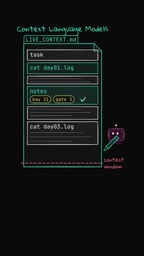
In other words, the context is no longer a passive buffer that passively accumulates and periodically gets wiped — it becomes a "working document" that the agent continuously maintains and dynamically optimizes. This actually closely mirrors how humans handle long-term tasks: we constantly reorganize our notes, delete outdated information, and preserve key details.
The Trade-off: Breaking Prefix Caching
Every solution has its trade-offs, and Context Language Model is no exception. The author specifically highlights one important engineering cost: it breaks prefix caching.
Prefix caching is an extremely important performance optimization in large model inference. When the prefix portion of the context remains unchanged, the inference engine can reuse previously computed KV cache entries, dramatically reducing latency and computational overhead. But the Context Language Model mechanism continuously modifies historical content in the context — once earlier content is edited, the cached prefix is invalidated and subsequent tokens must be recomputed.

This means trading more flexible context management for higher inference costs. Whether that trade-off is worthwhile in real deployments depends on how sensitive the task is to context quality and how much inference cost can be absorbed.
It's worth briefly explaining how prefix caching works. When a large language model processes input, the Transformer architecture computes Key-Value (KV) vectors for each token — a non-trivial expense. When consecutive requests share the same context prefix, inference engines (such as vLLM or SGLang) can cache those KV vectors in VRAM or memory, allowing subsequent requests to read cached results and skip redundant computation. For AI agent workloads that repeatedly read long contexts, prefix caching can typically deliver 50–80% computational savings and significantly reduce time-to-first-token (TTFT). Every time Context Language Model edits historical content, it invalidates the existing cache, meaning the model must recompute KV vectors for the entire context after each step — inference costs approach "starting from scratch" each time. In long-running tasks with frequent edits, the accumulated overhead can be quite substantial.
From Paper to Practice: Validation on a Local Model
Theoretical elegance doesn't automatically translate to practical effectiveness. To test whether this approach actually works in real-world scenarios, the author ran experiments on a local model using their own DGX machine.
There are several advantages to testing in a local environment: full control over the model and inference stack, the ability to directly observe the real performance impact of prefix cache invalidation, and the freedom to iterate without privacy concerns. However, the author does not present specific experimental conclusions in this segment, instead directing viewers to the full video for a more detailed walkthrough of the experimental process and results.
Takeaway: Context Management Is Moving from "Compaction" to "Editing"
Context Language Model represents a notable shift in direction: how agents handle context is moving away from passive, destructive compression and toward active, fine-grained self-editing.
For developers building agents that handle long-horizon, multi-step tasks, this offers a new path out of the "summary of summaries" trap. But the performance costs introduced by breaking prefix caching serve as a reminder that real tension still exists between context quality and inference efficiency. This work from Meta and the University of Washington reads more like a promising framework being put on the table — one that requires further empirical validation, like the local experiments described here, before its true effectiveness can be fully assessed.
Related articles

Huberman's Rational Supplement Guide: A Five-Layer Health Framework and Scientific Decision-Making
Stanford neurobiology professor Huberman proposes a rational supplement framework: behavior and nutrition are the foundation, basic combination supplements serve as insurance, and sleep/hormonal/cognitive directions should stick to single-ingredient experiments. Omega-3 is the top single-ingredient choice, and melatonin is not recommended.

The Unsung Painter Behind Gilded Age Manhattan Interior Design
HN discussion highlights the painter behind Gilded Age Manhattan interiors: he created murals and decorative paintings but was long overlooked as his work was seen as architectural appendage.

Can AI Agents Be Socially Engineered? Understanding Prompt Injection and Tool Permission Risks
Through Invariant Lab's GitHub Issue injection and Brave's AI browser attack, this article analyzes how Prompt Injection induces AI Agents to perform unauthorized actions, and offers protection advice across three layers: least privilege, tool validation, and operation auditing.