ContextGem 1.0: Decision Models Team Up with LLMs to Reshape Document Data Extraction

ContextGem 1.0 splits work between decision models and LLMs for low-cost structured document extraction.
ContextGem 1.0 launched on Product Hunt, combining decision models with LLMs to extract structured data from documents. LLMs handle understanding and generation, while decision models answer closed-ended questions by outputting candidate probabilities—fast and cheap. The release adds model groups that auto-route questions to the best model, Docling file parsing, and Agent tools.
ContextGem 1.0 has launched on Product Hunt, proposing an intriguing direction: letting decision models work alongside LLMs to extract structured data from documents.
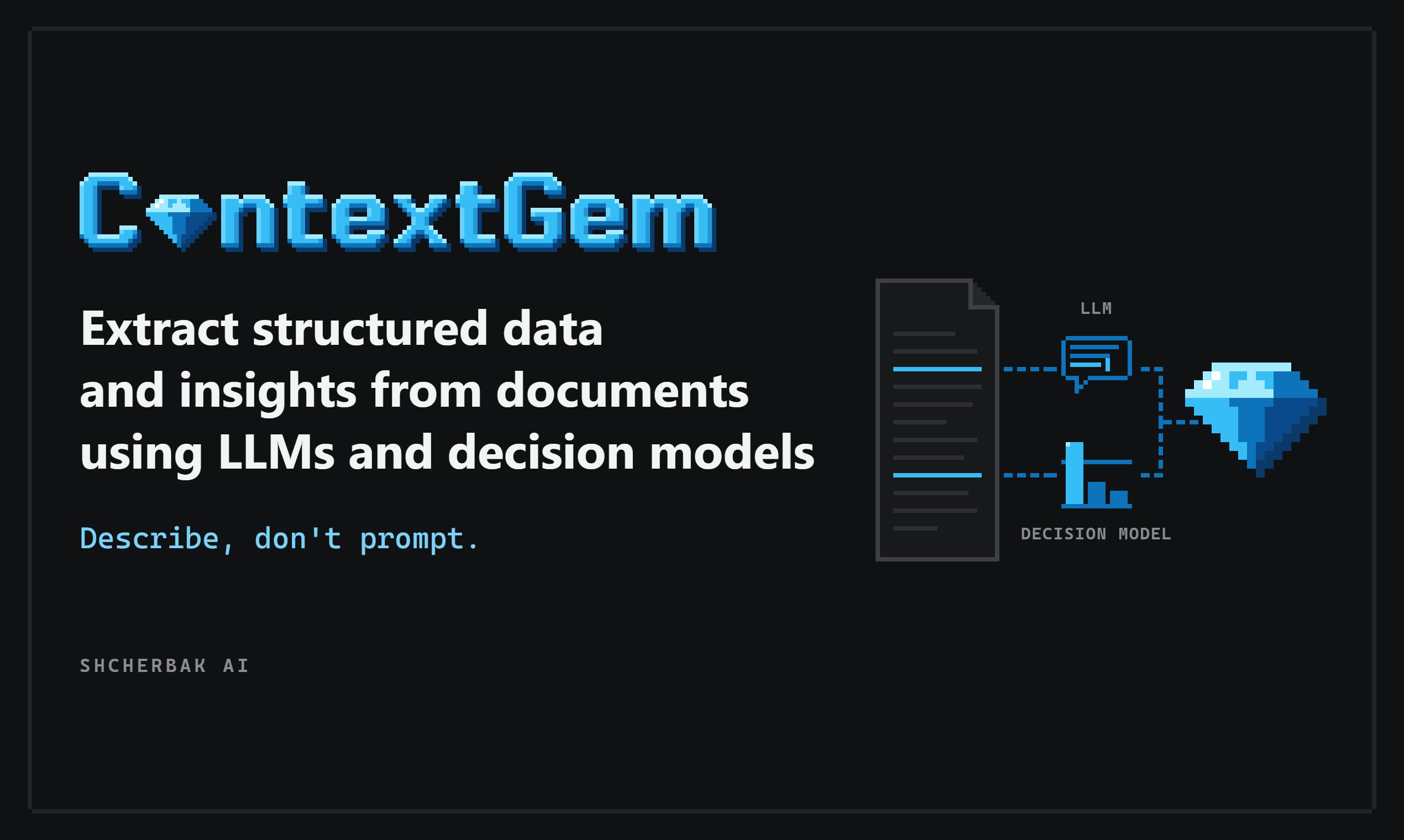
From "Generation" to "Judgment": Decision Models Fill the Gap in LLMs
LLMs excel at understanding and generation, but on closed-ended questions that demand definitive answers, their output tends to be verbose and costly. The decision model introduced in ContextGem 1.0 is purpose-built to answer such closed-ended questions, directly outputting a probability for each possible answer—fast and inexpensive. This design splits "understanding text" and "making judgments" into two separate steps, letting the right model do the right job.
Decision Model refers to a discriminative model trained specifically for closed-ended questions (such as classification, yes/no judgments, or selecting from a limited set of candidates). Unlike generative LLMs, it does not generate text token by token but instead directly outputs a probability distribution over each candidate label or answer, typically built on BERT-style encoders or smaller specialized networks. Since only a single forward pass is needed, the latency and inference cost of a decision model are far lower than an LLM call on the same task, and on closed tasks with sufficient labeled data, its accuracy is often higher. Its limitation is that generalization depends on the training distribution—it falls short of LLMs on open-ended generation or unseen complex reasoning. By combining the two, ContextGem is essentially adopting a hybrid architecture of "generative understanding + discriminative judgment."
Model Groups: Matching Each Question with the Most Suitable Model
The model group mechanism offered in the new version dispatches each question to the model best suited for it. This means developers no longer need to manually designate a model for each type of extraction task—the system automatically routes based on the nature of the question. For document processing pipelines, this dynamic scheduling both simplifies configuration and promises a better balance between accuracy and cost.
File Parsing and Agent Toolchain
Beyond model-layer updates, ContextGem 1.0 also integrates Docling for file handling and provides Agent-oriented tools. The addition of Docling completes the chain from document reading to information extraction, while the Agent tools allow ContextGem to be embedded in more automated workflows. As an open-source developer tool, these capabilities lower the barrier to entry for building document intelligence applications.
Docling is an open-source document parsing tool from IBM (later moved to the LF AI & Data Foundation), focused on converting formats such as PDF, DOCX, PPTX, and HTML into structured representations (Markdown, JSON), with built-in layout analysis, table structure recognition, reading order reconstruction, and OCR capabilities. Compared with basic libraries like PyPDF, Docling handles complex layouts (multi-column, nested tables, scanned documents) more robustly and can integrate with ecosystems like LangChain and LlamaIndex. In a document extraction pipeline, parsing quality directly affects downstream extraction accuracy—misaligned tables or scrambled reading order can cause structured field mapping to fail, so making Docling the front-end step is key to completing the "read—extract" chain.
Positioning and Observations
ContextGem targets developers who need to extract data from documents at scale, emphasizing low cost and structured output. Earning 67 votes and ranking 19th on Product Hunt shows there is still real demand in the document extraction niche. The idea of combining decision models with LLMs also offers a reference architecture for RAG and information extraction pipelines: not every question needs a large model to answer.
For developers, what's worth watching is how the model group's routing logic and the decision model's probability outputs play out in real document scenarios—this will determine how far it can go in extraction tasks with high accuracy requirements.
RAG (Retrieval-Augmented Generation) refers to an architecture that first retrieves relevant chunks from an external knowledge base, then injects them into the LLM context to generate answers. A traditional RAG pipeline typically includes several stages: document parsing, chunking, vectorization, retrieval, and generation—among which "extracting structured fields from documents" is often the part the generation stage struggles to do reliably, as LLMs tend to miss fields or drift in format. ContextGem's approach inserts a dedicated extraction and judgment layer between retrieval and generation, using decision models for closed-ended field judgments and LLMs for the open-ended parts that require semantic understanding, thereby improving the reliability of structured output. This pattern is especially valuable as a reference for RAG applications that need to convert unstructured documents into database records.
One-line Summary
ContextGem 1.0 divides the work between decision models and LLMs to achieve low-cost structured document extraction.
Paragraph Summary
ContextGem 1.0 has launched on Product Hunt, with a core idea of having decision models and LLMs divide the work to extract structured data from documents. LLMs handle understanding and generation, while decision models specialize in answering closed-ended questions by directly outputting probabilities for each candidate answer—fast and inexpensive. The new version introduces a model group mechanism that automatically routes each question to the most suitable model, reducing manual configuration. It also integrates Docling for file parsing and provides Agent-oriented tools, completing the chain from reading to extraction. Positioned as an open-source developer tool focused on batch document data extraction, the project earned 67 votes and ranked 19th on Product Hunt. The article argues that its "generation + judgment" combination offers a reference architecture for RAG and information extraction pipelines.
Related articles

T3 Code: The Open-Source AI Coding Assistant's Comeback Story
T3 Code is an open-source AI coding assistant that unifies subscriptions like Codex and Claude, with powerful remote control and parallel task management.

Never Elected, Yet Ruled New York for 30 Years: The Ultimate Case Study in the Mechanics of Power
Robert Caro's biographies reveal how unelected Robert Moses ruled New York for 30 years through legal drafting and public authorities, and how Lyndon Johnson built leverage as a "powerless" Senate Majority Leader. Unpacking the underlying logic of accumulating and sustaining power.

The CPython 3.10 Recursion Trap and Synthetic Recovery in TokenGuard, an LLM Circuit Breaker
TokenGuard's author recounts a recursion crash caused by OrderedDict.pop in CPython 3.10 and introduces v0.3.0's Loop Nudge synthetic recovery, inline DLP scanning, and other new LLM agent circuit-breaker capabilities.