Coop: A Secure Isolated VM Environment for Claude AI Code Execution
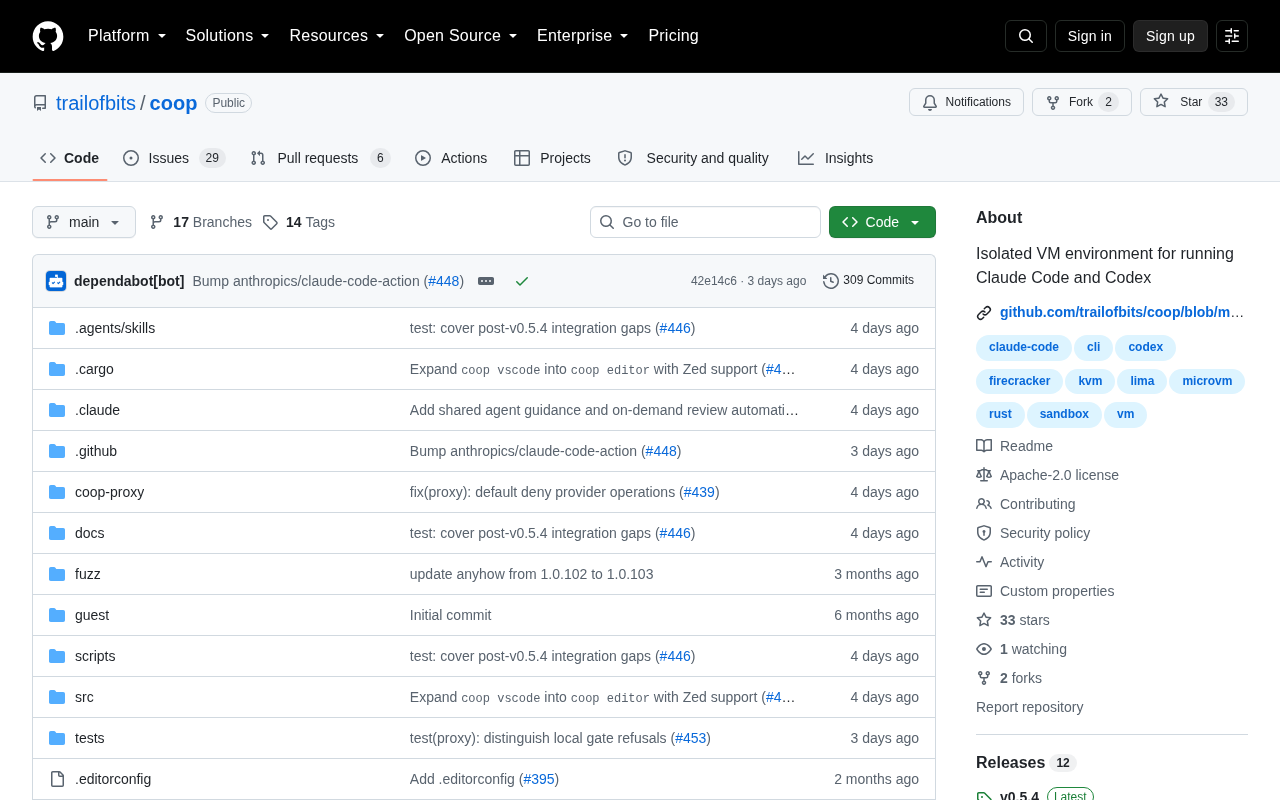
Coop provides VM-level isolation for safely executing AI-generated code from tools like Claude Code.
Coop is an open-source virtual machine isolation environment designed specifically for AI programming tools like Claude Code and Codex. By leveraging VM-level isolation instead of containers, it provides strong security boundaries that protect developers' local systems from potentially harmful AI-generated code. Coop features fast startup, snapshot-based state management, and native API integration, making it suitable for individual developers, teams, and educational settings.
What Is Coop?
Coop is an isolated virtual machine environment designed specifically for AI code execution, providing a secure sandbox for AI programming tools like Claude Code and Codex.
Background on Claude Code and AI Programming Assistants: Claude Code is an AI programming assistant developed by Anthropic, powered by the Claude large language model. Unlike similar tools such as GitHub Copilot and OpenAI Codex, Claude Code doesn't just generate code snippets — it can understand complex development requirements, perform code refactoring, and even execute complete programming tasks. Codex is a code generation model developed by OpenAI and serves as the underlying technology behind GitHub Copilot. These AI programming tools share a common trait: they can generate executable code directly from natural language descriptions. However, this capability introduces new security challenges — AI-generated code may contain unforeseen system calls, file operations, or network requests, posing potential risks when executed directly on a developer's machine.
As AI programming assistants become increasingly capable, securely executing AI-generated code has become a core challenge for developers. Coop is built specifically to address this pain point.
Coop has attracted attention on the Hacker News tech community. Hacker News and Its Influence in the Tech Community: Hacker News is a technology news aggregation community operated by Y Combinator, the renowned Silicon Valley startup accelerator, and holds enormous influence among developers worldwide. The platform is known for its high-quality technical discussions and rigorous community culture, with users primarily consisting of entrepreneurs, engineers, and tech investors. When a project gains visibility on the Hacker News front page, it often signals initial recognition from the tech community and can attract a large number of early users and contributors. However, Hacker News attention is a double-edged sword — community members are notoriously critical of technical solutions, and immature projects may face tough scrutiny.
The core problem the project addresses is universal: when an AI assistant writes and executes code, how do you prevent that code from causing harm to the local system?
Why Do We Need Code Isolation Environments?
Security Risks of AI Code Execution
AI-generated code is inherently unpredictable. Even advanced models like Claude can produce code with potential risks:
- File system risks: AI may accidentally modify or delete important files or directories
- Network security concerns: Unvetted external API calls could lead to data leaks
- System resource consumption: Infinite loops or high-load operations could compromise system stability
- Permission boundary breaches: Erroneous system calls may exceed intended permission scopes
Sandbox Technology in Software Security: A sandbox is a classic security isolation technique that originated in the field of operating system security. Modern browsers use sandboxes to isolate web script execution (e.g., Chrome's multi-process architecture), and mobile operating systems use sandboxes to restrict app permissions (e.g., iOS App Sandbox). In the developer tools space, online code execution platforms (such as CodeSandbox and Repl.it) also employ sandboxing to protect server security. The core principle of sandboxing is to create a restricted execution environment that ensures code can only run within defined boundaries through permission controls, resource quotas, and system call filtering. In AI programming scenarios, sandbox technology is particularly critical — since the quality and safety of AI-generated code cannot be guaranteed in advance, it's necessary to assume the code may contain dangerous operations and prevent harm through technical measures rather than relying solely on code review.
Boosting AI-Assisted Programming Efficiency
Isolation environments don't just ensure security — they also significantly improve the development experience:
- Freedom to experiment: In a sandbox, you can confidently let AI try multiple technical approaches
- Standardized environments: Eliminate compatibility issues caused by differences across development setups
- Optimized dependency management: Dependencies for different projects are fully isolated, preventing version conflicts
Dependency Management and Version Conflicts: Modern software development relies heavily on third-party libraries and frameworks, making dependency management a complex engineering challenge. Version conflicts (Dependency Hell) refer to situations where different projects or libraries require different versions of the same dependency package, making it impossible to satisfy all requirements simultaneously. For example, Project A needs version 1.0 of Library X, while Project B needs version 2.0, and the two versions have incompatible APIs. Package managers like Python's pip, Node.js's npm, and Java's Maven all face this problem. Solutions include virtual environments (Python venv), dependency lock files (package-lock.json), containerization, and more. In AI programming scenarios, the problem is even more complex — AI may generate code that depends on different library versions for different experiments, and running them in the same environment easily causes conflicts. Coop's VM isolation provides an independent environment for each execution task, fundamentally eliminating this issue.
Coop's Core Technical Advantages
VM-Level Strong Isolation
Coop uses VM virtualization technology rather than container solutions, achieving a higher level of security isolation:
Virtual Machines vs. Containers: Virtual machines (VMs) and containers are two mainstream isolation technologies, but they differ significantly in isolation strength. Container technology (such as Docker) achieves isolation through Linux namespaces and cgroups. Multiple containers share the host operating system kernel, offering fast startup but carrying container escape risks — malicious code could exploit kernel vulnerabilities to break through isolation boundaries. Virtual machines, on the other hand, use a Hypervisor (such as KVM or Xen) to create fully independent virtual hardware environments, with each VM running its own operating system kernel, achieving hardware-level strong isolation. The trade-off is higher resource overhead and slower startup times, but in scenarios with strict security requirements, this extra overhead is well worth it. Coop's choice of a VM-based approach reflects its prioritization of the stringent security isolation demands of AI code execution.
- Complete kernel-level isolation that effectively defends against container escape attacks
- Granular resource quota controls and real-time monitoring capabilities
- True multi-tenant security boundary guarantees
Container Escape Attack Mechanics: Container escape refers to an attack where malicious code breaks out of container isolation to gain access to the host system. Since containers share the host kernel, attackers can exploit kernel vulnerabilities, insecure container configurations (such as running in privileged mode), or Docker daemon vulnerabilities to achieve escape. Typical attack vectors include exploiting unpatched kernel vulnerabilities (such as Dirty COW), mounting sensitive host directories, and abusing Linux capabilities permissions. There have been multiple container escape zero-day vulnerabilities throughout history — for example, runC's CVE-2019-5736 allowed a process inside a container to overwrite the runC binary on the host. In contrast, escaping a virtual machine requires attacking the Hypervisor layer, which is exponentially more difficult. This is the security rationale behind Coop's choice of a VM-based approach.
Multi-Tenant Architecture and Security Isolation: Multi-tenancy is a core architectural pattern in cloud computing and SaaS services, where multiple users (tenants) share the same infrastructure while their data and execution environments remain isolated. Multi-tenant isolation can be implemented at various levels: application-level isolation (shared servers and databases, differentiated by tenant ID), database-level isolation (separate database instances), and VM-level isolation (independent VMs). Security strength increases with each level, but so does cost. While container technology is lightweight, it poses security risks in multi-tenant scenarios — a shared kernel means malicious code from one tenant could affect others. VM-level multi-tenant isolation provides the strongest security boundaries, with each tenant running on independent virtual hardware, ensuring that even if one VM is compromised, others remain unaffected. Coop's VM isolation makes it suitable not only for individual developers but also as a secure foundation for team or enterprise-level AI code execution platforms.
Optimizations Tailored for AI Programming Scenarios
Coop is designed specifically for AI tools like Claude Code and Codex:
- Fast startup mechanism: Optimized VM boot process to minimize code execution wait times
- Intelligent state management: Supports snapshot saving and restoration of code execution states
- Native API integration: Provides seamless connectivity with mainstream AI programming tools
Snapshot and State Restoration Technology: Snapshots are an important feature in virtualization technology, capable of capturing the complete state of a virtual machine at a given moment, including memory, disk, and network configuration. Snapshot technology is implemented through a Copy-on-Write mechanism — the initial snapshot only records metadata, and data blocks are copied only when the VM state changes, saving storage space. State restoration allows rolling back a VM to any snapshot point, which is particularly useful in AI code execution scenarios: when AI-generated code pollutes the environment or causes system anomalies, you can quickly restore to a clean state without rebuilding the environment. This capability supports iterative AI development — after attempt A fails, restore the snapshot and try approach B, which is far more efficient than traditional environment rebuilding workflows. Major virtualization platforms like VMware and KVM offer snapshot functionality, and Coop has optimized this specifically for AI programming scenarios.
Practical Use Cases for Coop
Experimental Sandbox for Individual Developers
Developers using AI programming tools like Claude or Cursor can use Coop to:
- Let AI freely explore creative solutions without worrying about breaking the local development environment
- Safely test unfamiliar tech stacks and open-source frameworks
- Quickly validate multiple technical approaches suggested by AI
Standardized Environments for Team Collaboration
In team development scenarios, Coop can serve as a unified AI code execution platform:
- Ensure all team members use a consistent runtime environment
- Safely run code under review during code review processes
- Reduce the learning curve for new team members setting up their environments
Secure Platform for Programming Education
AI programming education scenarios particularly benefit from isolation environments:
- Students can confidently experiment with various code exercises
- Instructors can demonstrate common security risk scenarios
- A unified environment makes it easier to quickly identify and resolve issues
Industry Trends in AI Programming Security
Coop's emergence reflects an important trend in AI-assisted programming: secure execution environments are becoming standard infrastructure for AI programming tools.
As products like Anthropic's Claude Code and GitHub's Copilot Workspace continue to strengthen their code execution capabilities, developer demand for secure isolation solutions is growing rapidly.
Anthropic and the Claude Model Family: Anthropic is an AI safety company founded by former OpenAI researchers, focused on developing controllable and reliable large language models. Claude is its flagship product, renowned for its Constitutional AI approach — training the model with predefined safety principles so it automatically adheres to safety and ethical guidelines when generating content. The Claude model family includes multiple versions, from the lightweight Claude Instant to the high-performance Claude 3 Opus, competing with models like GPT-4 and Gemini in code understanding and generation capabilities. Claude Code is Claude's specialized application for programming, capable of understanding codebase context, executing multi-file modifications, debugging issues, and explaining technical decisions. Anthropic's particular emphasis on AI safety makes external isolation solutions like Coop especially attractive to Claude Code users.
GitHub Copilot Workspace Feature Expansion: GitHub Copilot Workspace is an AI development environment launched by GitHub in 2024, significantly expanding capabilities beyond the original Copilot code completion. It not only generates code snippets but can also understand entire codebase contexts, perform cross-file refactoring, automatically generate Pull Requests from Issues, and even complete full development workflows from requirements to testing. Workspace employs a plan-execute-verify workflow: AI first breaks down complex tasks into steps, executes them sequentially, and verifies results — similar to how a human developer thinks. This enhanced capability introduces new security considerations — AI may execute build scripts, install dependencies, modify configuration files, and perform other high-privilege operations, significantly increasing the risk of running directly in a local environment. Copilot Workspace includes built-in sandboxing mechanisms, but third-party isolation solutions like Coop provide an additional layer of security.
Open-source projects like Coop fill a market gap, providing developers with self-controlled technology options.
It's worth noting that Coop currently has relatively limited discussion activity in the open-source community, which may indicate the project is still in its early stages. For developers concerned about AI programming security, this is a project worth tracking over time. If the team can improve technical documentation, refine the user interface, and achieve deep integration with mainstream AI programming tools, Coop has the potential to become a core tool in this niche.
Conclusion
Coop builds a critical component of the AI programming tool ecosystem — the secure execution layer. Through VM-level isolation technology, it provides a reliable code execution environment for AI tools like Claude Code. Although the project currently has limited visibility, the security problem it addresses has long-term value. As AI programming capabilities continue to evolve, security infrastructure like Coop will play an increasingly important role.
Developers currently using AI programming assistants should consider following Coop's ongoing development, or look into incorporating similar isolation mechanisms into their daily workflows — enjoying the productivity gains of AI while keeping their systems safe and secure.
Related articles

Flock AI Surveillance Faces Bipartisan Opposition: Why License Plate Recognition Technology Sparks Privacy Controversy
Flock Safety's AI license plate recognition surveillance system faces rare bipartisan opposition in the US. From Republican defection to uncontrollable cross-jurisdictional data sharing risks, an in-depth analysis of the privacy crisis and political backlash triggered by AI surveillance technology.

VR Public Speaking Simulator: Practice Your Presentation Skills Right in Your Browser
Public Speaking VR Simulator is a WebXR-based speech practice tool supporting both browsers and VR headsets. Upload slides and rehearse on configurable virtual stages to effectively reduce speaking anxiety.
MCPHub: The AI-Native Launchpad That Uses One MCP to Discover All MCP Servers
MCPHub is an AI-native MCP server discovery tool indexing ~4,000 servers with one-click Cursor, Claude, and VS Code integration for search, config, and stacks.