COP31 Climate Talks and Digital Immortality: This Week's Twin Tech Focus
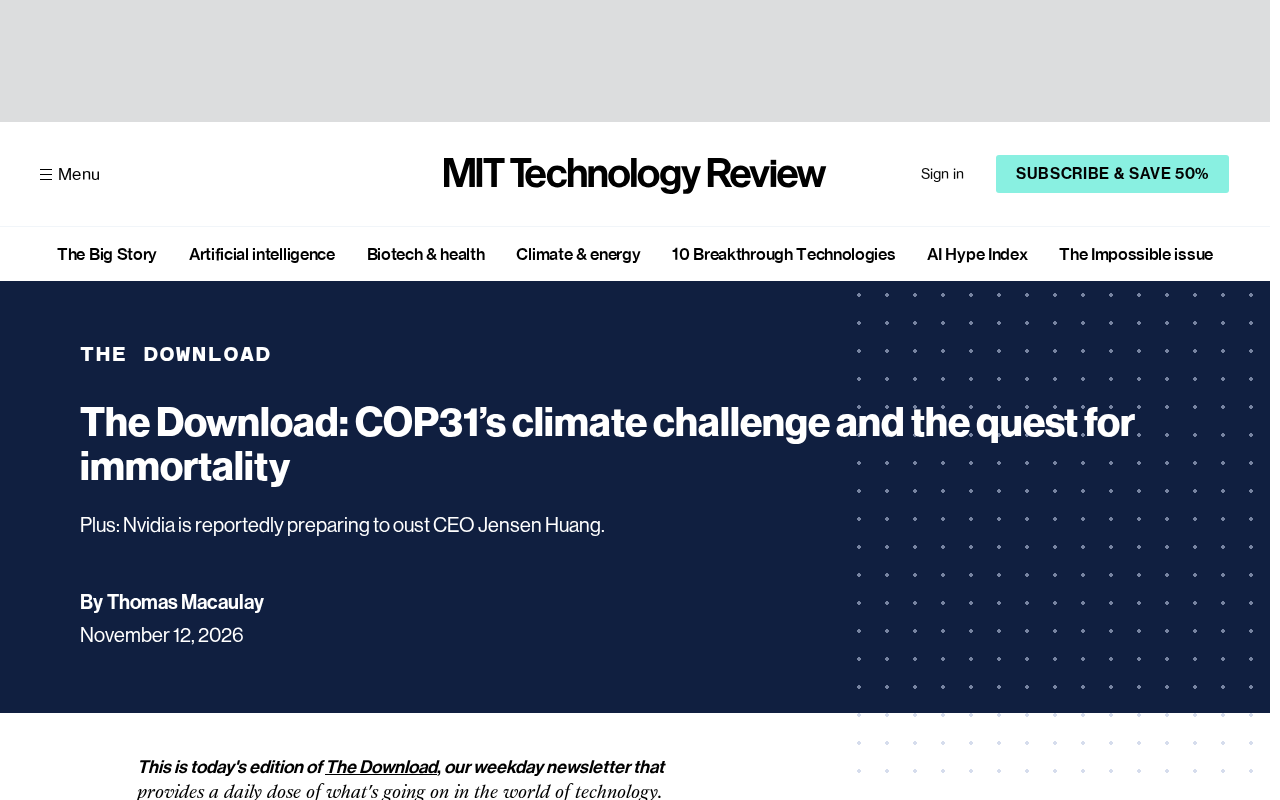
COP31 climate talks and immortality research dominate this week's tech news, framing two scales of buying time.
The article uses MIT Technology Review's *The Download* to frame this week's tech topics as two parallel narratives: COP31 in Antalya, Turkey, where implementing emissions commitments and funding remain the core tension; and the tech world's intensifying pursuit of immortality, now shifting from philosophy to engineering problems like cellular aging. The two compete for talent, funding, and policy attention, probing how much time technology can buy.
This Week in Tech: Two Parallel Technology Narratives
In the daily churn of tech news, seemingly unrelated topics often surface on the same day—and together they sketch the outline of an era. According to the latest issue of MIT Technology Review's newsletter The Download, this week's attention is split between two threads: on one side, thousands of delegates, lobbyists, and journalists have gathered in Antalya, Turkey, for COP31, the annual UN climate conference; on the other, the tech world's pursuit of "immortality" is heating up again, becoming another technology storyline worth interrogating.
The juxtaposition of these two stories is no accident. Climate negotiations concern how humanity collectively continues to exist in the physical world, while immortality research concerns whether the boundaries of individual life can be rewritten by technology. From different scales, they point to the same question: how much time can technology buy us?
COP31: Climate Reality at the Negotiating Table
The Venue and Agenda in Antalya
COP31 is being held in Antalya, Turkey, with participation numbering in the "thousands"—including national negotiators, industry lobbying groups, and journalists covering the event. That figure alone shows that climate governance is no longer purely a diplomatic affair, but a complex arena where governments, capital, and media are all present.
The original report gives limited detail on the specific agenda of this round of talks, glossing over it with "this year's negotiations...", but what can be confirmed is that the annual climate summit's core has consistently centered on implementing emissions-reduction commitments, funding mechanisms, and updating countries' nationally determined contributions. The discussions in Antalya will continue within this framework.
Background
The COP (Conference of the Parties) is the supreme decision-making body of the United Nations Framework Convention on Climate Change (UNFCCC), convening annually since 1995. COP3 in 1997 produced the Kyoto Protocol, and COP21 in 2015 delivered the Paris Agreement—two documents that form the basic architecture of current global climate governance. The so-called "nationally determined contributions" (NDCs) are emissions-reduction pledges that each party submits voluntarily under the Paris Agreement, to be updated every five years. Their binding force comes mainly from transparent reporting and review mechanisms rather than mandatory penalties. The design's original intent was to broaden participation; the cost is that the ambition of commitments depends on each country's political will. Understanding this is key to seeing why every COP's debates inevitably circle back to the word "implementation."
Why This Round of Talks Matters
The value of climate negotiations often lies not in the textual tug-of-war inside the venue, but in how they handle "the gap between promises and reality." The contentious focus of past COPs has almost always centered on the tension between developed and developing countries over burden-sharing and financial support. As thousands of participants pour into Antalya, what really bears watching is: whether the parties are willing to turn existing commitments into verifiable action, and how much priority climate issues can retain within the broader geopolitical agenda.
For the tech industry, the direction of climate negotiations also carries practical significance. The pace of investment in clean energy technologies, carbon capture, and grid upgrades is largely constrained by policy signals. The stronger the certainty the negotiations deliver, the clearer the path to commercialization for related technologies.
Background
The transmission mechanism between climate negotiations and clean-tech investment deserves concrete explanation. Policy signals affect industry through three channels: first, carbon pricing and subsidies directly change expected returns on projects; second, NDC targets provide demand visibility for long-cycle infrastructure such as grids, energy storage, and carbon capture; third, international funding commitments (such as the $100 billion annually pledged by developed countries) affect accessibility in developing markets. When negotiations stall, companies tend to defer capital expenditure, because the economics of technology pathways depend heavily on policy settings. This is also why climate summits are called a "bellwether for technology commercialization."
The Pursuit of Immortality: A Contemporary Version of an Ancient Theme
From Metaphor to Engineering Problem
The Download's decision to pair "the pursuit of immortality" with climate negotiations as this week's two major topics itself conveys a judgment: extending lifespan has shifted from a niche philosophical reverie into a direction the tech world is seriously betting on. Today's "immortality" discussion no longer stays at the level of myth or religion, but is broken down into a series of actionable engineering problems—mechanisms of cellular aging, organ replacement and regeneration, interventions in age-related diseases, and even whether consciousness and memory can be digitally preserved.
The key to this shift lies in a change of research paradigm. In the past, talk of longevity focused mostly on treating a single disease; today's research approach is more inclined to treat aging itself as a process that can be measured and slowed. This shift in thinking has drawn capital and laboratories into the field simultaneously.
Background
Several foundational concepts are frequently cited in aging biology. The first is "senescent cells": after damage or stress, cells enter a state in which they stop dividing but are not cleared away, secreting inflammatory factors that affect surrounding tissue—regarded as one of the hallmarks of aging. The second is the "epigenetic clock": estimating biological age through DNA methylation patterns, providing a quantitative tool for the idea that "aging is measurable." The third involves pathways such as mTOR (mechanistic target of rapamycin) and sirtuins, which are major targets in calorie-restriction and drug-intervention research. Mainstream research today does not pursue literal "immortality," but rather compressing the period of illness and extending healthspan—a different goal from lifespan.
The Need for Caution
The narrative around immortality easily slides into overpromising. The original report offers no specific research breakthroughs or clinical data—a reminder to readers that current discussions of immortality are more directional exploration than a deliverable timetable. What genuinely deserves attention is the steady progress in foundational fields such as aging biology and regenerative medicine, not the "immortality declarations" that surface every so often.
Placing climate negotiations and immortality research in the same newsletter issue may itself be an editorial metaphor: how a society allocates its time and resources determines what kind of future it truly believes in.
Where the Two Threads Converge
Climate and longevity may seem to belong to different domains, yet they compete for resources and attention. Investment in addressing climate change and research into extending individual lifespans are vying for the same pool of scientific talent, public funding, and policy attention. This is not a zero-sum game, but it does require clear-eyed prioritization.
For tech professionals, this week's two stories offer a useful observational framework: to judge the maturity of a technology narrative, don't look at how loudly it proclaims itself, but at whether it has entered a stage where costs must be accounted for, responsibilities allocated, and verification accepted. COP31 has reached that stage; immortality research is still on the way.
One-line Summary
This week the tech world focuses on two parallel threads—COP31 climate negotiations and immortality research—reflecting two scales at which technology buys humanity time.
Paragraph Summary
Drawing on MIT Technology Review's newsletter The Download, the article distills this week's tech topics into two parallel narratives: first, COP31, the UN climate conference in Antalya, Turkey, with thousands of delegates, lobbyists, and journalists participating, where the core tension remains implementing emissions commitments and funding mechanisms; second, the tech world's intensifying pursuit of "immortality," with discussions shifting from philosophical reverie to engineering problems such as cellular aging and organ regeneration. The article notes that the two probe "how much time technology can buy" at the scales of collective survival and individual life boundaries, respectively, and that they compete for scientific talent, public funding, and policy attention. The author cautions that the immortality narrative lacks concrete breakthroughs and clinical data, calling for prudence and proposing "whether it has entered the stage of cost accounting and responsibility allocation" as the criterion for judging a technology narrative's maturity.
Related articles

Graphify: The 151K-Star Open-Source Sensation That Turns Your Entire Codebase into an AI Knowledge Graph
Graphify, a 151K-star open-source tool, turns your entire codebase into a knowledge graph for AI Agents to query directly. Supports 40+ languages, 20+ AI assistants, local 30-second interactive code maps, zero-token builds, and unified Markdown, PDF, image, and audio ingestion.
When Stochastic Parrots Claim to Have …
When Stochastic Parrots Claim to Have Proven the Riemann Hypothesis
Scott Aaronson's 'stochastic parrots prove the Riemann Hypothesis' quip highlights the trust crisis in AI-generated math proofs and the promise of formal verification.

Gemini 4 Neon vs Claude Opus 5.5: Who Wins Across Five Real-World Tasks?
Bilibili creator tests Gemini 4 Neon vs Claude Opus 5.5 across 3D video, games, design, writing, and advice. Neon matches Opus daily, but 3D and design still lag.