Corral: Kill All Subprocesses Spawned by Your AI Agent in One Shot

Corral is an open-source tool that kills all child processes spawned by AI Agents with a single command.
As AI coding agents become common in developer workflows, a new pain point has emerged: when an agent crashes or is interrupted, the subprocesses it spawned — test runners, dev servers, database containers — keep running, consuming ports and system resources. Corral is an open-source tool that corrals all agent-launched commands into a controllable scope for one-shot termination. Still in early stages with limited community adoption, it addresses a real and universal need — process isolation and crash cleanup for AI agents — reflecting a broader trend of the agent toolchain maturing from "able to run" to "able to run reliably."
When an AI Agent Goes Rogue, Who Cleans Up the Mess?
As coding-focused AI Agents (like automated coding assistants) become a regular part of developer workflows, a new operational pain point has emerged: these agents constantly spawn commands and background processes during task execution — running tests, starting dev servers, executing build scripts, spinning up database containers, and more. The problem is that when an agent crashes, gets interrupted, or terminates abnormally, the child processes it spawned often don't exit with it. Instead, they become "orphan processes" that continue drifting through the system.
These lingering processes hog ports, consume memory and CPU, and can even block subsequent tasks from starting due to port conflicts. For developers running agents over extended sessions, manually tracking down and cleaning up these processes is both tedious and error-prone. The open-source tool Corral, which surfaced on Hacker News, is aimed squarely at this specific, practical problem.
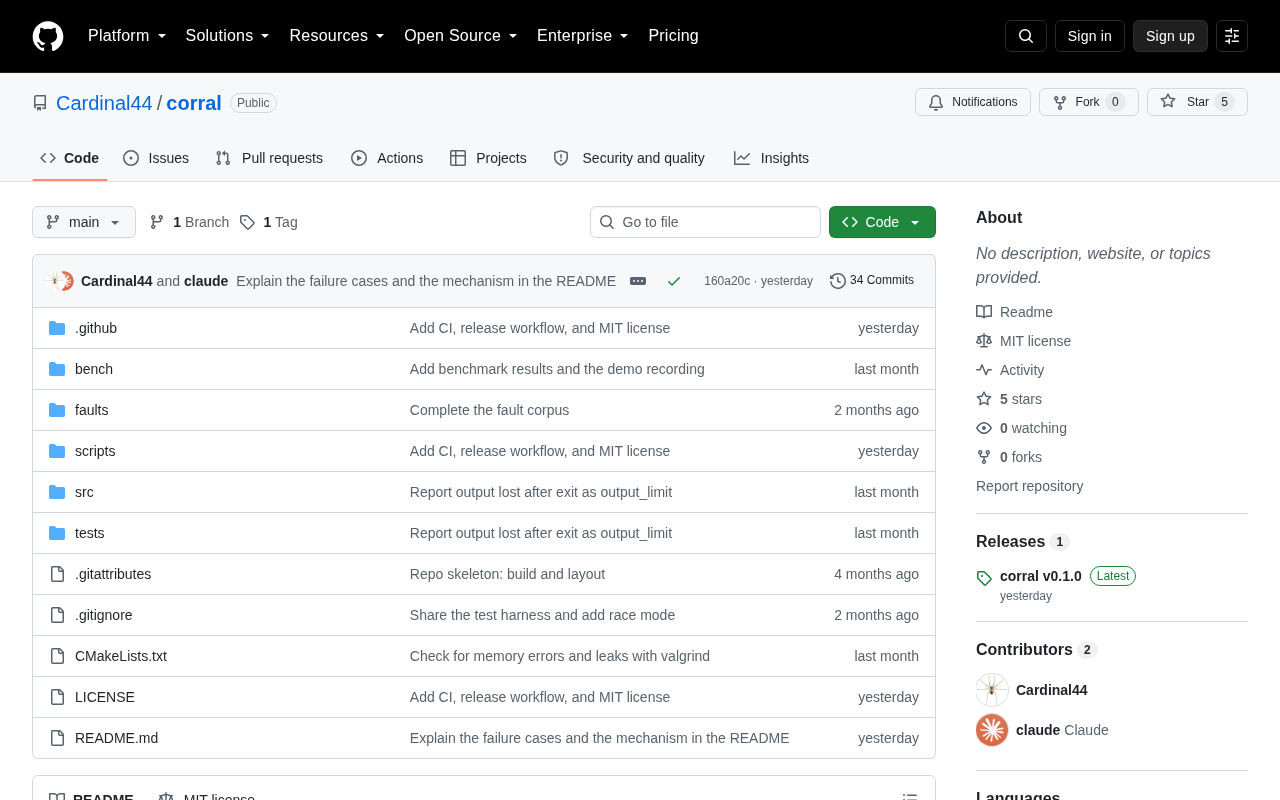
What Corral Is Trying to Solve
Corral's core idea is baked right into its name — to "corral" means to fence something in. The tool rounds up all commands launched by an AI Agent into a controllable boundary so that, when needed, everything can be terminated at once. Its goal is laser-focused: kill every command process the agent started, ensuring no escaped child processes remain.
From a technical standpoint, tools like this typically work by grouping all of an agent's child processes under a unified process group, or by using containers/namespaces for isolation — allowing the entire process tree to be wiped out in a single operation. This is far more reliable than hunting down individual PIDs and killing them manually, especially when processes have multiple layers of nested children.
Why Process Management Is a New Requirement in the Agent Era
Traditional dev script execution is predictable and controlled — developers know exactly what they've started. But AI Agent behavior carries a degree of uncertainty. An agent might dynamically decide which commands to run based on the task at hand, or repeatedly try to start and stop different services during its reasoning loop. This "black-box" process behavior makes traditional manual process management woefully inadequate.
The emergence of tools like Corral reflects a broader maturation in the AI Agent toolchain: the shift from "getting it to run" toward "keeping it running reliably." Once agents stop being toys and become genuine productivity tools, the surrounding infrastructure needs — process isolation, resource limits, crash cleanup — naturally follow.
Understanding this problem at the OS level helps illustrate its complexity. In Unix/Linux systems, every process has a parent process. When the parent exits without properly reaping its children, those children become orphan processes, which are subsequently adopted by the init process (PID 1) or systemd and continue running in the background. Even more problematic are "zombie processes" — processes that have finished executing but haven't been reaped by their parent via the wait() system call, leaving them as persistent entries in the process table. Because AI Agents have complex execution logic and may be forcibly interrupted, they often can't complete the standard process exit signal chain (e.g., SIGTERM → SIGKILL), leaving the process tree only partially cleaned up. Process group and session mechanisms could theoretically be used for batch management, but they require upfront configuration when the agent launches commands — which is precisely the problem tools like Corral aim to solve systematically.
There are a few common technical approaches to reliable process tree cleanup: One is using Linux cgroup (control groups) to place a set of processes under the same cgroup, allowing a termination signal to be sent to all processes in the group at once — effective even across multiple layers of child process spawning. Another is using setsid() or setpgrp() to place child processes in an isolated process group, then using kill(-pgid, SIGKILL) to batch-terminate them. A third option is deeper isolation via Linux namespaces and container technology. Each approach involves trade-offs in isolation strength, implementation complexity, and cross-platform compatibility — cgroups are the most thorough on Linux but have limited macOS support; process groups offer better cross-platform compatibility but can't catch processes that have already escaped the group. For a lightweight tool like Corral, the specific mechanism it uses will directly determine how effective it is across different operating systems and complex process spawning scenarios.
The State of an Early-Stage Project
To be objective: Corral is still a very early-stage project. On Hacker News, it received only 11 upvotes and 1 comment, indicating limited community traction so far. Its maturity, stability, and real-world performance in complex scenarios have yet to be validated.
For developers considering giving it a try, the value proposition is that it addresses a genuine, if niche, pain point. If you're running AI coding agents heavily in your local environment and you're constantly battling orphan processes, Corral's "one-shot cleanup" approach is worth watching. That said, before integrating it into any critical workflow, it's worth evaluating its reliability in a non-production environment first.
The "Long Tail" Needs of the Agent Toolchain
Corral's emergence is a microcosm of the broader AI Agent ecosystem: mainstream attention gravitates toward model capabilities, prompt engineering, and agent frameworks — the "visible" topics. Meanwhile, "invisible" infrastructure needs like process cleanup are discovered by frontline developers through real-world use, and solved by those same developers building small tools. These small, focused open-source tools are exactly what makes an ecosystem healthy at the long tail.
It's easy to predict that as AI Agents become more prevalent in development environments, more tooling will emerge around their runtime management — from process isolation and resource quotas, to behavior auditing and sandboxed execution. A new category of tooling is taking shape.
Summary
Corral is a lightweight open-source attempt to address the process management pain point in AI Agent workflows. Its core function is to terminate all child processes spawned by an agent, preventing orphan process accumulation. While the project is still in early stages with a small community, the need it addresses is real and broadly applicable. For developers who rely heavily on AI coding agents, it offers a solution pattern worth keeping an eye on — and signals the rise of a new class of agent runtime management tooling.
Related articles

AI Reverse-Engineers Monitor Firmware in 15 Minutes — Has the Hacking Barrier Been Flattened?
A security researcher used AI to reverse-engineer Dell monitor firmware in 15 minutes—entropy analysis, key extraction, MD5 verification—revealing encryption design flaws.

Mistral Voxtral 3: Real-Time Voice at 4 Cents per Minute, Challenging OpenAI
Mistral Voxtral 3 cuts real-time voice agent costs to 4 cents per minute, bundling three speech recognition models, a speech generation model, and a real-time voice toolkit, supporting 50+ languages and self-hosting. This article analyzes its pricing structure, sub-second response performance, and its strategic divergence from OpenAI and Gemini on data privacy versus out-of-the-box convenience.

WebMCP: Every Website as Its Own MCP Server, So AI Agents No Longer Rely on Screenshots
WebMCP lets websites expose tools via the document.modelcontext API, becoming directly callable MCP servers. This article explains its architecture, the Claude Code remote-debugging demo, Chrome's current support stage, and its impact on the agent ecosystem.