COTTI: A New Industrial Recommendation Framework for Combating Promotional Drift
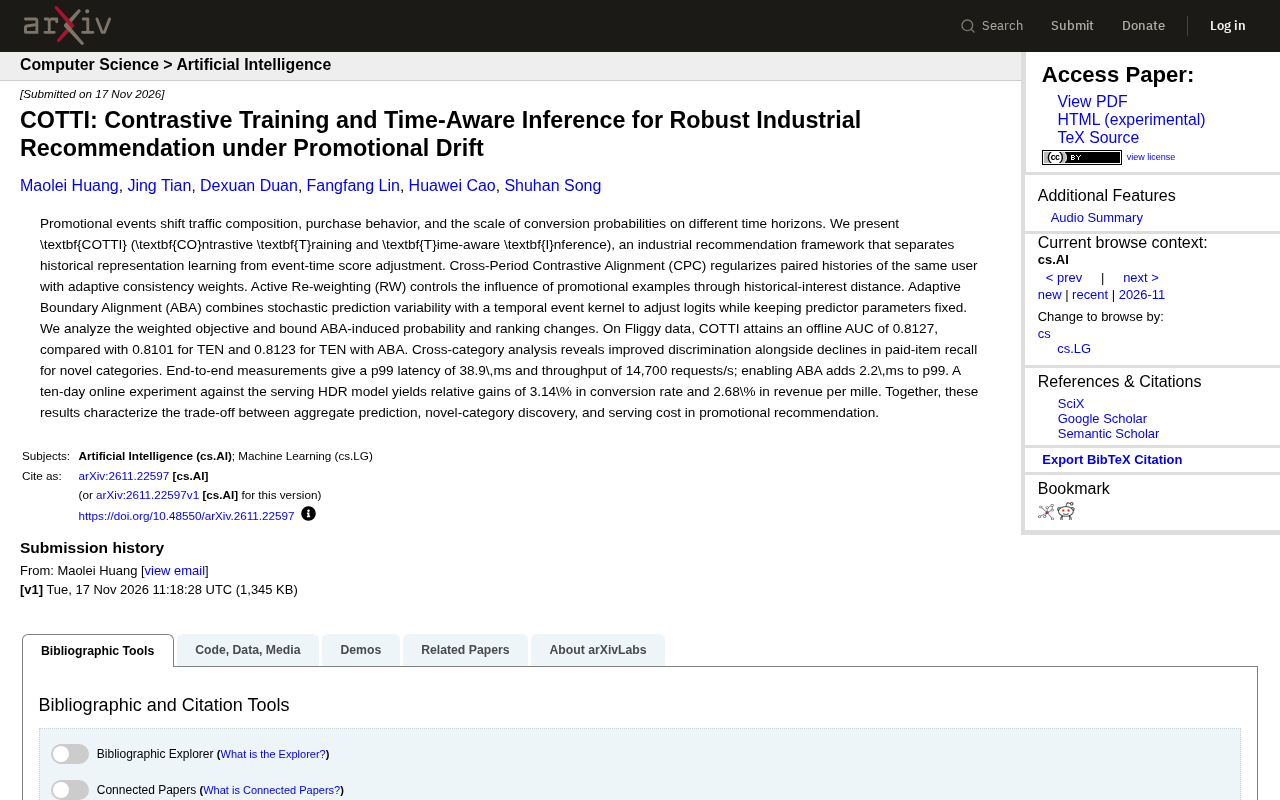
Fliggy's COTTI framework robustly addresses promotional drift by decoupling representation learning from score adjustment, boosting online conversion by 3.14%.
This article introduces COTTI, a recommendation framework from Alibaba's Fliggy team that tackles distribution drift during promotions. COTTI decouples historical representation learning from event-time score adjustment using three core techniques: Cross-Period Contrastive Alignment (CPC), Active Reweighting (RW), and Adaptive Boundary Alignment (ABA). It achieves 0.8127 offline AUC, outperforming the TEN baseline, and delivers a 3.14% relative conversion lift and 2.68% RPM lift in online A/B tests, with ABA adding only 2.2 ms to p99 latency at 14,700 requests/second. The article also highlights the trade-off between overall accuracy and new-category discovery.
Promotional events significantly alter traffic composition, purchasing behavior, and the distribution of conversion probabilities across different time scales, posing severe challenges to recommendation systems. Traditional models often perform unstably during promotions and struggle to balance overall prediction accuracy with new-category discovery. The COTTI framework, proposed by the Alibaba Fliggy team, provides a robust solution for industrial-grade recommendation systems by decoupling historical representation learning from event-time score adjustment.
The Recommendation Dilemma Under Promotional Drift
Promotional events cause drastic changes in user behavior patterns. For example, during major sales, users are more inclined to purchase discounted items, while on regular days they focus more on personalized needs. This drift causes models trained on historical data to exhibit prediction bias during promotions. The paper points out that promotions simultaneously affect traffic composition, purchasing behavior, and the scale of conversion probabilities, and these effects manifest differently across time ranges.
Existing methods such as TEN (Time-Aware Network) introduce temporal information but struggle to fully eliminate the distribution shift caused by promotions. The core idea of COTTI is to decouple representation learning from score adjustment: the former learns stable user interest representations from historical data, while the latter dynamically adjusts prediction scores when events occur. This separation design allows the model to maintain continuity of historical knowledge while flexibly responding to short-term fluctuations.
Distribution Shift is a core concept in machine learning, referring to the inconsistency between the joint distributions of training and test data (i.e., (P_{train}(X,Y) \neq P_{test}(X,Y))). In recommendation systems, promotional events are a typical trigger of distribution shift: during major sales, the probability distributions of user behaviors such as clicks, add-to-carts, and purchases systematically differ from regular days, causing models trained on historical data to make inaccurate predictions during promotions. Distribution shift can be subdivided into covariate shift (change in input distribution), label shift (change in output distribution), and concept shift (change in the mapping from input to output), and promotions often trigger all three simultaneously. Common mitigation strategies include importance weighting, domain adaptation, and robust representation learning; COTTI's active reweighting and contrastive alignment correspond to the first two approaches, respectively.
COTTI's Three Core Technologies
The COTTI framework contains three key components: Cross-Period Contrastive Alignment (CPC), Active Reweighting (RW), and Adaptive Boundary Alignment (ABA).
Cross-Period Contrastive Alignment (CPC)
CPC regularizes the historical representations of the same user across different periods through contrastive learning. Specifically, for two paired historical sequences of the same user, CPC forces their representations to be close in the embedding space and uses adaptive consistency weights to control the regularization strength. This design helps the model learn stable interest representations that are not disturbed by promotional events, thereby improving the robustness of cross-period recommendations.
Contrastive Learning is a self-supervised representation learning method whose core idea is to "pull similar samples closer and push dissimilar samples apart." In recommendation scenarios, behavior sequences of the same user across different time windows are typically treated as positive sample pairs, while sequences from different users or those with large differences are treated as negative sample pairs, optimizing representations in the embedding space through loss functions such as InfoNCE. Contrastive learning can learn user representations robust to noise and short-term fluctuations without relying on manual labels, and is therefore widely used to mitigate distribution shift. CPC builds on this by introducing adaptive consistency weights that dynamically adjust regularization strength based on the consistency degree of sample pairs, avoiding over-constraining users whose interests should legitimately drift, thereby achieving a balance between stability and flexibility.
Active Reweighting (RW)
An excessively high proportion of promotional samples in the training data causes the model to overfit to promotional patterns. RW dynamically adjusts the weights of promotional samples by computing the distance between samples and historical interests: promotional samples that differ more from historical interests are assigned lower weights. This effectively controls the influence of promotional examples on model training, preventing the model from being led astray by short-term behavior.
Adaptive Boundary Alignment (ABA)
ABA adjusts prediction logits during the inference stage while keeping predictor parameters fixed. It combines stochastic prediction variability with a temporal event kernel to dynamically adjust score boundaries based on event time. The paper theoretically analyzes the weighted objective and provides bounds on the probability and ranking changes caused by ABA, ensuring the controllability of the adjustment. This design enables the model to smoothly adjust predictions during promotions without retraining.
Logits and Score Boundary Adjustment is a post-processing technique during the inference stage of recommendation systems. Logits refer to the unnormalized scores output by the model's final layer, which are converted into prediction probabilities via Softmax or Sigmoid. ABA does not modify predictor parameters but instead applies event-time-dependent offsets (i.e., "boundaries") to logits during inference, thereby changing the prediction distribution without retraining. This approach falls under the category of Test-Time Adaptation, whose advantages include low deployment cost and fast response, but it requires theoretical guarantees that the adjusted ranking and probability changes are controllable. By analyzing the weighted objective function, the paper provides boundary conditions for the probability changes and ranking flips caused by ABA, ensuring that score adjustment does not disrupt the rationality of the overall ranking.
Offline Experiments and Performance
On the Fliggy dataset, COTTI achieved an offline AUC of 0.8127, outperforming TEN's 0.8101 and TEN+ABA's 0.8123. Cross-category analysis shows that while COTTI improves overall discriminative power, recall for paid items in new categories decreased. This reveals a trade-off between aggregate prediction accuracy and new-category discovery.
End-to-end measurements show that COTTI has a p99 latency of 38.9 milliseconds and a throughput of 14,700 requests per second; enabling ABA adds only 2.2 milliseconds to p99 latency. This demonstrates that COTTI is highly efficient in industrial-grade serving scenarios.
Online A/B Testing and Business Gains
A ten-day online experiment compared against the HDR model in service, and COTTI achieved significant gains of 3.14% relative improvement in conversion rate and 2.68% relative improvement in revenue per thousand impressions (RPM). These results validate the effectiveness of COTTI in real promotional scenarios.
The paper also notes that while COTTI improves overall prediction and revenue, it may sacrifice new-category discovery capability. This trade-off suggests that model configurations need to be adjusted according to business objectives in actual deployment.
Industrial Recommendation Trends from Multiple Perspectives
According to analyses from Bilibili UP creators and YouTube tech channels, industrial recommendation systems are evolving from single models to decoupled architectures, and COTTI's separation design follows this trend. Multiple sources agree that temporal awareness and contrastive learning are effective means of addressing distribution drift, but disagreements remain on balancing new-category discovery with overall revenue. COTTI's practice provides a new data point for this debate.
Overall, COTTI provides a solution that balances robustness and efficiency for recommendation systems in promotional scenarios, and its technical approach offers reference value for the industry.
One-line Summary
Fliggy's COTTI framework robustly addresses promotional drift by decoupling representation learning from score adjustment, achieving a 3.14% online conversion rate improvement.
Paragraph Summary
This article introduces the COTTI recommendation framework proposed by the Alibaba Fliggy team, aimed at solving the distribution drift problem caused by promotional events. COTTI decouples historical representation learning from event-time score adjustment, incorporating three core technologies: Cross-Period Contrastive Alignment (CPC), Active Reweighting (RW), and Adaptive Boundary Alignment (ABA). Offline experiments achieve an AUC of 0.8127, outperforming the TEN baseline; in online A/B testing, conversion rate relatively improves by 3.14% and RPM by 2.68%, while ABA adds only 2.2 milliseconds to p99 latency, with throughput reaching 14,700 requests/second. The article also notes that COTTI may sacrifice new-category discovery capability while improving overall accuracy, revealing the trade-off between precision and exploration.
Related articles

Zero-Code Replication of a $10,000 3D Website with Claude Code: A Six-Tool Breakdown
Bilibili creator Yomi used Claude Code plus five free tools to build a 3D product landing page quoted at $10,000 overseas—zero code. Breakdown of the six-tool division of labor, image-to-3D workflow, and the core collaboration method: "give AI a reference, not 'make it look better.'"

Claude Code in Practice: Install, Connect Models, Calculate Tokens, and Ship a Full-Stack Project with a Single Document
Based on a Bilibili public course demo, this covers Claude Code installation, model connection, token cost calculation, and the practical path of shipping a full-stack project with a single document, plus comparisons with Copilot, Cursor, Trae, and other coding assistants.

Who Accepts AI-Written Code? A 25-Minute Deep Dive into Verification Loops and the New Code Review Paradigm
After AI writes lots of code, how should Code Review verify it? This article breaks down the Claude Code team's verification loop framework: surface-level end-to-end verification, setup/drive/check three-stage skills, hybrid end-to-end testing and reliability checklists, and how to tighten the loop when issues slip through.