Coze 3.0 Full-Stack Agent Development Course: A Practical Guide to Building AI Workflows from Zero

Bilibili's Coze Agent Full-Stack Development Course teaches zero-foundation users to build agents with Coze, covering both automatic and manual paths.
This article introduces the "Coze Agent Full-Stack Development Course" on Bilibili, which aims to help zero-foundation users build agents on the Coze platform. Core content includes Coze 3.0's automatic building (generating workflows from a single natural-language sentence) and manual building (live-fire drills for complex scenarios). Manual building covers digital humans, comic drama, e-commerce, self-media, education, finance, and more. The course emphasizes AI product thinking and structured methodology rather than mere technical operations. It also notes the limits of automatic building and advises learners to start easy and progress to harder tasks, viewing the learning curve rationally.
AI tools are iterating faster and faster, and along with that comes anxiety—many people find themselves wanting to learn but not knowing where to start. The "Coze Agent Full-Stack Development Course" on Bilibili attempts to offer an answer: you don't need to know how to code, and you don't need to be a business expert—ordinary people can use Coze to build agents that complete complex tasks with a single click.
Two Building Paths in Coze 3.0: Automatic and Manual
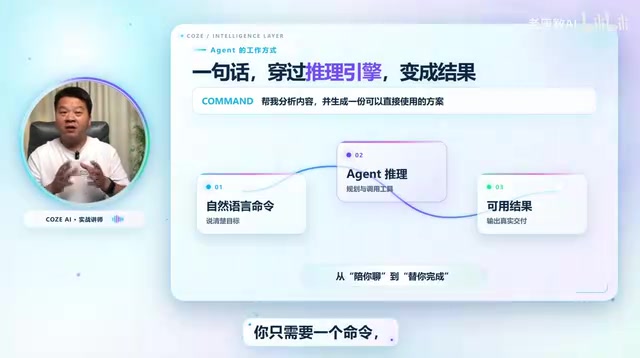
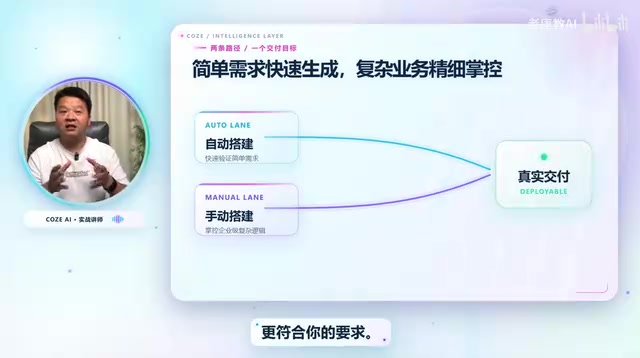
According to the Bilibili creator's tutorial, Coze currently supports both automatic and manual agent-building methods, which form the core teaching framework of the course.
Automatic Building: Generate a Workflow from a Single Sentence
A major feature of Coze 3.0 is natural-language-driven automatic building. Users only need to enter a single sentence, such as "Help me build an agent that automatically generates promotional images when I upload a product image," and the system will automatically start constructing the workflow. Once building is complete, upload a product image and wait a moment to get the result.

The same logic can be reused in other scenarios: enter "Help me build a workflow that automatically generates poetry learning cards when I input the name of a poem," add constraints such as "images that match the mood and aesthetically pleasing poetry layout," and drop in "Quiet Night Thought" to generate a beautifully designed learning card. Skills can also be created with a single sentence—for example, a skill that automatically generates viral Xiaohongshu copy and covers after you input a topic, suitable for parent-child education graphic content production.
The creator also candidly points out that what is generated from a single sentence may not be perfect at first, and later lessons will teach how to make it more precise and better aligned with specific requirements. Automatic building is suitable for simple needs, but complex tasks or enterprise-level agents still require manual building.
Agent refers to an AI system capable of perceiving its environment, making autonomous decisions, and executing actions to achieve goals. Unlike traditional chatbots, agents typically have task decomposition, tool-calling, and memory capabilities, and can chain multiple steps together to complete complex tasks. In Coze, agents are orchestrated through visual workflows that connect large models, plugins, knowledge bases, and other components to automate processing from input to output. Understanding the basic components of an agent (such as planning, tool use, and memory) helps in designing better workflows.
Manual Building: Live-Fire Drills for Complex Scenarios
The course teaches manual building around real-world implementation scenarios across multiple industries, covering a fairly wide range:
- Digital humans: Input a script and automatically generate a digital human talking-head short video
- Comic drama industry: Give a simple description and generate a comic drama video
- E-commerce industry: Upload an image of clothing and generate a high-quality product promotion image; upload an image and generate a product promotion video
- Self-media industry: Deconstruct the underlying logic of various viral short videos
- Education industry: Essay grading assistant, idiom learning cards, teaching aid tools
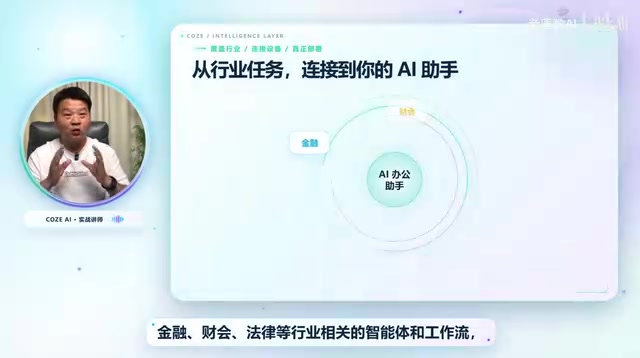
- Finance, accounting, legal, and other industries: Related agent and workflow courses are all covered
This industry-by-industry breakdown allows learners to map abstract workflow concepts onto specific business areas they are familiar with, lowering the barrier to understanding.
Workflow is the core mechanism in Coze for implementing complex tasks. It connects multiple nodes (such as LLM nodes, code nodes, plugin nodes, conditional branches, etc.) in sequence to form reusable automated processes. Workflows support logic such as conditional judgment, loops, and parallelism, and can handle multi-step, multi-branch business scenarios. When manually building agents, developers need to design the workflow structure according to business requirements, configure the parameters and input/output mappings of each node, and debug and run it to ensure the process is correct. Mastering workflow orchestration is a key skill for building enterprise-level agents.
What the Course Really Aims to Teach
One point this tutorial repeatedly emphasizes is that it is by no means only about technology. The creator states clearly at the outset that the core value of the course lies in helping learners build AI product thinking and a structured application methodology, so that you can draw inferences and build AI tools tailored to your own industry needs.
In other words, learning the specific operations of Coze is only the starting point. The goal is to turn AI from a chat tool into an advanced assistant that can complete complex tasks with one click, and to form your own "high-quality AI team." The course also mentions that it will explain Coze 3.0's local device and cloud device capabilities, making it a full-scenario AI office assistant.
AI product thinking refers to the mindset of designing solutions using AI capabilities starting from user needs. It emphasizes understanding the boundaries of AI (such as hallucinations in large models and context limits), focusing on scenario value, and iteratively optimizing product experience. In agent development, AI product thinking is reflected in how to break down business problems into tasks that AI can execute, how to design human-machine collaboration processes, and how to evaluate and improve agent performance. This mindset helps learners go beyond specific tools and apply them by analogy in different fields.
Who It's For, and What to Keep in Mind
Judging from its positioning, the course targets ordinary people with zero foundation and non-technical backgrounds—it requires neither programming ability nor business expertise. The full course and accompanying knowledge base documents are said to be shared for free, obtainable by following, liking/coins/favoriting, and leaving a comment.
What needs to be viewed rationally is this: the effectiveness of one-sentence automatic building depends on the precision of the prompt, and the course itself admits that the first version of the result "may not yet be perfect." Manual building of enterprise-level agents involves multiple layers of detail such as workflow orchestration, plugin calls, and knowledge base configuration, and the learning curve is not as gentle as the promotional language suggests. Treating such tutorials as an introductory map is reasonable, but expectations may need adjusting if you expect to launch production-grade applications immediately after finishing.
For ordinary learners, a more pragmatic path may be: first use automatic building to quickly get a small scenario in your own industry running and establish positive feedback, then move into the deeper waters of manual workflows. This course provides exactly such a zero-to-one roadmap, and how far you can ultimately go depends on how many times you apply it to your own real problems.
One-line Summary
A Bilibili course, "Coze Agent Full-Stack Development Course," teaches zero-foundation users how to build agents with Coze, covering both automatic and manual paths.
Paragraph Summary
This article introduces the "Coze Agent Full-Stack Development Course" on Bilibili, which aims to help zero-foundation users build agents using the Coze platform. The core content includes two approaches in Coze 3.0: automatic building (generating workflows from a single natural-language sentence) and manual building (live-fire drills for complex scenarios). Manual building covers multiple industry scenarios such as digital humans, comic drama, e-commerce, self-media, education, and finance. The course emphasizes cultivating AI product thinking and structured methodology rather than mere technical operations. The article also points out the limitations of automatic building and suggests learners start easy and progress to harder tasks, while viewing the learning curve rationally.
Related articles

Random Pruning of the DPO Computation Graph: 1.4x Training Speedup and Lower Peak Memory
DPO training too slow and memory-hungry? This paper proposes a random pruning framework for the DPO computation graph, sampling independently across position, sequence, and branch dimensions; branch pruning achieves a 1.426x step-time speedup and cuts training time by about 30%, with in-depth attribution of memory and time gains.

Why Does JEPA Underperform MLM in Longitudinal EHR Representation Learning?
New study compares JEPA and MLM for longitudinal EHR representation learning on MIMIC-IV: three JEPA variants train stably without collapse but underperform MLM; target size, not heterogeneity, drives prediction error.

Transfer Learning + Visible Light Communication: A New Approach to Energy-Efficient Indoor Positioning
A study proposes a transfer learning-based visible light communication indoor positioning method, achieving 47% accuracy improvement on the BOSCH factory dataset, 67.5% model efficiency under high noise, and introducing the ME composite metric for energy-efficient positioning in energy-constrained industrial IoT scenarios.