Coze Agent Development Bootcamp: From Zero to Commercial Deployment

Coze 3.0 practical tutorial: from one-sentence automatic building to manual workflows and local deployment, implementing AI apps with zero programming.
The article introduces a Coze 3.0 agent development bootcamp course focused on zero programming and real multi-industry cases. It has three progressive stages: automatic building, generating agents, workflows, or skills with one sentence for quick validation of simple needs; manual workflows, covering digital humans, comic drama, e-commerce, self-media, education, and finance, explaining multi-branch workflow design and variable debugging; and local/cloud deployment with permission configuration. The core goal is AI product thinking and structured methodology, though auto-generated results may need manual polishing.
AI tools keep emerging, and many people want to learn but don't know where to start. This Coze agent development bootcamp course focuses on zero programming background and real cases across multiple industries—from automatic building to manual workflows to local deployment—aiming to help ordinary people complete the full cycle of putting AI applications into practice.
Automatic Building: Generate an Agent with One Sentence
According to the Bilibili tutorial, Coze 3.0 supports both automatic and manual building methods. Automatic building is a major feature of 3.0: one sentence can generate an agent, workflow, or skill.
For example, enter "help me build an agent that automatically generates promotional images after uploading product photos," and after running, the system starts building automatically. Once done, upload a product image and wait a moment for the result. Workflows also support one-sentence generation—enter "help me build a workflow that automatically generates poetry learning cards when I input the name of a poem; the card should have images that match the mood, and the poetry layout should be aesthetically pleasing," then drop in a poem title and get a learning card. Skill creation works the same way.
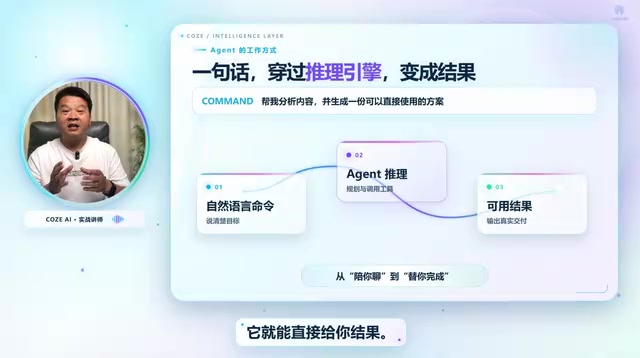
The tutorial also admits that what one sentence generates may not be perfect at first, and later lessons will teach how to make it more precise. Automatic building is fine for simple needs, but complex tasks and enterprise-grade agents still require manual building.
Agent is the core concept of platforms like Coze. Simply put, an agent is an AI program that can perceive input, call tools (such as search, image generation, code execution), and autonomously complete multi-step tasks. It usually consists of three parts: persona and instructions (defining the role and task boundaries), skills/plugins (callable external capabilities such as generating images or querying databases), and workflows (execution logic that strings multiple steps together). Coze 3.0's one-sentence generation essentially lets the large model automatically infer these three parts of configuration from a natural language description and assemble them into a runnable agent. Understanding this structure is the key to understanding what you're actually adjusting during manual building later—you're not tuning "magic," but changing instructions, swapping plugins, and rearranging workflow nodes.
Manual Workflows: Real-World Scenarios Across Industries
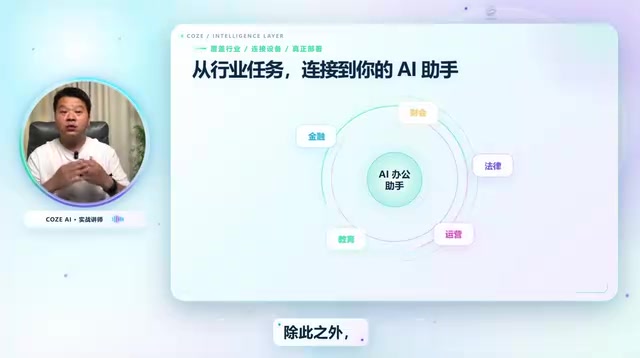
The course delivers in-depth practice around real implementation scenarios in various industries. In the digital human field, input a script to automatically generate a digital human talking-head short video; in the comic drama industry, give a simple description to generate a comic drama video; in e-commerce, upload clothing images to generate high-quality product marketing images, and upload images to generate marketing videos; in the self-media industry, break down the underlying logic of viral short videos; in education, cover essay grading assistants, idiom learning cards, and teaching aid tools; agents and workflows related to finance, accounting, law, and other industries are also covered.

The keywords here are "multi-branch workflow design" and "variable debugging"—complex tasks often require conditional branches and variable passing, and only manual building gives you true control over the logic. The practical path mentioned in the tutorial is actually the process of translating industry know-how into workflow nodes and variable rules.
Workflow is an orchestration method that breaks a complex task into several nodes executed in sequence or under conditions. Common node types include: start/end nodes, large model nodes (calling an LLM for generation or judgment), plugin nodes (calling external APIs), conditional branch nodes (if-else), variable assignment and reference nodes, loop nodes, etc. Variables are the carriers that pass data between nodes—the output of the previous node can be stored in a variable, and the next node reads and uses it. Multi-branch workflows add conditional judgment so that different inputs take different paths; for example, in an e-commerce scenario, "whether the uploaded item is clothing or shoes" determines which promotional image generation pipeline to follow. Variable debugging is checking whether each node's input and output meet expectations, and it is a key action for ensuring stable workflow operation.
Local and Cloud: Full-Scenario AI Office
The course also covers Coze 3.0's local devices and cloud devices, making Coze a full-scenario AI office assistant.
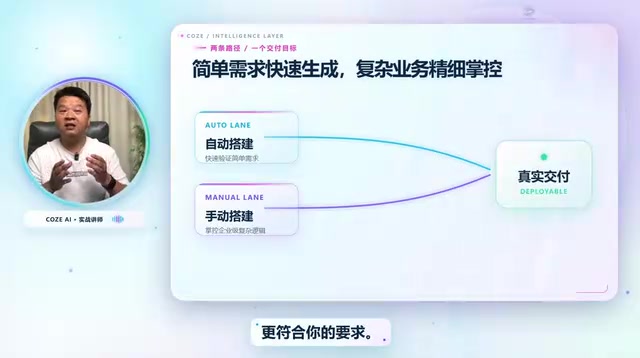
The localization deployment section involves permission configuration, an unavoidable step for enterprise applications—who can access, who can modify, and how data is isolated all directly determine whether an agent can truly be put into commercial use. The tutorial links design thinking, building techniques, practice methods, and localization deployment into one line; what it teaches is not only technology, but also industry thinking and methodology.
Localized deployment refers to deploying an agent or its dependent services on devices or private servers you control, rather than relying entirely on the platform's public cloud. The value lies in keeping data within the internal network, integrating with existing enterprise systems, and customizing permissions as needed. Permission configuration usually involves role division (administrator, editor, user), access control (who can call which agent or workflow), and data isolation (data from different departments or customers is invisible to one another). For enterprise applications, these configurations directly determine whether an agent can be put into commercial use compliantly—without clear permission boundaries, no matter how powerful the agent is, it will be hard to move into production.
Course Positioning and Target Audience
According to the tutorial, regardless of your role, you don't need to know programming, nor do you need to be a business expert—anyone can learn. The entire course and corresponding knowledge base documents are shared for free; to receive them, follow, like, coin, and favorite (one-click triple), and leave a comment in the comment section.
The core goal repeatedly emphasized in the tutorial is not to teach a particular tool, but to build AI product thinking and a methodology for structured applications, so that learners can draw inferences and build AI tools that fit their own industry needs. From the content structure, it divides automatic building, manual workflows, and local deployment into three progressive stages, suitable for practitioners who want to quickly get started with Coze while also understanding the underlying logic of workflows. It should be noted that the advertised effect of "completing complex tasks with one click" depends heavily on the specific scenario and debugging quality; actual implementation still requires investing time to polish workflow details.
One-line Summary
Coze 3.0 practical tutorial: from one-sentence automatic building to manual workflows and local deployment, implementing AI applications with zero programming.
Paragraph Summary
The article introduces a Coze 3.0 agent development bootcamp course focused on zero programming background and real cases across multiple industries. The tutorial is divided into three progressive stages: automatic building, using one sentence to generate an agent, workflow, or skill, suitable for quickly validating simple needs; manual workflows, covering scenarios in digital humans, comic drama, e-commerce, self-media, education, finance, and other industries, explaining multi-branch workflow design and variable debugging, and translating industry know-how into nodes and variable rules; local and cloud deployment, involving permission configuration, making Coze a full-scenario AI office assistant. The tutorial emphasizes that the core goal is not to teach a specific tool, but to build AI product thinking and structured methodology, while also noting that automatically generated results may not be perfect at first and complex tasks still require manual polishing.
Related articles

T3 Code: The Open-Source AI Coding Assistant's Comeback Story
T3 Code is an open-source AI coding assistant that unifies subscriptions like Codex and Claude, with powerful remote control and parallel task management.

Never Elected, Yet Ruled New York for 30 Years: The Ultimate Case Study in the Mechanics of Power
Robert Caro's biographies reveal how unelected Robert Moses ruled New York for 30 years through legal drafting and public authorities, and how Lyndon Johnson built leverage as a "powerless" Senate Majority Leader. Unpacking the underlying logic of accumulating and sustaining power.

The CPython 3.10 Recursion Trap and Synthetic Recovery in TokenGuard, an LLM Circuit Breaker
TokenGuard's author recounts a recursion crash caused by OrderedDict.pop in CPython 3.10 and introduces v0.3.0's Loop Nudge synthetic recovery, inline DLP scanning, and other new LLM agent circuit-breaker capabilities.