Coze Agent Hands-On Tutorial: Multi-Agent Collaboration and Workflow Building for Beginners

Coze builds AI teams from multiple Agents; this article outlines its capabilities, products, and learning path.
Based on Bilibili's Mash Group tutorial, this article outlines Coze's platform awareness framework. The core idea is combining multiple Agents in expert roles with humans into an "AI team"—e.g., two people plus four Agents form a six-person project team, suited to AI comic drama, development, and other multi-role scenarios. The platform offers industry templates, freely customizable Agent skills, web/desktop/mobile interoperability, and local Agent connections for remote AI programming. The author is skeptical of "one-sentence project completion" due to uncertain output and high credit costs. The four official directions are Coze, Coze Code, Compass, and Coze Open Source, with daily use focusing on the first two. The suggested learning order is platform awareness, multi-Agent collaboration, workflows, and Coze Code, relying on the latest official interface.
Why Coze: From Solo Work to AI Team Collaboration
Traditional AI tools often map one model to one task, but the core idea behind Coze is to organize multiple Agents into an "AI team." According to an analysis of the hands-on tutorial by Bilibili's Mash Group, Coze lets users assign each Agent an expert role in a different domain, and then combine them with human members into a hybrid team—for example, "two people + four Agents" can form a six-person project team that divides up work for specific needs. This model is especially well suited to scenarios that require multi-role coordination, such as AI comic drama production and software development.
A vivid metaphor from the tutorial: in a company, HR recruits people to build a team, whereas the "talent" in Coze can be summoned with credits alone.
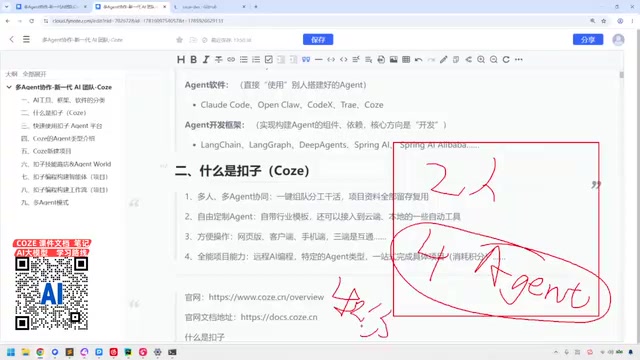
Figure: The tutorial uses "tokens and credits" as an analogy for the cost of talent in the AI era
This "credits as manpower" mechanism lowers the barrier to assembling a virtual team, but it also means that ongoing project operation consumes credits—a point that becomes especially important in the later discussion of "one-stop projects."
Agent is the foundational concept for understanding the Coze model. Unlike a chatbot that only handles single-turn Q&A, an Agent is typically composed of a large language model, instruction prompts, callable tools (such as search, code execution, and APIs), and a memory mechanism, enabling it to autonomously plan and execute steps toward a goal. In Coze, each Agent is given a clear expert role and skill boundaries. The essence of multi-Agent collaboration is to let Agents in different roles each handle the subtasks they excel at, and then have humans or orchestration logic aggregate the results. This division of labor draws on the idea of multi-agent systems in software engineering, and its effectiveness depends heavily on how well tasks are decomposed and how accurately information is passed between Agents.
Platform Capabilities Breakdown: Free Customization, Three-Platform Interoperability, and Project Delivery
Freely Customizable Agents and Industry Templates
Coze provides a large number of industry templates by default, covering verticals such as legal consulting, short video production, and AI comic drama. Users can apply templates directly or let Agents learn new skills on their own. For users who don't want to build from scratch, templates are a shortcut to quickly validating a scenario; for teams with clear requirements, however, a custom combination of Agent skills is the key to realizing the platform's value.
Workflow is the core capability in Coze for carrying complex logic. It can be understood as a visual flow made up of multiple nodes connected in sequence: an input node receives parameters, large model nodes handle understanding or generation, plugin and code nodes perform retrieval, computation, and external calls, conditional branch nodes control the direction, and finally an output node returns the result. Compared with the free-form conversation of a single Agent, workflows fix the steps in place, making behavior more controllable and easier to debug—suitable for business scenarios that require stable output. The multi-Agent collaboration and "one-stop projects" mentioned in the article often come down to workflow orchestration at the implementation level, so understanding nodes and the variable-passing mechanism is a necessary step from platform awareness to actual delivery.
Three-Platform Interoperability: Web, Desktop, and Mobile
Coze supports operation across the web version, desktop client, and mobile app. The tutorial author emphasizes that this design makes "working anytime, anywhere" possible—on a trip, you can pull out your phone, tap a couple of times, and direct an Agent to handle a task. For projects that need flexible response, three-platform synchronization does improve operational convenience.
Figure: Coze desktop client and mobile support
All-Around Project Capabilities and Remote AI Programming
Coze can connect to local Agents, letting AI perform operations on the user's own computer—similar to the capabilities of tools like OpenClawAd, but requiring a specific local Agent to do so. The tutorial also mentions the vision of "completing a project in one stop": the user says one sentence and the rest is left to multiple Agents collaborating. However, the author is skeptical of this—Agent output may not meet expectations, may require repeated adjustment, and credit consumption can be considerable.
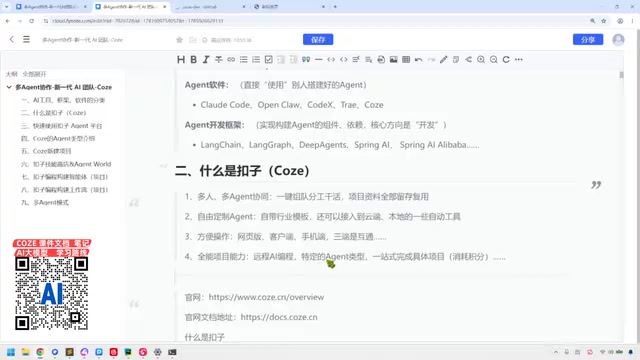
Figure: Several Agent types provided by Coze
Coze Code is Coze's programming capability direction for developers, positioned around generating and deploying applications, plugins, and backend logic via natural language or low-code methods, complementing the conversational building experience aimed at general users. The "Coze Programming" mentioned in the article refers to this product line, while "Coze Open Source" corresponds to Coze Studio, which provides an open version that can be self-deployed, making it convenient for enterprises with data compliance or private deployment needs. Compass focuses on Agent testing and evaluation, used to verify effectiveness before launch. Distinguishing these product lines helps with decision-making: choose Coze for everyday building, choose Coze Code when you need to write code or do integrations, choose Compass when evaluation matters, and look to the open-source version when you need self-controlled deployment.
Official Website Navigation and Product Matrix Awareness
After entering the Coze official website, you first see the entry points for the personal and enterprise editions. The tutorial suggests trying the personal edition first; the upper right corner offers two options, "Open Web Version" and "Download Coze," corresponding to browser operation and desktop client download respectively, which together with mobile form three-platform interoperability. The official homepage also showcases some example scenarios, such as quickly reading multiple medical papers and extracting key points, illustrating the platform's generality for information-processing tasks.
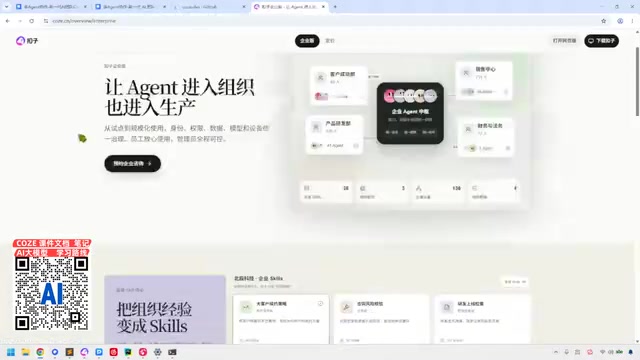
Figure: Personal edition entry point and download options on the official website
At the bottom of the page, Coze's core product directions are listed: Coze, Coze Code, Compass, and Coze Open Source. The tutorial notes that Compass is mainly used for testing Agents and does not need to be a focus for now; daily use should focus on Coze and Coze Code, while Coze Open Source corresponds to Coze Studio. Clarifying the relationship among these four products helps you choose tools as needed later, rather than getting lost in a frequently iterating official website.
From Awareness to Delivery: Suggested Learning Path
The title of this tutorial covers four levels: platform awareness, multi-Agent collaboration, workflow building, and Coze Code programming. Judging from the original content, the platform awareness section already provides a clear framework: first understand the "AI team" collaboration model, then become familiar with three-platform operation and the product matrix, and finally move on to the hands-on practice of workflows and programming. For beginners, it is recommended to proceed in this order to avoid getting stuck in complex workflow configuration right away.
It is worth noting that the Coze platform iterates frequently, and the official website structure and feature entry points may change at any time. The tutorial author also admits that "you may not be able to find many things you're looking for," so during learning you should rely on the latest official interface, treating the tutorial as a cognitive framework rather than a fixed operations manual.
The real difficulty of multi-Agent collaboration is not creating Agents, but task decomposition and result validation—which is also why "one-stop projects" are not recommended. Designing the points where humans step in and estimating credit costs are issues that need to be thought through before project delivery.
One-line Summary
Coze forms an AI team from multiple Agents; this article outlines its platform capabilities, product matrix, and learning path.
Paragraph Summary
Based on the hands-on tutorial by Bilibili's Mash Group, this article outlines the platform awareness framework for Coze. The core idea is to combine multiple Agents serving as experts in different roles with human members into an "AI team"—for example, two people plus four Agents form a six-person project team, suitable for multi-role scenarios such as AI comic drama and software development. The platform offers industry templates for legal, short video, AI comic drama, and other fields, supports free customization of Agent skills; the web version, desktop client, and mobile app are interoperable; and it can connect to local Agents for remote AI programming. The author is skeptical of "completing a project in one sentence," believing output is uncertain and credit consumption is high. The four main directions on the official website are Coze, Coze Code, Compass, and Coze Open Source, with daily use focusing on the first two. The article suggests learning in the order of platform awareness, multi-Agent collaboration, workflows, and Coze Code, and relying on the latest official interface.
Related articles

ChatGPT Plus Subscription Pitfall Guide: Go/Plus/Pro Tier Comparison and Quick Activation
A complete ChatGPT Plus subscription guide based on a Bilibili tutorial: from registering an account, comparing Go/Plus/Pro tiers, to the practical steps for quickly completing your subscription.

GPT-6.2 Sol/Astra Released! A Step-by-Step ChatGPT Plus Subscription Guide and Tier Comparison
GPT-6.2 Sol/Astra is out—here's a ChatGPT Plus subscription guide: register an account, compare Go/Plus/Pro tiers, and subscribe in a minute.

Comparing Three Channels for Subscribing to GPT Plus in China: Is Website Top-Up the Easiest?
How to subscribe to GPT Plus in China? This article compares website top-up, credit card, and mobile top-up channels—process, cost, and risk—with steps and tips to help you choose wisely.