Coze Space vs Manus: Hands-On Comparison — Which AI Agent Automation Tool Is Better?

Hands-on test of Coze Space versus Manus reveals strong AI automation task planning capabilities.
ByteDance's Coze platform has launched Coze Space, an AI automation tool positioned directly against Manus, currently in closed beta. Testing shows impressive performance in enterprise analysis report generation and stock investment comparison scenarios, with automatic task decomposition, information retrieval, data analysis, and visualized web page generation. Key advantages include native MCP tool support, localized data access, and Coze ecosystem integration, though challenges remain around beta stability and tool ecosystem maturity.
Introduction
Coze recently launched a brand-new product — Coze Space — currently still in closed beta and accessible only via invitation codes. As an AI automation task planning tool positioned directly against Manus, how does Coze Space actually perform? This article puts it through multiple real-world tests, giving you an in-depth look at its core features and user experience, while providing a comprehensive comparison with Manus to determine which is the better choice in the current AI Agent automation space.
What Is Coze Space? Understanding Its Core Positioning in One Minute
If you've been following the widely popular Manus, understanding Coze Space becomes straightforward. Manus was developed by the Chinese team Monica.im and released in March 2025, quickly garnering global attention. Its core selling point is that users only need to describe tasks in natural language, and the system automatically breaks them down, plans, and invokes various tools to complete complex workflows. The emergence of Manus marked a paradigm shift in AI applications from "conversational assistant" to "autonomous executor," officially kicking off competition in the AI Agent track.
An AI Agent refers to an AI system capable of autonomously perceiving its environment, formulating plans, and executing actions. Unlike traditional single-turn Q&A interactions with large models, it possesses capabilities for multi-step reasoning, tool invocation, and autonomous decision-making. While the concept of AI Agents traces back to early artificial intelligence research, it truly entered mainstream awareness after breakthroughs in large language model (LLM) capabilities. A complete AI Agent typically comprises four core modules: a perception module (receiving user input and environmental information), a planning module (decomposing goals into executable steps), an execution module (invoking tools to complete specific operations), and a memory module (storing contextual information to support multi-step tasks). Between 2024 and 2025, as model reasoning capabilities improved significantly and Function Calling technology matured, AI Agents rapidly evolved from academic concepts into commercial products, forming a multi-layered ecosystem that includes general-purpose Agents, vertical-domain Agents, and development frameworks (such as LangChain and AutoGPT).
In simple terms, Coze Space is an AI-driven automated work planning and execution tool with a core workflow consisting of four steps:
- Problem Analysis: Receives the user's natural language instructions and understands task requirements
- Task Decomposition: Automatically breaks complex requirements into multiple executable subtasks
- Tool Invocation: Automatically calls built-in tools and MCP (Model Context Protocol) tools to complete each subtask
- Solution Output: Generates the final deliverable, including reports, web pages, data analysis, and other formats
This mode of autonomously completing the entire process from task input to final deliverable output is called end-to-end automation. It differs fundamentally from traditional workflow automation tools (such as Zapier, n8n, etc.): traditional tools require users to predefine trigger conditions and execution logic for each step — essentially "rule-driven" automation using a DAG (Directed Acyclic Graph) pattern, where users must predefine triggers, conditional branches, and execution actions, encoding human operational processes into fixed rules. Coze Space and Manus, on the other hand, are "intent-driven" automation tools — users only need to describe the end goal, and the system determines the execution path, selects tools, and handles exceptions on its own. The technical foundation is the large language model's planning capability and tool use capability. The model can dynamically generate execution plans based on task objectives and adjust strategies based on intermediate results during execution — this capability is known as the ReAct (Reasoning + Acting) paradigm, proposed by Yao et al. in 2022, which alternates between reasoning and action to significantly improve the quality of complex task completion. This paradigm shift dramatically lowers the barrier to automation, enabling non-technical users to accomplish complex tasks that previously required coordination of multiple specialized tools.
Users only need to describe their requirements through a Prompt, and Coze Space can complete the entire task chain end-to-end. Particularly noteworthy is that Coze Space has natively integrated MCP tool support. MCP (Model Context Protocol) is a standardized protocol open-sourced by Anthropic in late 2024, designed to establish a unified communication interface between large language models and external tools and data sources. Before MCP, every AI application that needed to connect to different tools (such as database queries, API calls, file operations, etc.) required custom adapter code, resulting in high development costs and poor reusability. MCP defines a standardized request-response format that allows any protocol-compliant tool to be invoked by AI models in a plug-and-play manner, similar to how the USB interface unified peripheral connection standards.
From a technical architecture perspective, MCP uses a client-server architecture where the AI application acts as the MCP client making requests, and external tools serve as MCP servers providing capabilities. The protocol defines three core primitives: Tools (functions the model can call), Resources (data the model can read), and Prompts (predefined interaction templates). MCP uses JSON-RPC 2.0 as its communication format and supports two transport methods: stdio (standard input/output) and HTTP+SSE (Server-Sent Events), a design that enables unified access for both local tools and remote services. Currently, MCP has gained support from major vendors including OpenAI and Google, and is becoming the de facto standard for AI Agent tool invocation. As of mid-2025, the MCP ecosystem has seen thousands of community-contributed tool servers covering common scenarios like database operations, code execution, file management, and web browsing, though the number of enterprise-grade high-availability tools remains relatively limited. Coze Space's native MCP integration means users can connect various MCP tools to handle more complex task scenarios, giving it a clear advantage in tool ecosystem extensibility.
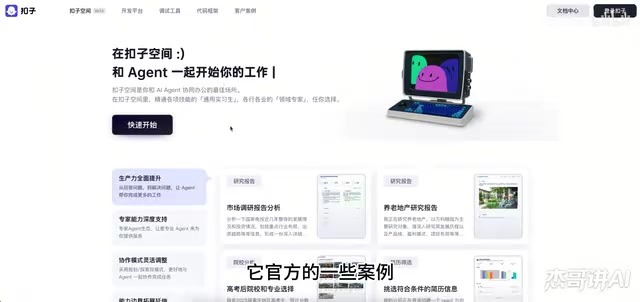
Hands-On Testing of Coze Space Official Cases: Deep Dive into Two Typical Scenarios
Coze Space provides official case demonstrations across multiple dimensions, covering four major directions: productivity enhancement, expert-level deep support, collaboration modes, and capability boundary extension. We selected two of the most representative cases for detailed testing.
Case 1: Automatically Generating an Enterprise Development Analysis Report
The first test task was to have Coze Space analyze a major enterprise's overall development over recent years, including industry positioning and news trends, requiring a thorough and detailed report presented as a visualized web page.
After receiving the task, Coze Space automatically executed the following steps:
- Information Retrieval: Automatically searched for and collected public data and industry information about the relevant enterprise
- Web Page Generation: Performed UI design based on retrieval results and automatically generated web page code
- Review and Refinement: Checked and supplemented the generated web page to ensure content completeness and accuracy
The final page output was impressive — not only rich in content and accurate in data, but the overall UI design was quite professional. This capability of automatically generating visualized web pages relies on the combination of large language models' code generation abilities and frontend technology stacks. Typically, such systems generate single-page applications containing HTML, CSS, and JavaScript, using visualization libraries like Chart.js, ECharts, or D3.js to render data charts. This "AI-generated frontend" approach has developed rapidly in recent years, with products like Vercel's v0 and Anthropic's Artifacts demonstrating similar capabilities. The core challenges lie in ensuring cross-browser and cross-device compatibility of generated code, as well as striking the right balance between aesthetics and information density. The page supports direct download, making it convenient for users to save and share.

In terms of practical results, Coze Space demonstrates impressive capabilities in information aggregation and visual presentation. For scenarios requiring rapid production of industry analysis reports, this feature can significantly reduce the time spent on manual compilation and formatting.
Case 2: Stock Investment Comparison Analysis with Smart Recommendations
The second case leans more toward data analysis — requiring Coze Space to compare stock price performance and financial conditions of different companies, and provide investment recommendations.
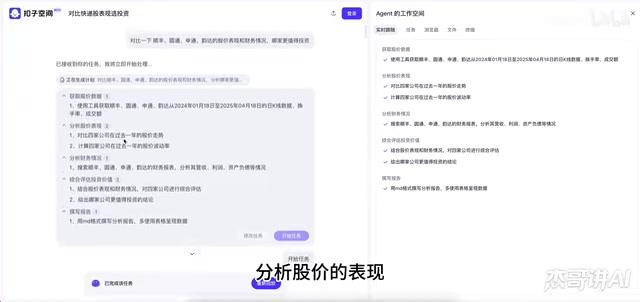
Coze Space's processing workflow was very clear:
- Fetch Stock Price Data: Automatically retrieved historical stock price information for target companies
- Analyze Stock Performance: Compared stock price trends and volatility across companies
- Analyze Financial Conditions: Provided in-depth interpretation of key financial statement indicators
- Comprehensive Investment Value Assessment: Delivered final investment recommendations based on multi-dimensional data
Throughout the process, Coze Space displayed a detailed Chain of Thought — the thinking, execution, and re-thinking process at each step was clearly visible, giving users full transparency into the AI's decision-making logic. Chain of Thought (CoT) is a key technique for improving large language model reasoning capabilities, first systematically proposed by Wei et al. from the Google research team in their 2022 paper "Chain-of-Thought Prompting Elicits Reasoning in Large Language Models." The core idea is to have the model show intermediate reasoning steps before giving a final answer, similar to how humans "show their work" when solving problems.
Since its introduction, Chain of Thought technology has undergone several important evolutions: from the initial Few-shot CoT (guiding the model to show reasoning steps through examples), to Zero-shot CoT (triggering reasoning through instructions like "Let's think step by step"), to Tree of Thoughts (allowing the model to explore multiple reasoning paths and backtrack), and Graph of Thoughts (supporting more complex non-linear reasoning structures). OpenAI's o1 series models have further internalized chain of thought as a core mechanism in model training, using reinforcement learning to teach the model to automatically unfold detailed thinking processes during reasoning.
In AI Agent scenarios, Chain of Thought plays an even more critical role — it not only helps the model make more accurate decisions but also allows users to audit every step of the AI's reasoning logic and judge whether conclusions are reliable. For high-stakes decision scenarios like financial analysis, this transparency design is especially important, as users can determine whether the AI's analysis contains logical gaps or data biases. The final analysis report is saved as a file, containing comprehensive data charts and analytical conclusions.
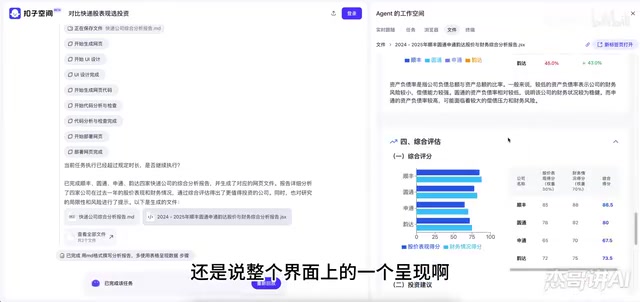
In terms of report quality, the data presentation is clear, the interface design is professional, and the overall result is quite impressive. The report also supports downloading, making it convenient for users to further edit and use.
Coze Space vs Manus: Multi-Dimensional Comparison
As a product explicitly positioned against Manus, the similarities and differences between Coze Space and Manus are worth exploring in depth. Below is a breakdown comparison across multiple dimensions.
Core Similarities
- Consistent Core Philosophy: Both are natural language-driven automated task planning and execution tools
- End-to-End Capability: Full automation from requirement understanding to final delivery
- Multiple Output Formats: Support for web pages, reports, data analysis, and other output formats
Coze Space's Differentiating Advantages
- MCP Tool Ecosystem: Native built-in MCP support with stronger tool extensibility and greater potential for integrating third-party capabilities in the future. As the MCP protocol is adopted by more developers and vendors, Coze Space can directly benefit from this growing tool ecosystem without needing to develop separate integration solutions for each new tool
- Localization Advantages: As a domestic product, it has advantages in Chinese semantic understanding, domestic data source access, and regulatory compliance. For example, in scenarios like fetching A-share financial data or searching Chinese industry reports, Coze Space can more smoothly access domestic data sources, while Manus may face limitations in data acquisition and network access in these scenarios
- Deep Integration with the Coze Ecosystem: Coze is an AI application development platform under ByteDance, officially launched in 2024. Users can create chatbots, configure plugins, build workflows through a visual interface, and publish built Bots to multiple channels including Feishu, WeChat, and web pages. As of 2025, the Coze platform has accumulated a rich plugin marketplace and workflow templates, forming a relatively mature developer ecosystem. As a new member of the Coze ecosystem, Coze Space can naturally leverage the platform's existing Bots, plugins, and workflow capabilities to create synergistic effects — an ecosystem synergy advantage that standalone products cannot quickly replicate
Current Shortcomings of Coze Space
- Still in Closed Beta: Feature completeness and operational stability still await large-scale user validation
- Invitation Code Barrier: Access channels are currently limited, and regular users cannot freely experience it. This is similar to Manus's early invitation-only strategy — while it controls product quality and server load, it also limits user growth and community feedback speed
- Tool Richness Needs Improvement: The actual number and quality of available MCP tools still requires time to accumulate through community contributions. Although the MCP protocol has great prospects, the entire ecosystem is still in its early stages, with a limited number of high-quality MCP tool servers, and some tools still having room for improvement in stability and feature completeness
Conclusion: Is Coze Space Worth the Hype?
Based on our hands-on testing, Coze Space demonstrates solid capabilities in task planning, information retrieval, data analysis, and visual presentation. The automatically generated visualized web pages and analysis reports, in terms of both content depth and interface design, reach a level that's ready for direct use.
For users who frequently need to conduct industry analysis, data comparisons, and report generation, Coze Space has the potential to become a highly efficient productivity tool. Of course, as a product still in closed beta, its ultimate stability, accuracy, and tool ecosystem richness will need to withstand broader scrutiny after official release.
Competition in the AI Agent automation track is intensifying rapidly. Beyond Manus and Coze Space, OpenAI's Operator focuses on browser automation, capable of completing shopping and booking tasks on behalf of users; Google's Project Mariner similarly focuses on browser Agents, leveraging Gemini's multimodal capabilities to understand web content; Microsoft's Copilot Studio targets enterprise users, providing Agent-building capabilities deeply integrated with Microsoft 365. In the open-source space, frameworks like AutoGPT, BabyAGI, and CrewAI continue to iterate. We can see these products moving from "proof of concept" to "practically usable."
The core challenge in this track is: how to maintain high accuracy and reliability in open-ended tasks while building a sufficiently rich tool ecosystem to cover users' diverse needs. The competition is essentially a three-dimensional game of "model capability × tool ecosystem × user scenarios" — pure model capability advantages alone cannot form lasting moats. The true competitive moat comes from deep coverage of specific scenarios and irreplaceable tool ecosystems. Whoever can establish real barriers across the three dimensions of tool ecosystem, task accuracy, and user experience will likely become the ultimate winner in this space.
Related articles
 Product Reviews
The Programmer's Desk Setup Guide: Building a Workspace That Feels Like Home
Discover how programmers build productive, comfortable workspaces. From multi-monitor setups to ergonomic design, explore the desk philosophy that drives focus and flow.
 Product Reviews
Qoder vs Cursor Real-World Comparison: Which $20/Month AI IDE Is Better?
Hands-on comparison of Qoder vs Cursor AI IDEs: Agent autonomy, human interaction count, and architecture decisions. Qoder needed only 2 interactions vs Cursor's 8.
 Product Reviews
Cursor Cloud Agent Demo: Eliminating Bottlenecks Across the Entire Software Development Lifecycle
Deep analysis of Cursor's Cloud Agent demo showing how cloud VMs, automated test artifacts, and a full-chain control plane systematically eliminate human bottlenecks across the software development lifecycle.