CRAFT: A New Offline CoT Compression Method That Reuses Long Patterns to Save 90% of the Budget

CRAFT abstracts details into slots and clusters expression variants, greatly reducing the offline CoT compression budget with controllable accuracy loss.
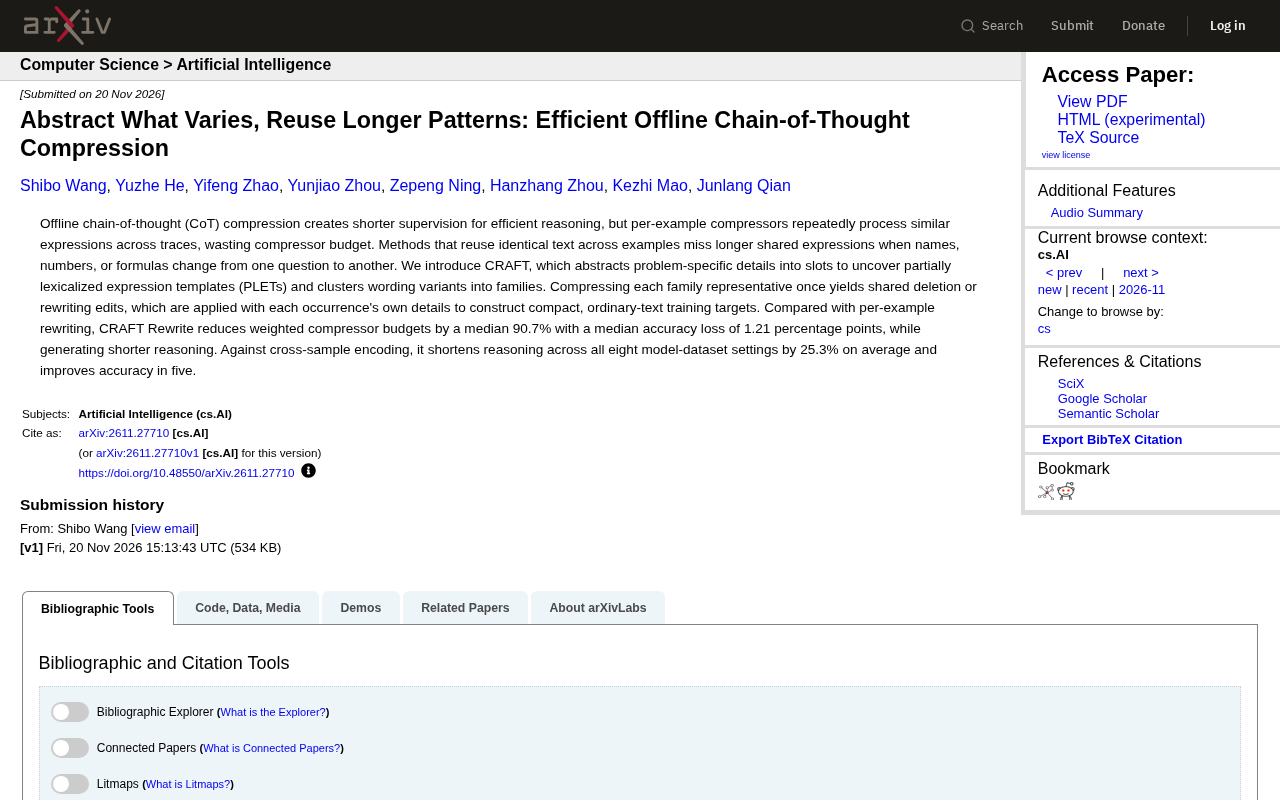
Offline chain-of-thought compression aims to generate shorter reasoning supervision signals, but existing per-example compression methods repeatedly process similar expressions and waste compression budget; simple text reuse also fails when details change. CRAFT proposes abstracting question-specific details into slots, discovering partially lexicalized expression templates (PLETs), and clustering wording variants into families. Each family compresses a representative sample only once, shares edit operations, and then adapts other samples through slot filling. Experiments show that CRAFT Rewrite reduces the median weighted compressor budget by 90.7%, with a median accuracy loss of only 1.21 percentage points; compared with cross-sample encoding methods, it shortens reasoning length by an average of 25.3% across eight settings and improves accuracy in five settings. This method reuses long patterns while maintaining expression diversity, providing an efficient solution for large-scale generation of reasoning training data.
Offline chain-of-thought (CoT) compression aims to generate shorter supervision signals so that models can reason more efficiently. However, existing methods typically run a compressor separately for each sample, causing similar expressions to be processed repeatedly and wasting a large amount of compression budget. More troublesome is that when names, numbers, or formulas in the question change, simple text-reuse strategies miss longer shared expression patterns. To address this contradiction, researchers propose the CRAFT method, which abstracts question details to discover "partially lexicalized expression templates" (PLETs) and clusters wording variants into families, thereby reusing longer patterns.
Pain Point: Budget Waste in Per-Example Compression and Short-Sighted Reuse
The core goal of offline CoT compression is to generate concise reasoning paths for training data. However, a per-example compressor must run separately for each reasoning trajectory, and even if different trajectories contain highly similar expressions, they are treated as entirely new content. This repetitive work directly consumes the valuable compressor budget.
Another class of methods attempts to reuse exactly identical text across samples, but their reuse granularity is too short. Once entity names, numerical values, or formulas in the question are replaced, the originally identical long expressions no longer match, causing reuse to fail. In other words, existing methods lack a middle ground between "exact matching" and "complete independence"—one that can identify expression templates with the same structure but different details.
"Offline" in offline CoT compression means that the compression process occurs during the training-data preparation stage rather than dynamically during model inference. The compressor (usually a smaller language model) reads the complete reasoning trajectory and outputs a shorter version as a supervision signal to train the target model. Because compressor calls require computational resources, researchers use "compressor budget" to measure this cost, such as the number of calls or the total number of generated tokens. Per-example compression means that the compressor is called independently once for each trajectory; even if the content is highly repetitive, computation cannot be shared, so budget consumption grows linearly with data volume.
CRAFT's Core Idea: Abstract Details, Cluster Variants
The key innovation of CRAFT is to abstract question-specific details (such as specific names, numbers, and formulas) into "slots," thereby revealing partially lexicalized expression templates (PLETs). These templates retain the structural skeleton of the expression but allow slots to be filled with different specific content.
On this basis, CRAFT clusters wording variants into different "families." Each family only needs to compress a representative sample once to obtain shared deletion or rewriting edit operations. When applied to other samples in the family, it is only necessary to combine the sample's own details to fill the slots and construct a compact plain-text training target. In this way, the compressor does not need to repeat work for each sample while still adapting to changes in details.
Partially lexicalized expression templates (PLETs) draw on the concept of "lexicalized templates" in natural language processing: part of the template consists of fixed words, and the other part consists of variable slots. For example, "calculate the area of a circle with radius 5" is abstracted as "calculate the area of a circle with radius [SLOT]," where [SLOT] can be filled with any numerical value. Unlike fully lexicalized exact text, PLETs retain structural information and can therefore match more expressions that differ on the surface. CRAFT further groups PLETs with similar slot-filling patterns into "families," where the same set of compression edits (such as deleting redundant modifiers or rewriting sentence patterns) is shared within a family. Only the representative sample needs to be compressed once, and other members are adapted through slot substitution, thereby balancing reuse length and detail adaptability.
Experimental Results: Budget Greatly Reduced, Accuracy Loss Controllable
The researchers compared CRAFT with per-example rewriting methods. The results show that CRAFT Rewrite reduces the median weighted compressor budget by 90.7%, while the median accuracy loss is only 1.21 percentage points. At the same time, the generated reasoning paths are shorter. This means that compression efficiency achieves an order-of-magnitude improvement with almost no sacrifice in model performance.
In comparisons with cross-sample encoding methods, CRAFT shortens reasoning length in all eight model-dataset settings, with an average reduction of 25.3%, and improves accuracy in five of those settings. This result shows that reusing longer patterns not only saves budget but also brings dual benefits in reasoning quality and efficiency.
Weighted compressor budget is a comprehensive metric for measuring compression cost, usually calculated by weighting and summing the number of compressor calls, the number of input and output tokens, and similar factors. A 90.7% reduction in the median means that in half of the test cases, CRAFT consumes less than one-tenth of the budget of the original method. Accuracy loss refers to the decline in accuracy on the final task of a student model trained with compressed CoT compared with training with the original CoT; a median loss of 1.21 percentage points indicates that the performance degradation caused by compression is small. Together, these metrics show that CRAFT can still maintain the effectiveness of supervision signals under an extremely low budget.
Significance and Outlook
CRAFT reveals a neglected optimization space: offline CoT compression does not have to choose between "per-example independence" and "exact reuse." By abstracting details and clustering variants, long patterns can be reused while maintaining expression diversity. For scenarios that require large-scale generation of reasoning training data, this method is expected to significantly reduce compression costs and promote the deployment of more efficient reasoning models. In the future, how to combine slot abstraction with more complex expression structures and how to adapt to multilingual or multimodal scenarios are directions worth exploring.
One-line Summary
CRAFT abstracts details into slots and clusters expression variants, greatly reducing the offline CoT compression budget with controllable accuracy loss.
Paragraph Summary
Offline chain-of-thought compression aims to generate shorter reasoning supervision signals, but existing per-example compression methods repeatedly process similar expressions and waste compression budget; simple text reuse also fails when details change. CRAFT proposes abstracting question-specific details into slots, discovering partially lexicalized expression templates (PLETs), and clustering wording variants into families. Each family compresses a representative sample only once, shares edit operations, and then adapts other samples through slot filling. Experiments show that CRAFT Rewrite reduces the median weighted compressor budget by 90.7%, with a median accuracy loss of only 1.21 percentage points; compared with cross-sample encoding methods, it shortens reasoning length by an average of 25.3% across eight settings and improves accuracy in five settings. This method reuses long patterns while maintaining expression diversity, providing an efficient solution for large-scale generation of reasoning training data.
Related articles

GLM-5.4 vs. Opus and Neon: How Far From the Top?
No official benchmarks for GLM-5.4. Based on a YouTube deep test and developer trials, we analyze its gap vs. Claude Opus 5.5 and Gemini Neon, the speed bottleneck from marathon-style thinking, and its real position in enterprise agent scenarios.

From Gobbler to Sloppy Joe: The Hit-Making Playbook of a New Jersey Deli Institution
NYT Cooking visits Milburn Deli in New Jersey to break down the hit logic behind the Gobbler turkey sandwich and the local Sloppy Joe: bread sliced to order, house-made sauces, a group shout culture, and customer co-creation behind six locations.
In the Age of AI Programming, When Do You Still Need to Write Code by Hand?
Is handwritten code still valuable once AI programming agents are widespread? This article outlines three scenarios where handwriting is essential—learning, style development, and prototype validation—and provides a division-of-labor framework between AI and humans to help developers balance efficiency and skill growth.